
A quilting-shop educator has no ML team and still wants a handbook Q&A helper this month. Which AWS GenAI-service advantage lets them ship by calling a managed foundation model?
Select an answer to reveal the explanation.
Short Explanation
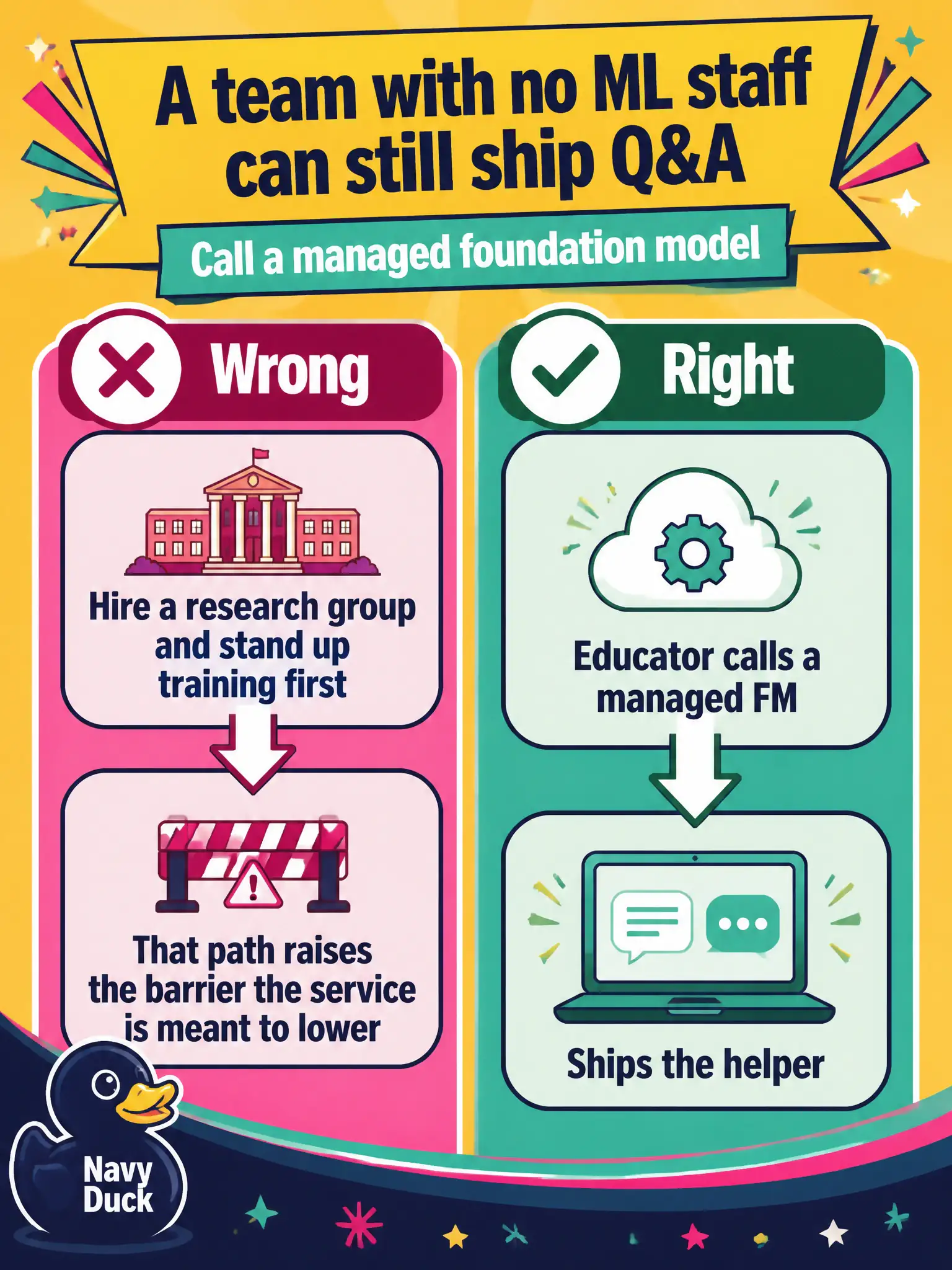
Think of a quilting-shop educator shipping handbook Q&A this month with no ML team. Call a managed foundation model. That lower barrier is the point. A research group or a training cluster would miss the month.
Full Explanation
A lower barrier to entry is the AWS GenAI-service advantage that lets a quilting-shop educator with no ML team ship handbook Q&A this month by calling a managed foundation model. Managed consumption removes the need to build training infrastructure or staff a research group before a first helper exists. That is the practical meaning of lowering the barrier for small civic or shop teams.
Requiring a research group before any Q&A can ship raises the barrier the scenario rejects and misses the month. Standing up a custom training cluster first delays a handbook Q&A that can start from a managed FM. Claiming they must self-host GPUs because managed FMs require an ML team inverts the value proposition: managed FMs exist so small teams are not forced into that path.
Exam caveat: a low barrier to a first helper does not remove evaluation, content grounding, or access control on handbook material. Operational check: point the helper at approved handbook sources, smoke-test common questions before month-end, document who owns prompt changes without inventing an ML org chart, and schedule a quality review after the first week of shop use.
Lower barrier means first ship is possible; it does not mean the educator skips a thin evaluation set of handbook questions with known answers. Pair the managed FM call with a one-page acceptance list so “this month” includes both availability and basic correctness.