
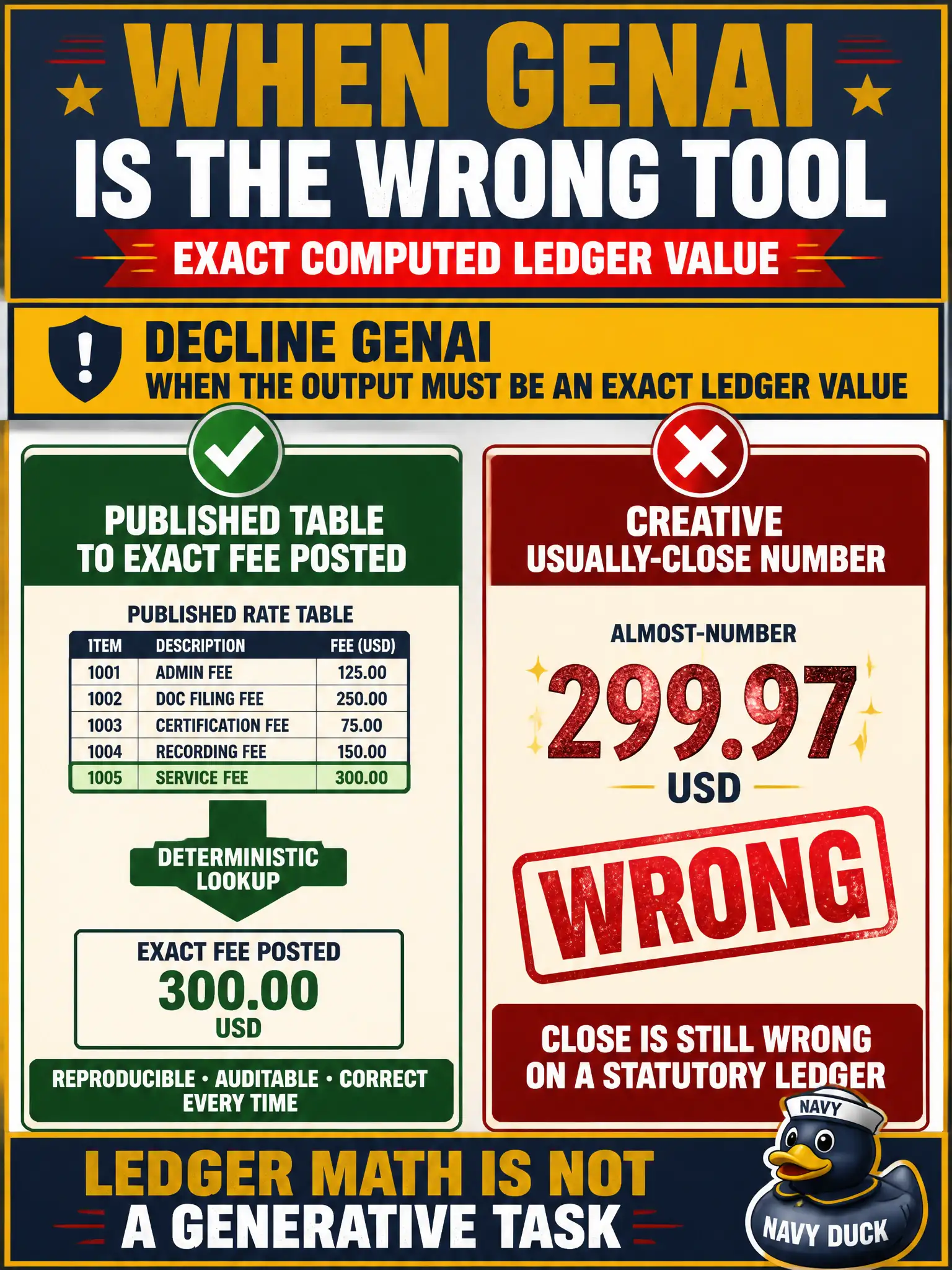
A scout council must post badge-fee totals to a statutory ledger. The amount has to match the published table exactly. A vendor offers a creative GenAI number that is usually close. Which action should the council take?
Select an answer to reveal the explanation.
Short Explanation
Think of posting a statutory fee that has to match the published table. Decline the creative, usually-close GenAI number. Raising temperature makes it more random, and a cluster average is still a guess.
Full Explanation
Decline GenAI and use the existing exact calculation when scout-council badge-fee totals must match a published statutory table. Generative models sample and approximate; they are the wrong tool for a ledger line that must be identically correct. Exact arithmetic or a lookup against the published schedule is the compliant path, and “usually close” is not a statutory standard.
Posting a creative, usually-close number fails because statutory ledgers do not accept approximate creativity as compliance. Raising temperature increases randomness in generation; it does not make a generative guess more exact against a fee table. Clustering last year’s fees and posting the cluster average is still a statistical guess, not the published table amount required for this posting.
Exam caveat: GenAI may still draft explanations around a fee once the authoritative number is computed elsewhere, but the number itself must come from the deterministic source of truth. Operational check: compute the fee from the published table or approved calculator, have a second person verify the ledger line, keep the model out of the amount field, and retain an audit trail of the exact source used.
In practice, separate “narrative help” from “ledger truth”: any GenAI draft that mentions a fee should quote the already-computed amount as an immutable field, never regenerate it. That separation is what keeps statutory posting safe while still allowing plain-language explanations around the fee.