
The same foundation model drafts ice-rink closure notes well and drafts creamery allergen cards poorly, run after run. A vendor says one FM is equally good at every business domain. Which statement is accurate?
Select an answer to reveal the explanation.
Short Explanation
Think of a model that writes great ice-rink notes and terrible allergen cards, every time. Uneven domain performance is a selection issue. One FM is not universal, and GPU heat does not close the gap.
Full Explanation
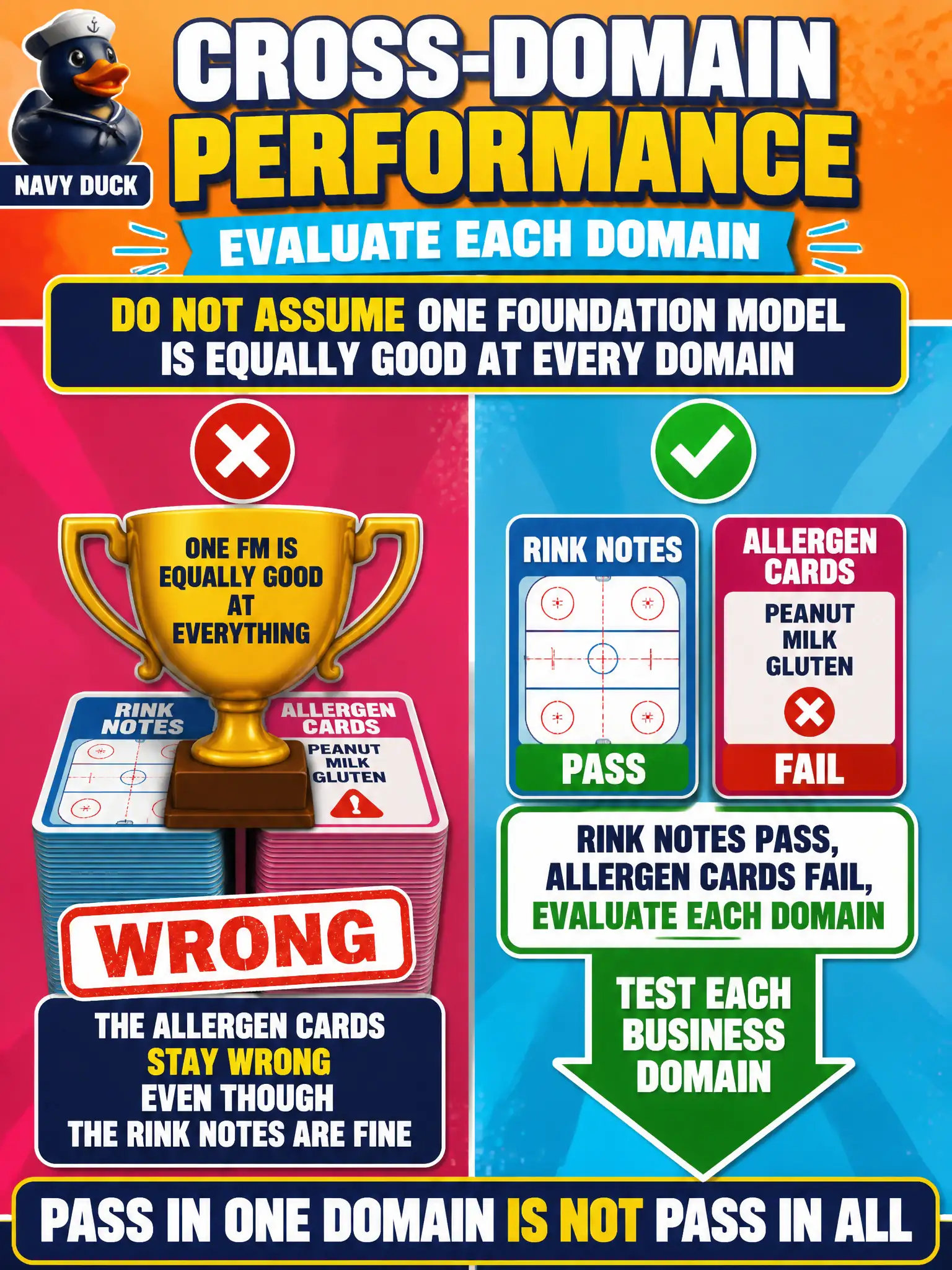
Uneven cross-domain performance is a selection and evaluation issue: the same foundation model can draft ice-rink closure notes well and creamery allergen cards poorly, run after run. Practitioners must evaluate each domain’s risk and quality bar instead of assuming one FM is universal. That gap drives model choice, prompting, retrieval grounding, or separate adaptation—not wishful thinking about equal skill everywhere.
Claiming one FM is always equally good at every business domain contradicts observed specialization and evaluation practice. Allergen misses do not prove rink notes are also wrong; domains fail independently, so you score each corpus on its own labels and harm profile. Raising GPU heat does not close a capability or knowledge gap; temperature and utilization are not substitutes for domain evaluation or better grounding.
Exam caveat: strong performance in a low-harm domain never licenses unsupervised use in a high-harm domain such as allergens without separate checks and policy gates. Operational check: keep separate evaluation sets for rink notes and allergen cards, block allergen drafts that fail policy review, and select or ground models per domain rather than shipping one untested winner everywhere.