
A community-theater helper writes clever Saturday-show blurbs, but paid overtime did not drop and the theater did not add a second show. Which measure should leadership ask for?
Select an answer to reveal the explanation.
Short Explanation
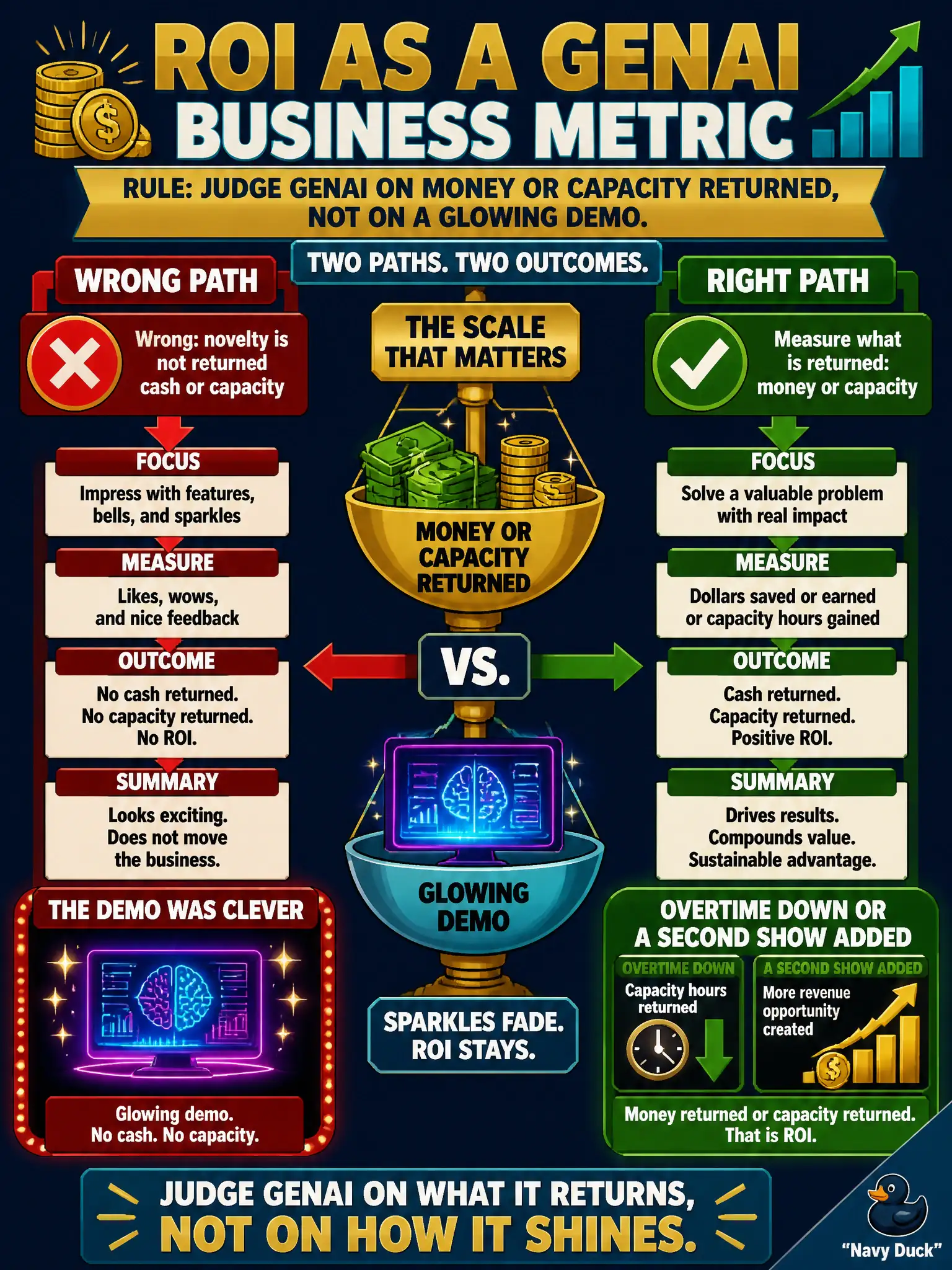
Think of clever blurbs that still leave overtime unpaid and no second show. Ask for ROI: money or capacity returned. Demo charm, GPU heat, and BLEU are not that.
Full Explanation
When a community-theater helper writes clever Saturday-show blurbs but paid overtime did not drop and no second show was added, leadership should demand return on investment: money or capacity returned, not applause for a glowing demo. ROI asks whether GenAI changed a board-visible outcome—labor cost, seats, or shows staged—rather than whether the marketing copy sounded witty in a conference room. Domain 2 treats that outcome link as the business measure that justifies keeping or killing the helper.
Judging only how clever the demo sounded confuses presentation polish with program value; charm does not free staff hours or add a performance. GPU temperature during the demo is host telemetry with no relationship to overtime or capacity. Treating BLEU on the blurbs as if it equaled overtime saved mixes a language-overlap lab score with a workforce result; high n-gram similarity never proves payroll fell.
Exam caveat: ROI can be financial or operational capacity, but attribution still matters—credit the helper only when the metric moves in a defined window after use. Operational check: lock a baseline for overtime hours and show count, run the helper for a fixed period with the same seasonality, and compare those metrics before celebrating blurb quality.