
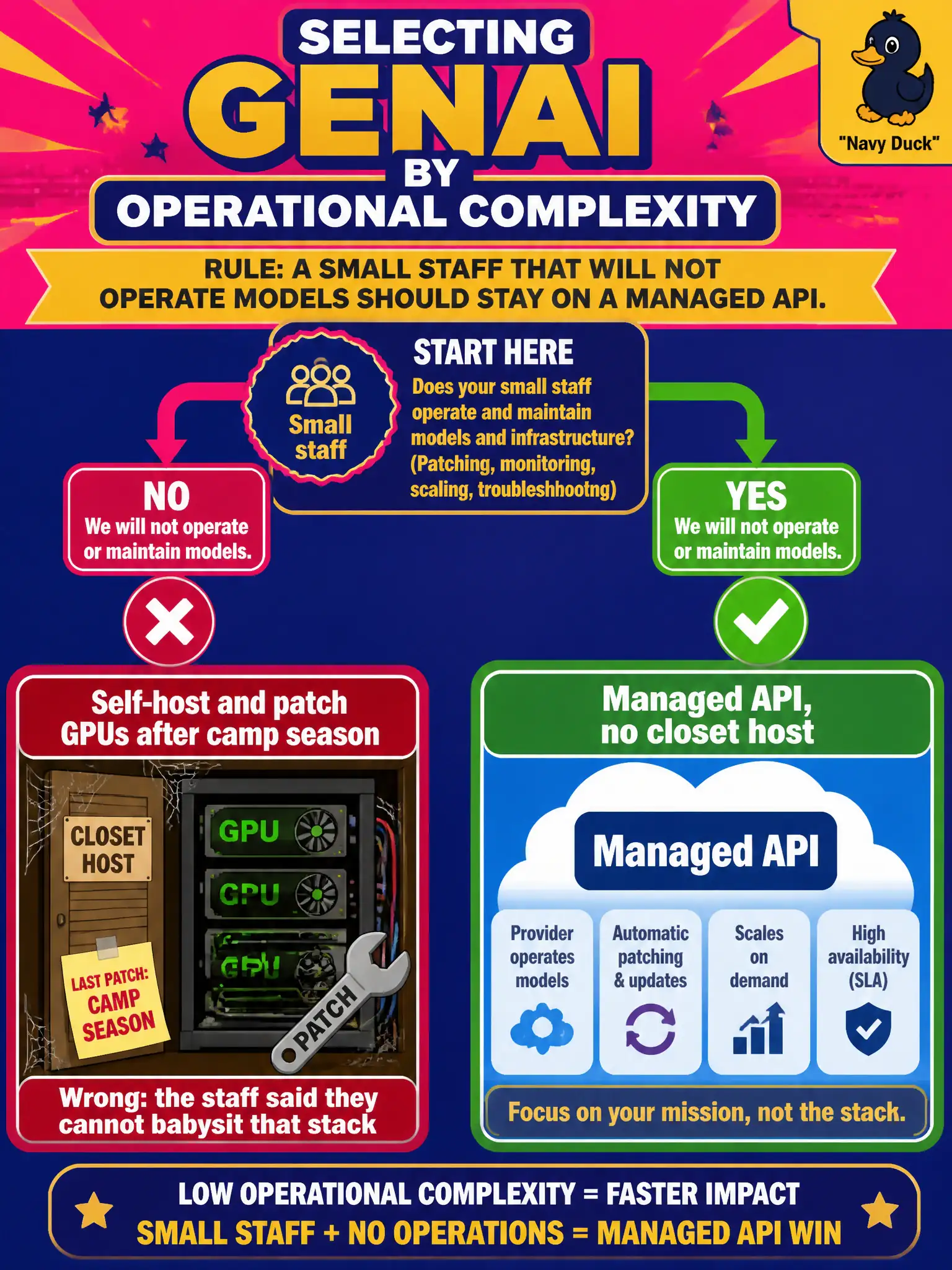
A three-person scout-council staff can call a managed foundation-model API. They cannot babysit a self-hosted stack after camp season. Which factor should decide how the model is offered?
Select an answer to reveal the explanation.
Short Explanation
Think of three seasonal clerks who will not babysit a closet server after camp. Stay on a managed API. Caption quality does not remove nightly GPU patching.
Full Explanation
When a small scout-council staff can call a managed foundation-model API but cannot operate a self-hosted stack after camp season, operational complexity is the decisive selection factor. Managed inference keeps patching, capacity, and runtime ownership with the provider so seasonal clerks are not on-call for GPU hosts. That match between staffing reality and delivery model is what Domain 2 treats as a practical GenAI choice, not a preference for clever captions alone.
Self-hosting because a small staff supposedly wants a closet server reverses the constraint: they already said they will not babysit infrastructure, so adding hosts creates the failure mode they cannot staff. Caption quality does not erase ops burden; a model that writes fine labels still needs patching, monitoring, and recovery if you own the stack. Choosing a path that requires nightly GPU patching by seasonal clerks is the operational anti-pattern the scenario forbids.
Exam caveat: managed APIs still leave prompt, data-handling, and application-layer controls with you—operations relief is not a free pass on content safety or access policy. Operational check: before go-live, write who patches what after camp, who gets paged on API errors, and confirm the managed path has a documented owner who is not a seasonal clerk.