
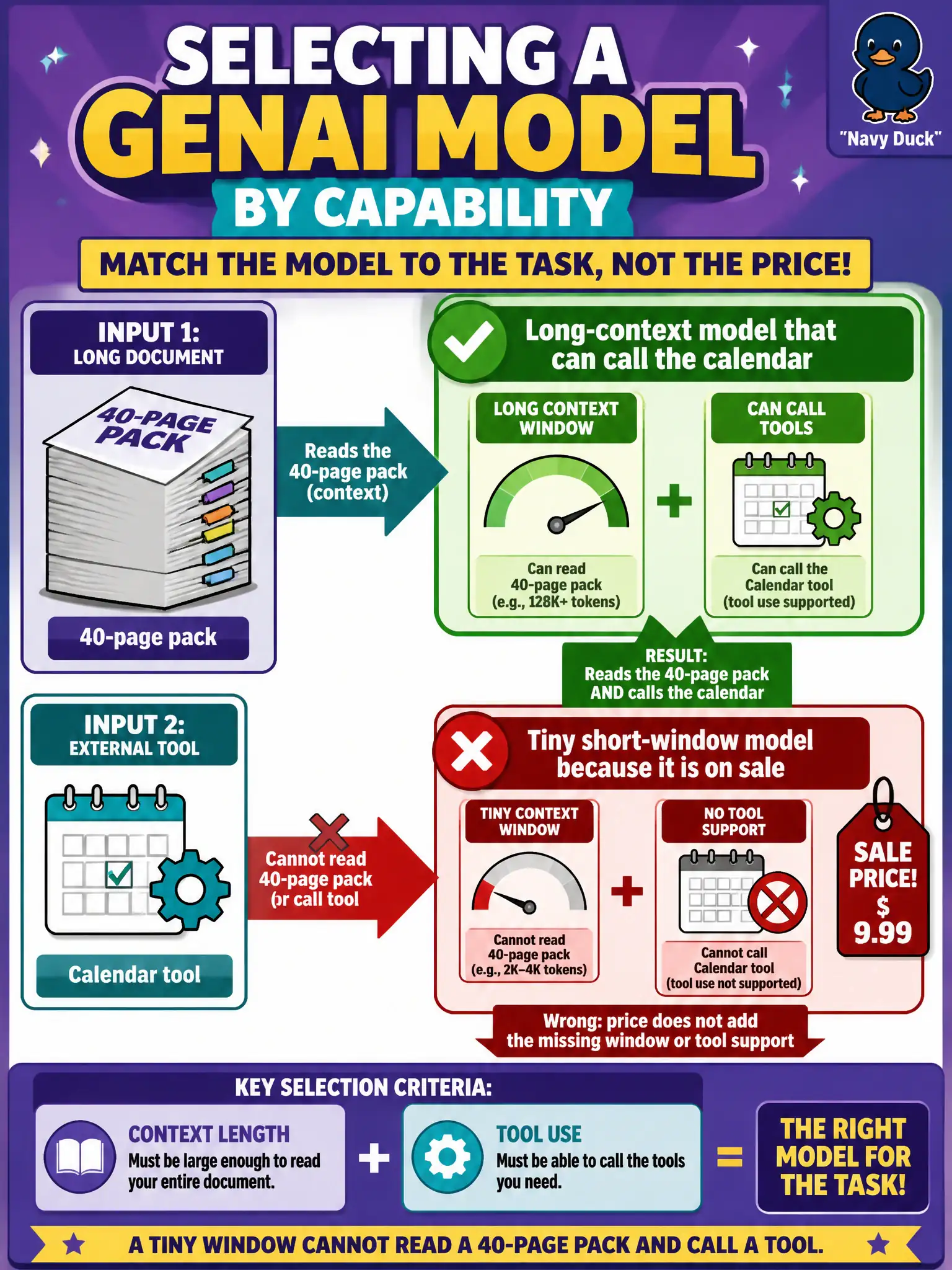
A school-board office needs a model that can read a 40-page facilities pack in one sitting and then call a calendar tool to hold a room. A tiny model with a short context window is on sale. Which statement is accurate?
Select an answer to reveal the explanation.
Short Explanation
Think of stuffing a 40-page pack into a tiny mailbox, then asking it to book a room. Context length and tool use are the documented specs. Sale price does not stretch the window, and a PDF still has to fit.
Full Explanation
Model selection must use documented capabilities that match the job: enough context length to hold a 40-page facilities pack in one sitting, plus tool use to call a calendar and hold a room. A tiny short-window model on sale cannot meet those documented needs, so capability fit—not sale price—decides for the school-board office.
Buying the tiny short-window model because sale price replaces context length confuses procurement discounts with technical capacity; a discount does not stretch the context window. Claiming context length never matters if the pack is saved as a PDF is false: PDF is a file format, and the tokens still must fit in the model's context to be read together. Saying tool use is only a clustering feature mislabels tool calling; clustering groups items and is not calendar invocation for a room hold.
Exam caveat: read capability cards for context window, tool or function calling, and modality before purchase. Discounts and file formats do not create missing capabilities the job requires.
Operational check: measure tokenized length of the 40-page pack against the candidate context window with headroom for the question and tool schema, run a calendar hold in a sandbox, and reject any model that truncates the pack or cannot complete the tool call.