
A creamery's shift logs include employee IDs that must stay in one region and must not be used to train a vendor's public base model. A demo from another region was funnier. Which constraint should win?
Select an answer to reveal the explanation.
Short Explanation
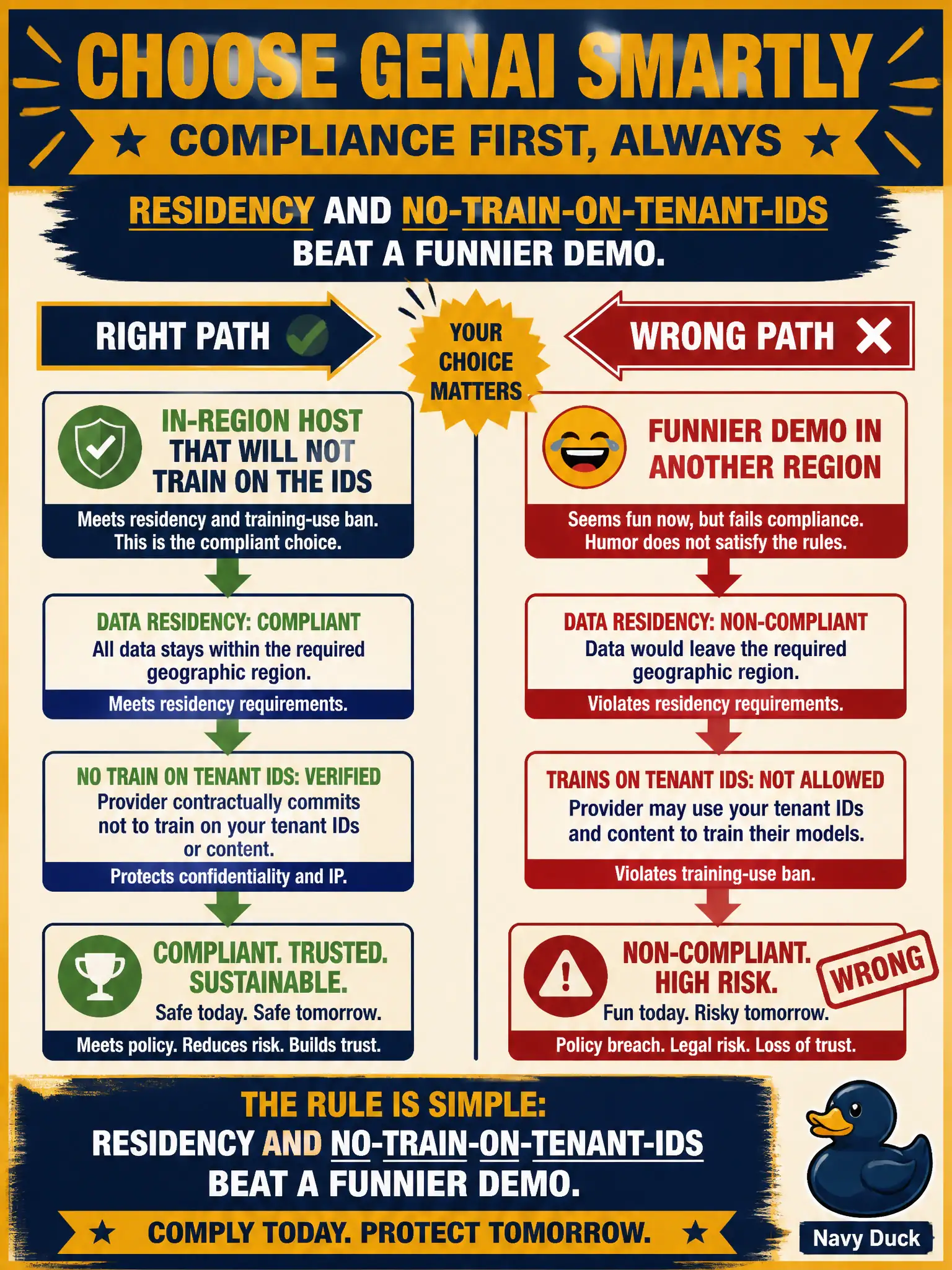
Think of employee IDs that have to stay in one region and off a vendor's public training set. Residency and the no-train rule beat a funnier demo. Pictures in another region do not hide those IDs.
Full Explanation
Compliance constraints such as data residency and a prohibition on using tenant identifiers to train a vendor's public base model outrank demo quality. Creamery shift logs with employee IDs that must stay in one region and must not train a public base require residency and a no-train-on-tenant-IDs rule to win over a funnier demo from another region.
Choosing the funnier demo because humor outranks compliance elevates UX theater over legal and contractual controls. Any public base that will train on the employee IDs, because more data is always allowed, directly violates the no-train restriction. An image generator in another region, because pictures hide identifiers, fails on both residency and the false claim that images erase ID risk; moving modality or region does not satisfy the rule.
Exam caveat: on selection questions, residency and training-use restrictions beat charm. Do not invent a SKU—reason from the constraint language in the stem.
Operational check: confirm the chosen deployment region, obtain a contractual no-train / no-retention commitment for employee IDs, redact or tokenize IDs where possible, and reject any pilot that ships logs to an out-of-region public training path.