
A locksmith chatbot invents a plausible cylinder torque that never appears in the shop manuals. The sentence reads fluently. The manuals did not drift, and the model is not being scored on a twelve-row training set. What limitation is this?
Select an answer to reveal the explanation.
Short Explanation
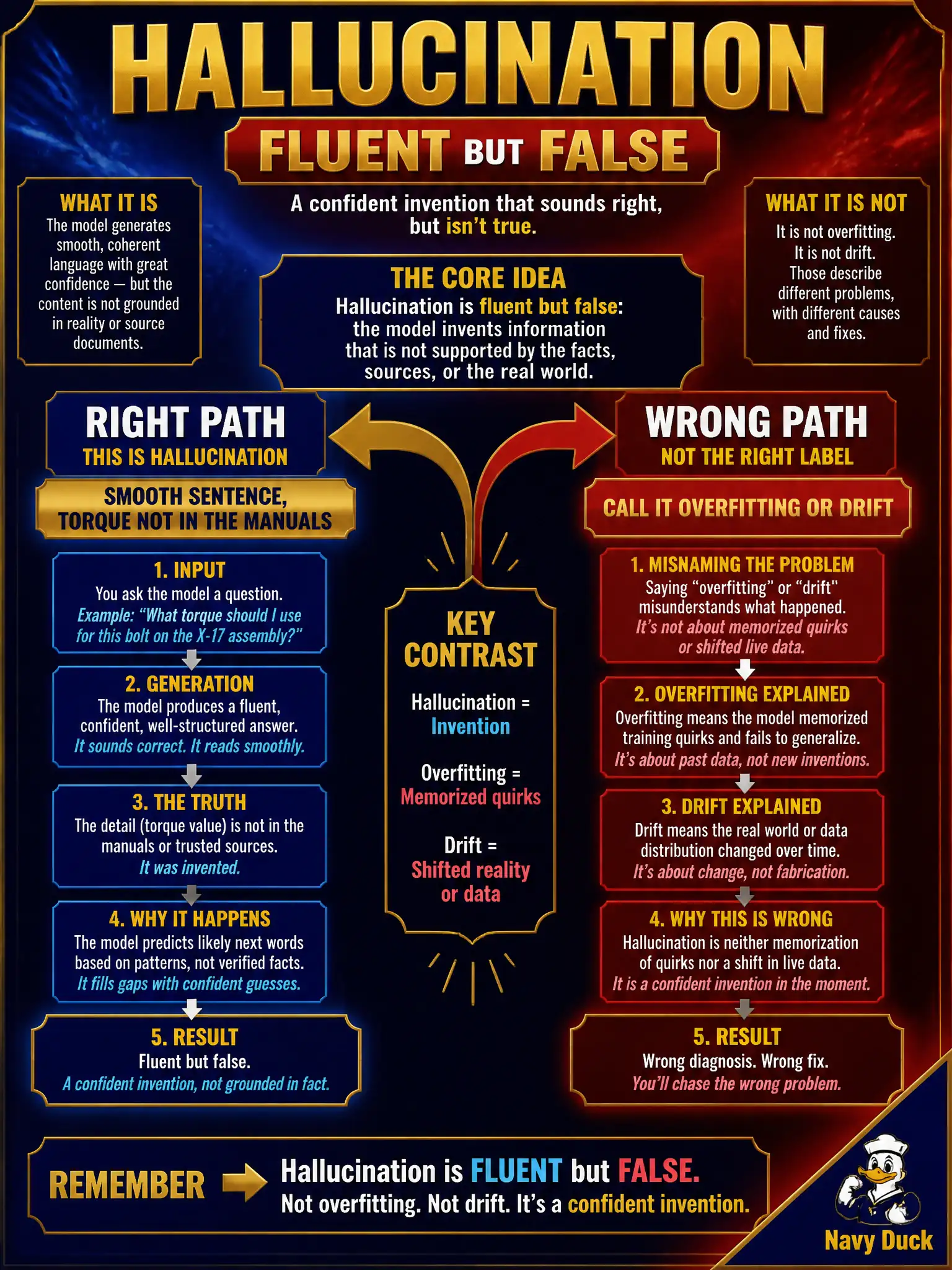
Think of a fluent sentence that invents a torque the manuals never listed. That is a hallucination. The manuals did not drift, this is not a twelve-row overfitting story, and a missing GPU does not make up a number.
Full Explanation
Hallucination is fluent but false content: the model produces a sentence that reads confidently while stating something unsupported by source material. The locksmith chatbot invents a cylinder torque that never appears in the shop manuals, the sentence is fluent, manuals did not drift, and the scenario is not a tiny training-set scoring story—so the limitation is hallucination.
Overfitting to a tiny training table is memorizing quirks of a small labeled set during training; the stem is about an invented production answer, not twelve-row training memorization. Production data drift in the manuals would mean live sources shifted after deploy; the stem says the manuals did not drift. A GPU shortage in the shop closet is a capacity problem and does not fabricate a torque number in a fluent sentence.
Exam caveat: fluency is not truth. Hallucination is about unsupported claims, and it is distinct from drift (source change) and overfitting (training memorization) even when all three appear in AI risk lists.
Operational check: require retrieval from shop manuals with citation for any numeric torque guidance, and block or flag replies that assert specs not present in the retrieved passages before a locksmith acts on them.