
A quilting guild needs twenty original social captions from one fabric fact sheet. They are not asking anyone to group last year's captions into unlabeled piles. Which advantage is this?
Select an answer to reveal the explanation.
Short Explanation
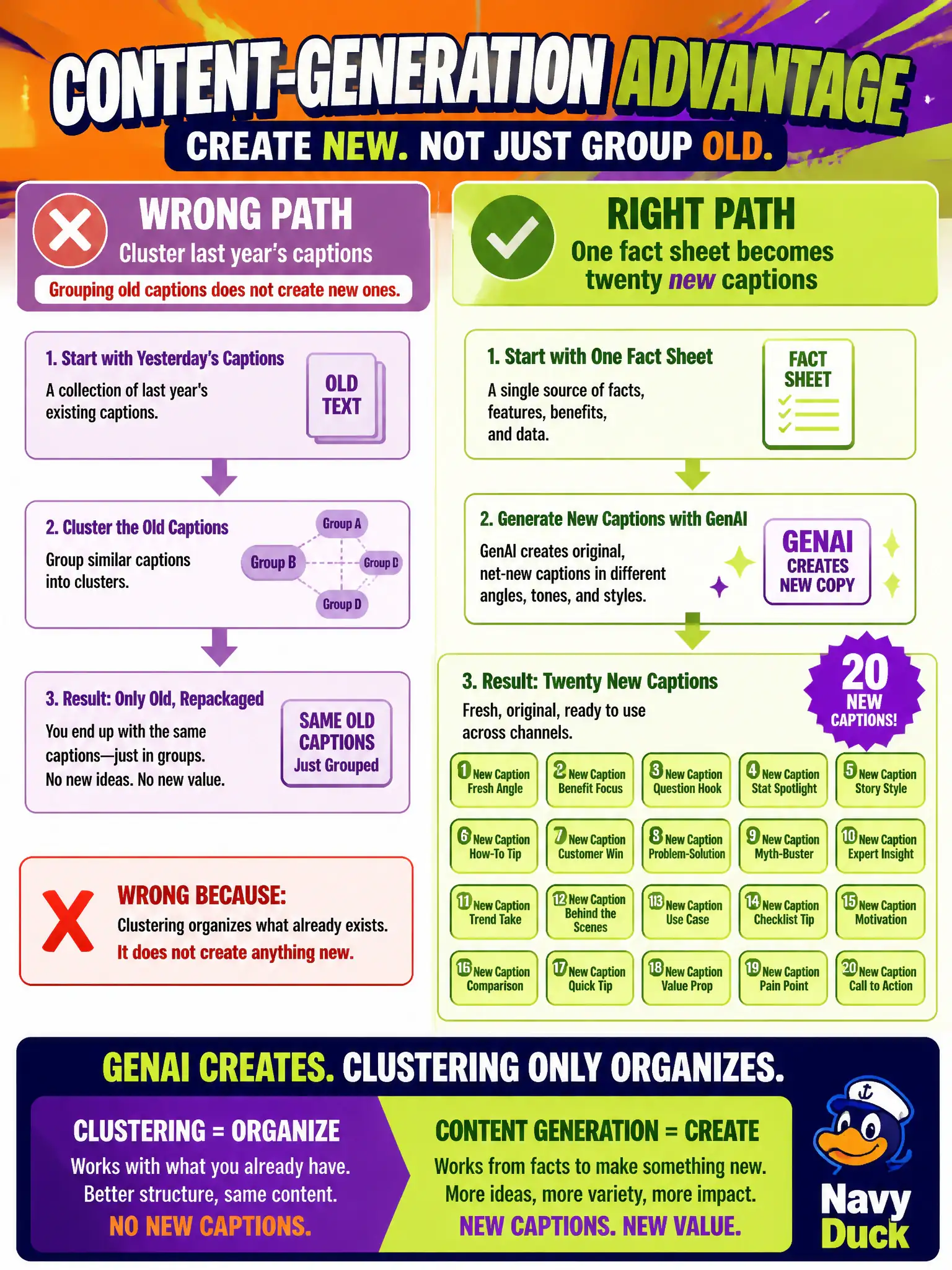
Think of twenty new social captions from one fabric fact sheet. That is content generation. Clustering last year's captions, transcribing the meeting, and a booth-fee table do not write the new copy.
Full Explanation
Content generation is the GenAI advantage of creating net-new text or media from patterns in source material—here twenty original social captions derived from one fabric fact sheet. The quilting guild wants new copy for outreach channels, not a regrouping of last year's captions, so content generation is the correct advantage to name.
Clustering last year's captions only partitions existing text into unlabeled groups; it does not write twenty new captions for the guild's channels. Speech-to-text of the guild meeting transcribes audio into a transcript and does not invent social copy from a fabric fact sheet. A statute-table lookup that computes an exact booth fee is deterministic calculation under fixed rules, not generative caption writing from patterns in the sheet.
Exam caveat: generation creates new artifacts; clustering rearranges existing ones. When the stem says original or net-new, clustering is almost always the wrong pattern to pick on the exam.
Operational check: review generated captions against the fact sheet for invented fabric claims, keep a human approval queue before any social post, and retain the source sheet link with each approved caption set for later audit.