
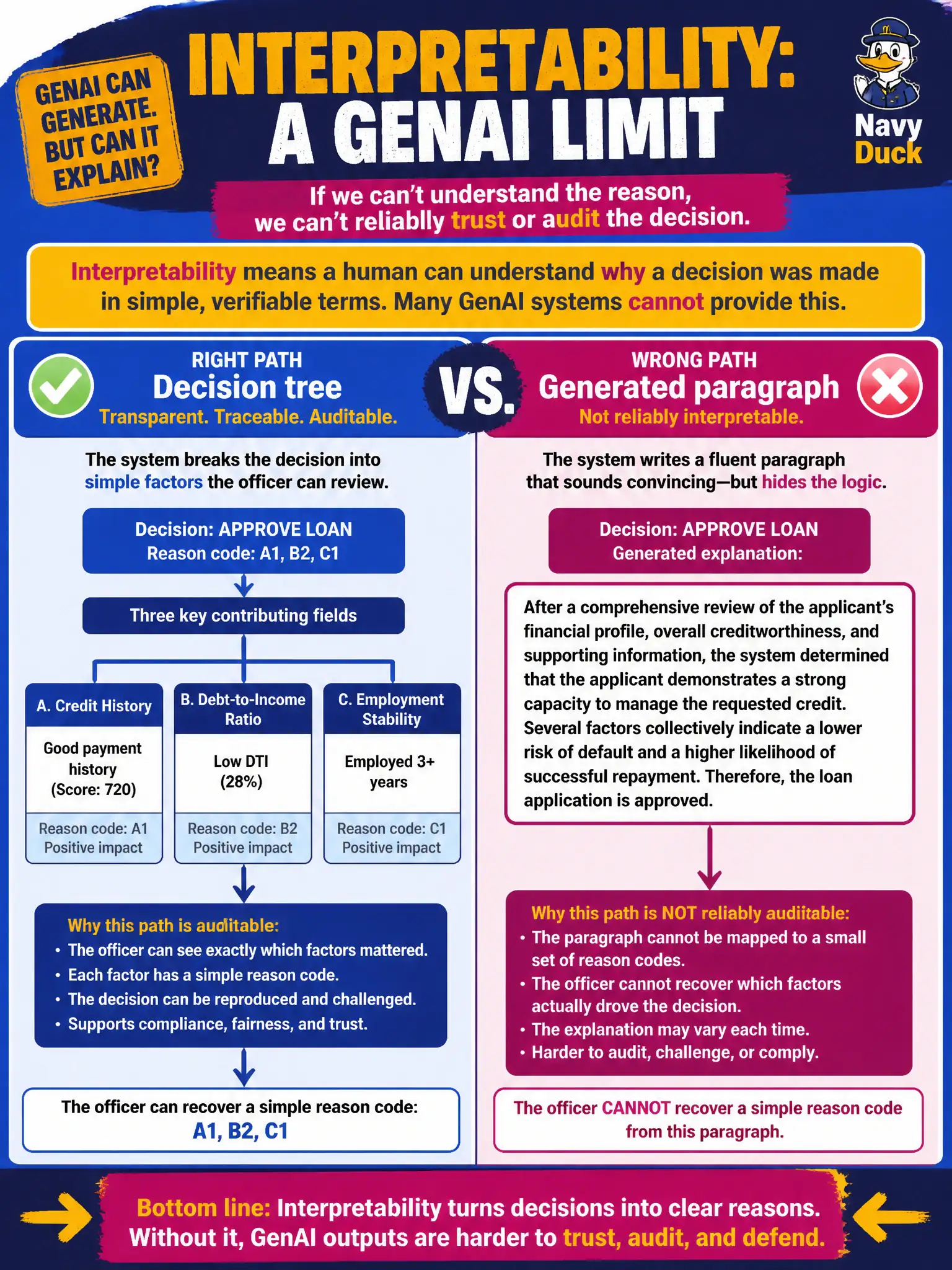
A fire-grant officer cannot list the three fields that caused a generated deny this hose request paragraph the way they could with a small decision tree. Which GenAI limitation is this?
Select an answer to reveal the explanation.
Short Explanation
Think of a small tree that can list the three boxes it checked, versus a generated deny paragraph that cannot. That is weak interpretability. It is not a billing unit, and hose-color clusters do not explain the denial.
Full Explanation
Weak interpretability means the system does not expose a short, auditable reason code or feature contribution list the way a small decision tree can list the fields that drove a deny. The fire-grant officer cannot list the three fields that caused a generated 'deny this hose request' paragraph; that is an interpretability limitation of many generative systems.
Proof that the generated paragraph is always the more auditable option is false: a free-form paragraph is typically harder to audit than an explicit reason code from a transparent model. A token-pricing error miscasts interpretability as a billing unit; interpretability is about explainability of decisions, not token meters. Clustering of unused hose colors groups attributes and does not explain why a grant request was denied.
Exam caveat: generative fluency can reduce auditability. When the stem contrasts a tree's field list with a generated paragraph, the limitation is interpretability, not cost or clustering.
Operational check: for grant denials, require structured reason codes alongside any generated prose, log contributing policy clauses, and retain an officer-review path that can reconstruct why a hose request was denied.