
A carnival incident desk splits one closure job across three helpers: one reads ride-log notes, one drafts the public notice, and one checks the inspection number. Leadership is not asking for three separate attendance predictors. Which pattern is this?
Select an answer to reveal the explanation.
Short Explanation
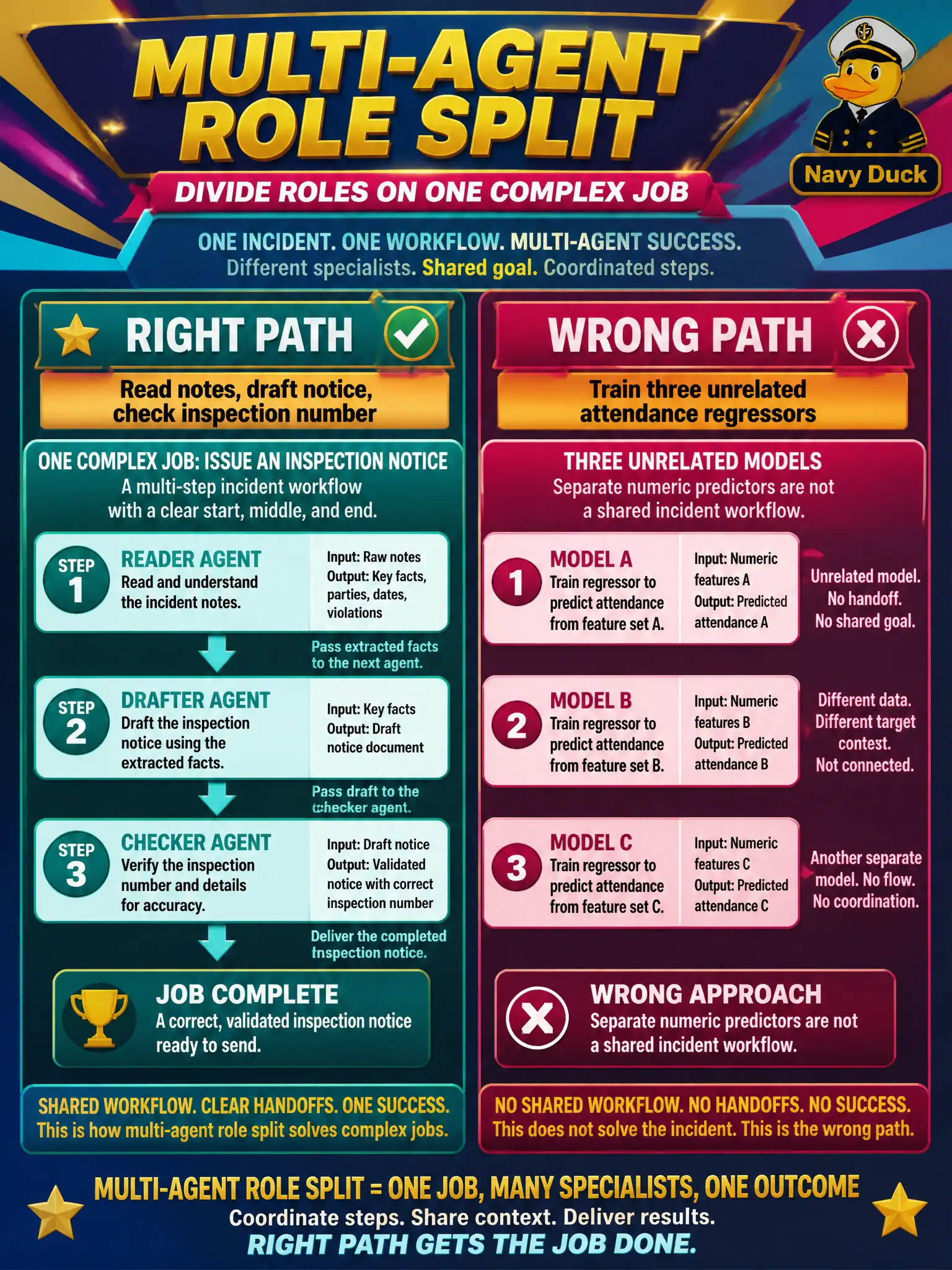
Think of one incident with three specialists: notes, public notice, inspection number. That is a multi-agent split on one job. Three attendance predictors, leftover prizes, and last year's popcorn do not close the ride.
Full Explanation
A multi-agent pattern assigns specialized roles that collaborate on one complex job—here one helper reads ride-log notes, one drafts the public notice, and one checks the inspection number for a carnival closure. Leadership is coordinating division of labor on a single incident workflow, not asking for three unrelated numeric predictors.
Three unrelated regressors, each predicting a different attendance number, would be classical forecasting on separate targets. That is not role division on one closure notice. A single clustering run on unused prize SKUs groups inventory and does not draft or verify a public closure communication. Batch inferencing of last year's popcorn sales scores a finished model on historical sales; it is not a multi-role agent design for incident handling.
Exam caveat: multi-agent means coordinated roles on one task graph, not 'run three unrelated models.' Attendance regressors are a distractor when the stem describes reading, drafting, and checking steps.
Operational check: define handoff contracts between the three helpers (what the reader must pass to the drafter, what the checker must verify), log each tool call, and require the inspection-number check to pass before the public notice can publish.