
A tool-library agent needs a standard way to reach the reservation database and the calendar without a one-off integration for each model vendor. The team is not asking anyone to write protocol code on the exam. Which idea is this?
Select an answer to reveal the explanation.
Short Explanation
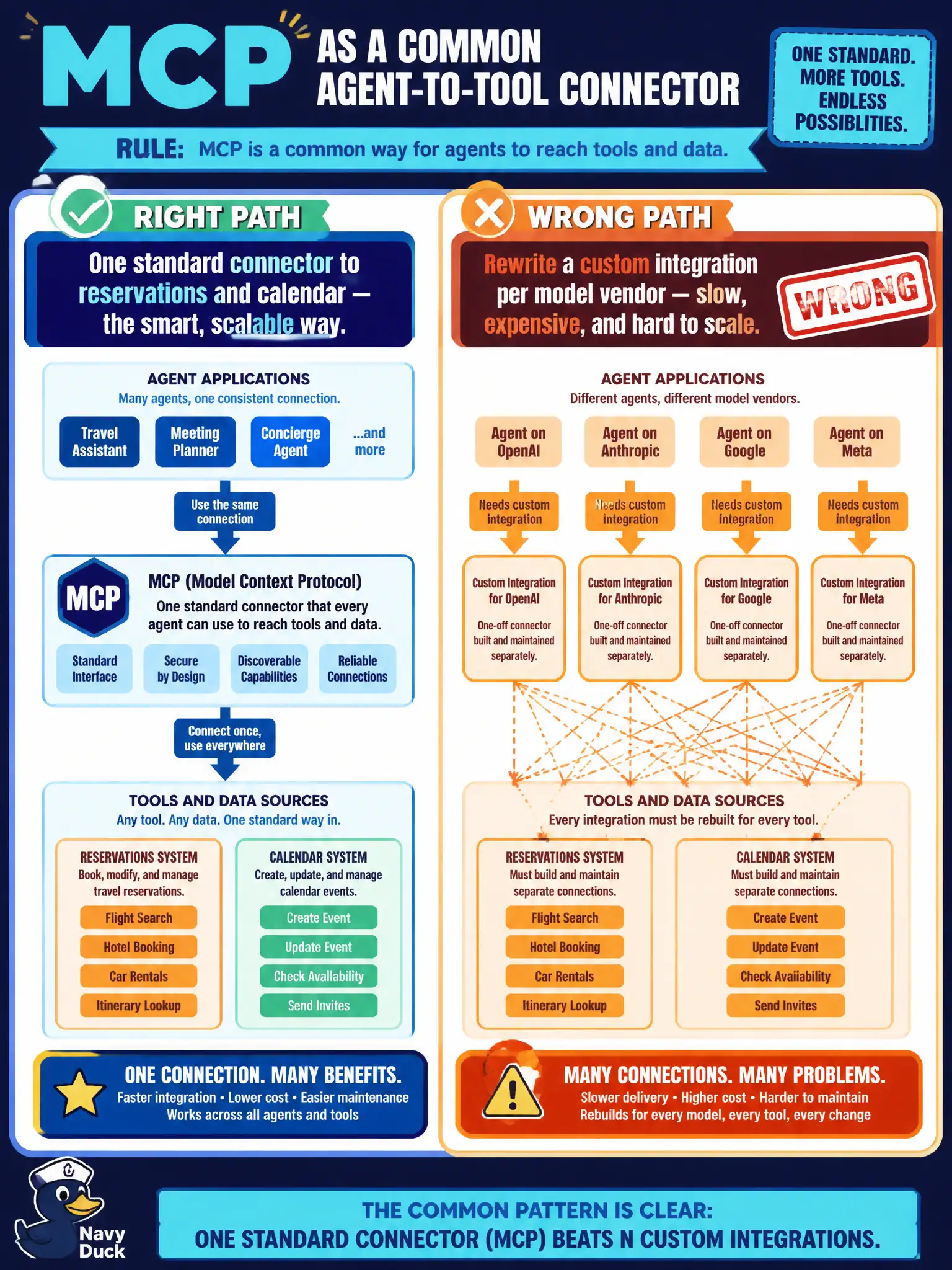
Think of one wall plug that every vendor can use to reach the reservation book and the calendar. MCP is that common tool hook. Rewriting a connector per vendor is the mess it is meant to stop, and a learning rate does not open a database.
Full Explanation
Model Context Protocol (MCP) is a shared approach that lets agents reach tools and data sources through a common interface instead of a one-off integration for every model vendor. The tool-library agent needs standard access to the reservation database and calendar without rewriting connectors per vendor; that is the MCP idea. The exam asks for the concept, not for writing protocol code.
A unique custom connector rewritten for every new model vendor is the anti-pattern MCP is meant to reduce: brittle, duplicated integration work. A learning-rate search that replaces tool access confuses training hyperparameters with runtime tool connectivity; tuning a learning rate does not grant database or calendar calls. Clustering overdue-tool file names groups files and does not provide a standard tool-use interface for agents.
Exam caveat: recognize MCP as the interoperability idea for agent-to-tool access. You are not expected to implement the wire protocol on the exam; you are expected to know why a common tool interface matters.
Operational check: expose reservation and calendar through one MCP-style tool surface, authenticate the agent with least privilege, and verify a vendor model swap still reaches the same tools without a new custom connector project.