
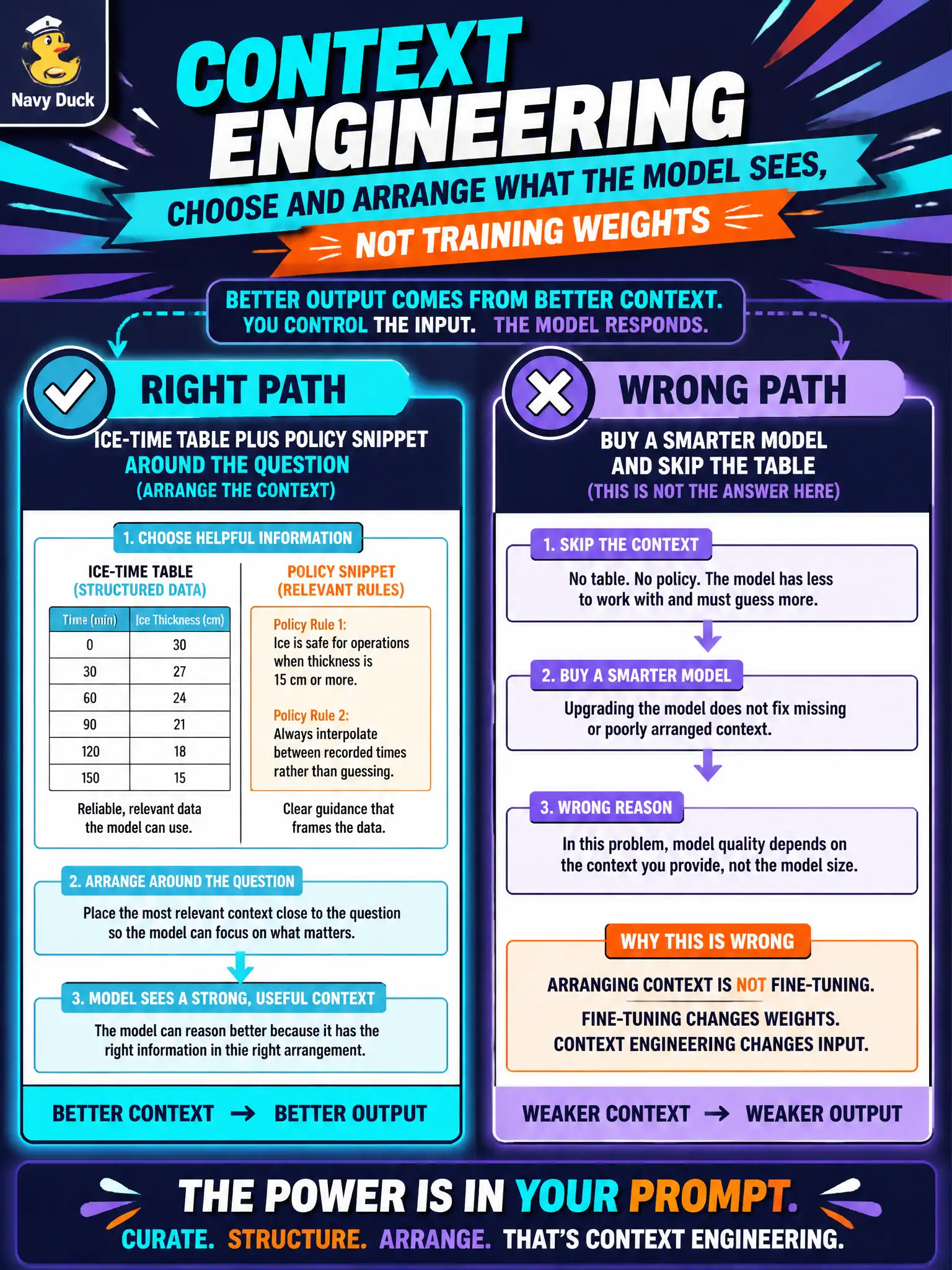
An ice-rink desk learns that a good ice-time draft depends less on a smarter model and more on which ice-time table, skate-size note, and policy snippet they place around the question. They are not rewriting model weights. Which craft is this?
Select an answer to reveal the explanation.
Short Explanation
Think of setting the table around the question: ice-time chart, skate-size note, policy snippet. That is context engineering, not a weight-changing fine-tune. A learning rate and unused locker numbers do not arrange what the model sees.
Full Explanation
Context engineering is the craft of choosing and arranging what the model sees around the user question—tables, notes, and policy snippets—so the draft is grounded without changing weights. The ice-rink desk found that ice-time quality depends on which ice-time table, skate-size note, and policy snippet surround the ask, while they are explicitly not rewriting model weights; that is context engineering.
Calling the work fine-tuning fails because arranging a table in the prompt does not update parameters; fine-tuning is a weight-changing adaptation on labeled data. Hyperparameter search for a learning rate belongs to training configuration, not to assembling inference-time context for a desk draft. Clustering unused locker numbers groups identifiers and does not arrange the information the model consumes for an ice-time answer.
Exam caveat: strong results from better context are not evidence that fine-tuning occurred. Prompt- and retrieval-side arrangement is a separate lever from weight updates.
Operational check: version the ice-time context pack (which tables and snippets are injected), A/B the arrangement on a sample of desk questions, and confirm no training job ran when staff only changed what was placed around the question.