
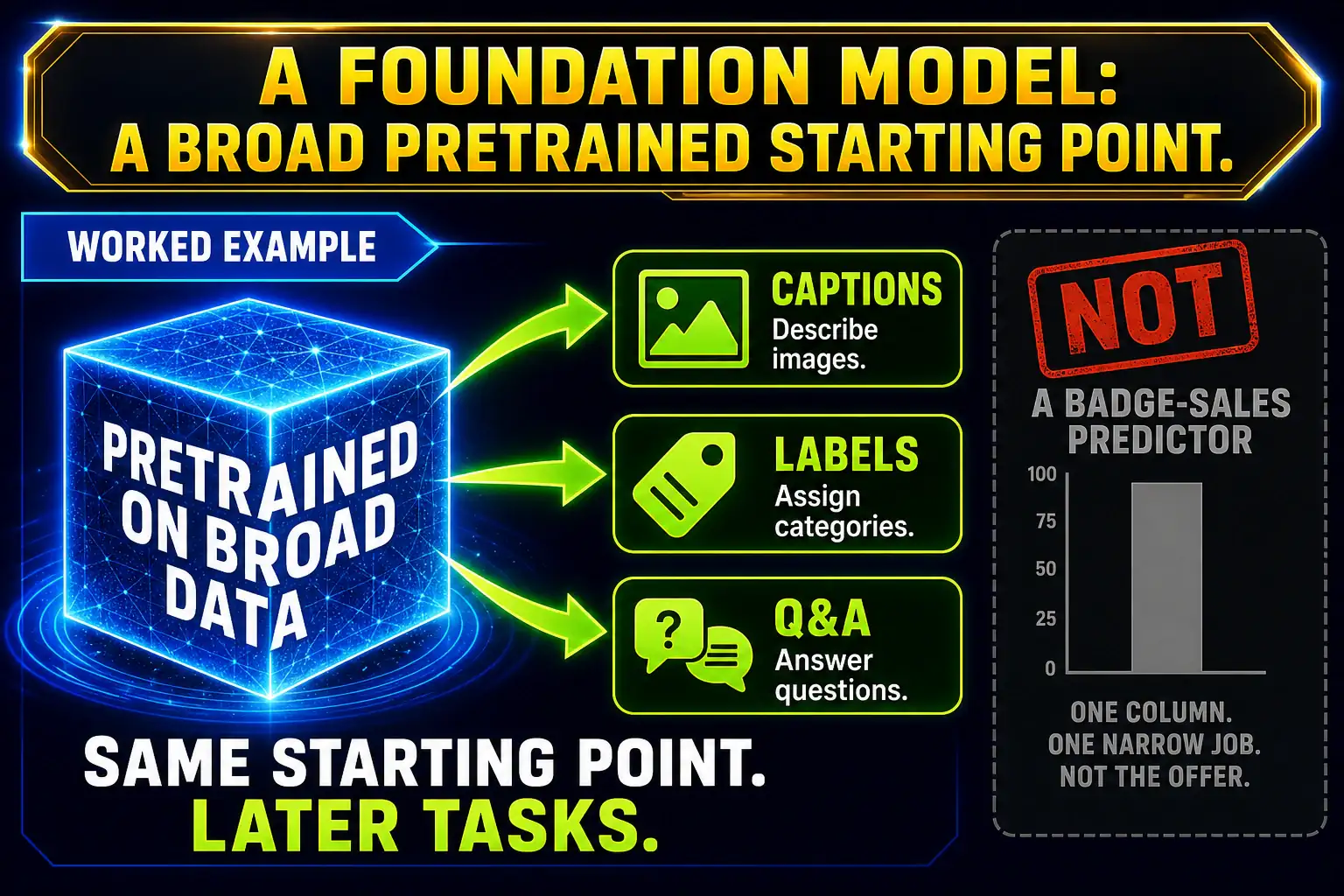
A scout-council vendor offers a large model already pretrained on broad internet-scale data. Later the council can point that same starting point at captions, labels, or Q&A. The offer is not a one-column predictor of badge sales. What kind of model is this?
Select an answer to reveal the explanation.
Short Explanation
Think of a well-trained apprentice who already read the whole library, then can be pointed at captions, labels, or Q&A. That broad pretrained starting point is a foundation model. A one-column badge-sales predictor or a watering-rule table is the opposite.
Full Explanation
A large model already pretrained on broad internet-scale data that can later be pointed at captions, labels, or Q&A is a foundation model: a broad pretrained starting point for many downstream tasks. The scout-council offer is valuable because general pretraining creates transferable representations; specialization can come afterward through prompting, adapters, or fine-tuning. It is explicitly not a one-column predictor of badge sales.
A one-task linear regressor of badge counts is a narrow classical model for a single numeric target. It is not a broad pretrained starting point reusable across captions and Q&A.
A rules table that only waters planting beds is fixed automation logic, not a pretrained statistical model and not adaptable to language or vision tasks by pointing at new modalities.
A confusion matrix with no model behind it is an evaluation artifact, not a trainable or pretrained system you can point at new tasks.
Exam caveat: foundation model does not mean ready for every regulated use out of the box—downstream evaluation, safety filters, and task adaptation still matter for council communications.
Operational check: before adopting the vendor model for captions or Q&A, run a scout-specific evaluation set covering those tasks and document whether prompting alone meets quality bars or whether further adaptation is required.