
A weekly shopper-paper editor notices that a writing assistant can tell whether bank means a river edge or a cash window by looking at the other words in the same sentence. The editor is not asking for a math proof and is not generating a rival image from noise. Which idea explains that behavior?
Select an answer to reveal the explanation.
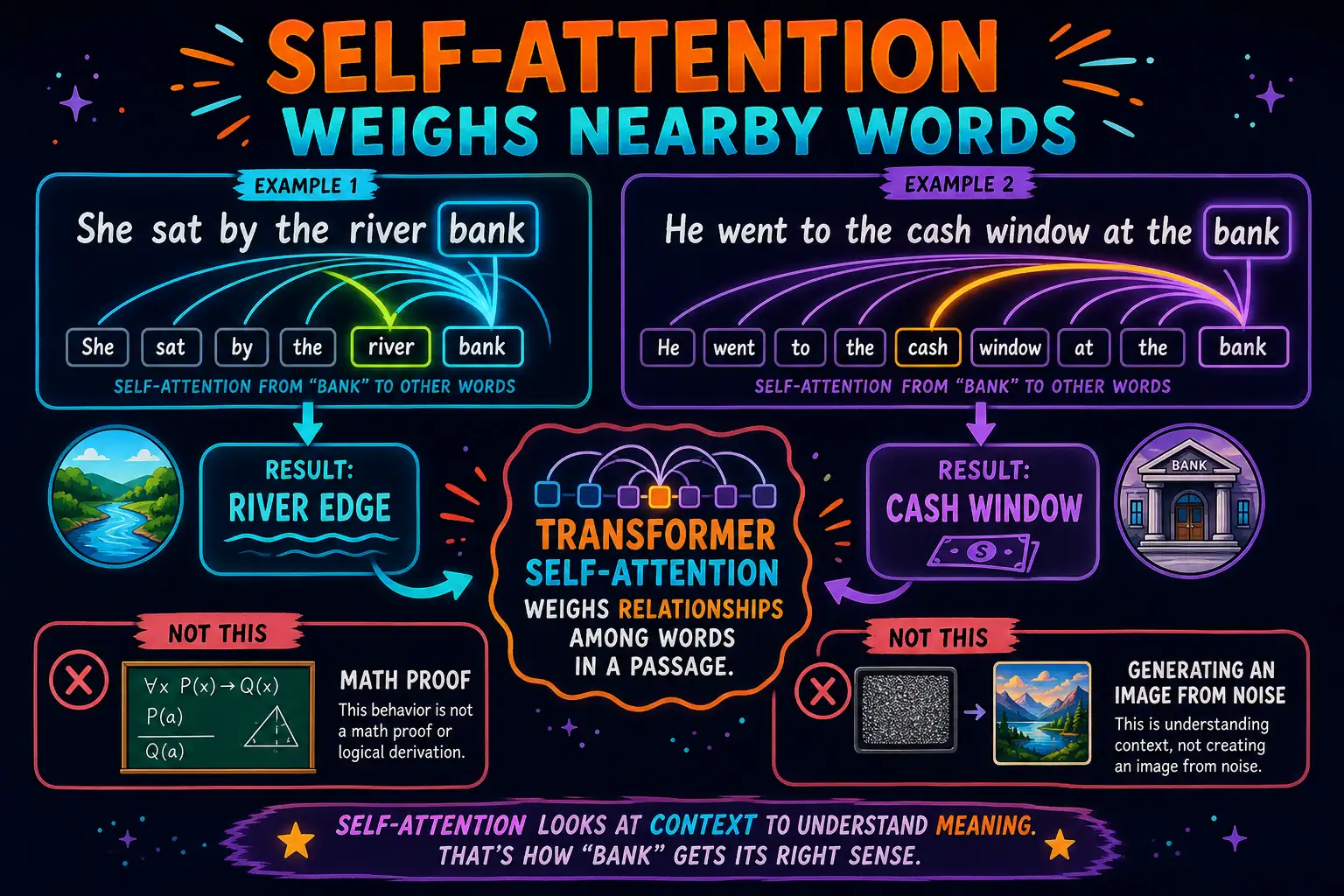
Short Explanation
Think of reading bank and knowing whether it is a river or a cash window from the rest of the sentence. A transformer with self-attention weighs those nearby words. That is not a GAN, an ad-inch forecast, or a pile of filenames.
Full Explanation
Disambiguating bank as river edge versus cash window from other words in the same sentence is explained by a transformer with self-attention, which weighs relationships among tokens in a passage. Self-attention lets the model condition the representation of an ambiguous word on its neighbors, producing context-sensitive meaning without the editor needing a formal proof and without generating images from noise.
Calling every language model a GAN is incorrect. Generative adversarial networks are a different generative family commonly associated with image synthesis contests between generator and discriminator, not the standard explanation for contextual word sense in modern language assistants.
A linear regressor that predicts next week's ad inches is a classical forecast of a numeric business series. It does not read sentence context to resolve lexical ambiguity in a writing assistant.
A clustering job on newspaper file names groups labels or paths; it does not compute contextual relationships among words inside a sentence about banks.
Exam caveat: self-attention explains contextual weighting inside the window the model can see; it does not magically use documents outside that context unless retrieval or another grounding step brings them in.
Operational check: when testing shopper-paper copy assists, include sentences with known ambiguous terms and confirm the assistant's continuation matches the intended sense before publishing automated rewrites.