
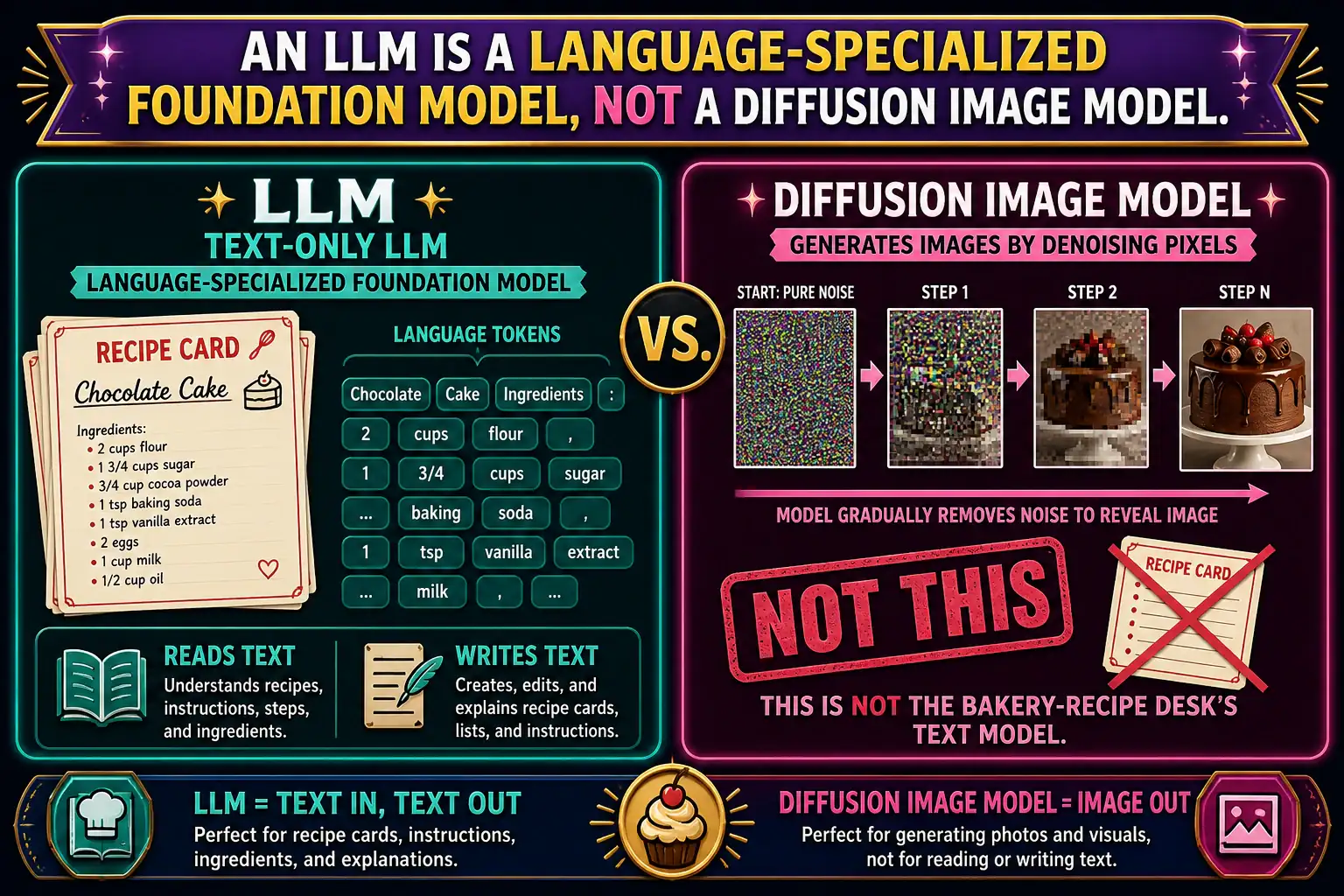
A bakery-recipe desk later buys a model that only reads and writes text at high quality. A designer on the team calls it a diffusion image model. Which statement keeps the names straight?
Select an answer to reveal the explanation.
Short Explanation
Think of a baker who only writes recipes, not a painter who starts from noise. An LLM is the language-specialized foundation model. A diffusion image model is a different shop, and neither name means clustering.
Full Explanation
A model that only reads and writes text at high quality is an LLM: a language-specialized foundation model. A diffusion image model is a different generative approach that synthesizes images by iterative denoising from noise, often conditioned on text. Keeping the names straight means recognizing language specialization versus image-generation machinery, which is what the bakery-recipe desk purchased versus what the designer mislabeled.
Calling an LLM the parent of every foundation model, including image generators, reverses the taxonomy. Foundation model is the broader pretrained starting-point idea; an LLM is the language-focused specialization, not the ancestor of all image generators.
Equating LLM and diffusion model with clustering collapses three distinct ideas. Clustering is unsupervised grouping; LLMs generate or understand language; diffusion models generate images through noise schedules.
Claiming an LLM cannot process language and only a diffusion model can is inverted. Language processing is exactly what LLMs are for; diffusion models are not the default text engine for recipe desks.
Exam caveat: some products wrap multiple modalities, but the conceptual labels still matter on the exam—text-only high-quality read/write points to LLM, not diffusion.
Operational check: verify the purchased endpoint's modality card lists text in and text out only; if image generation appears in the same SKU description, separate the recipe-writing workload onto the language model path and keep poster art on an image generator.