
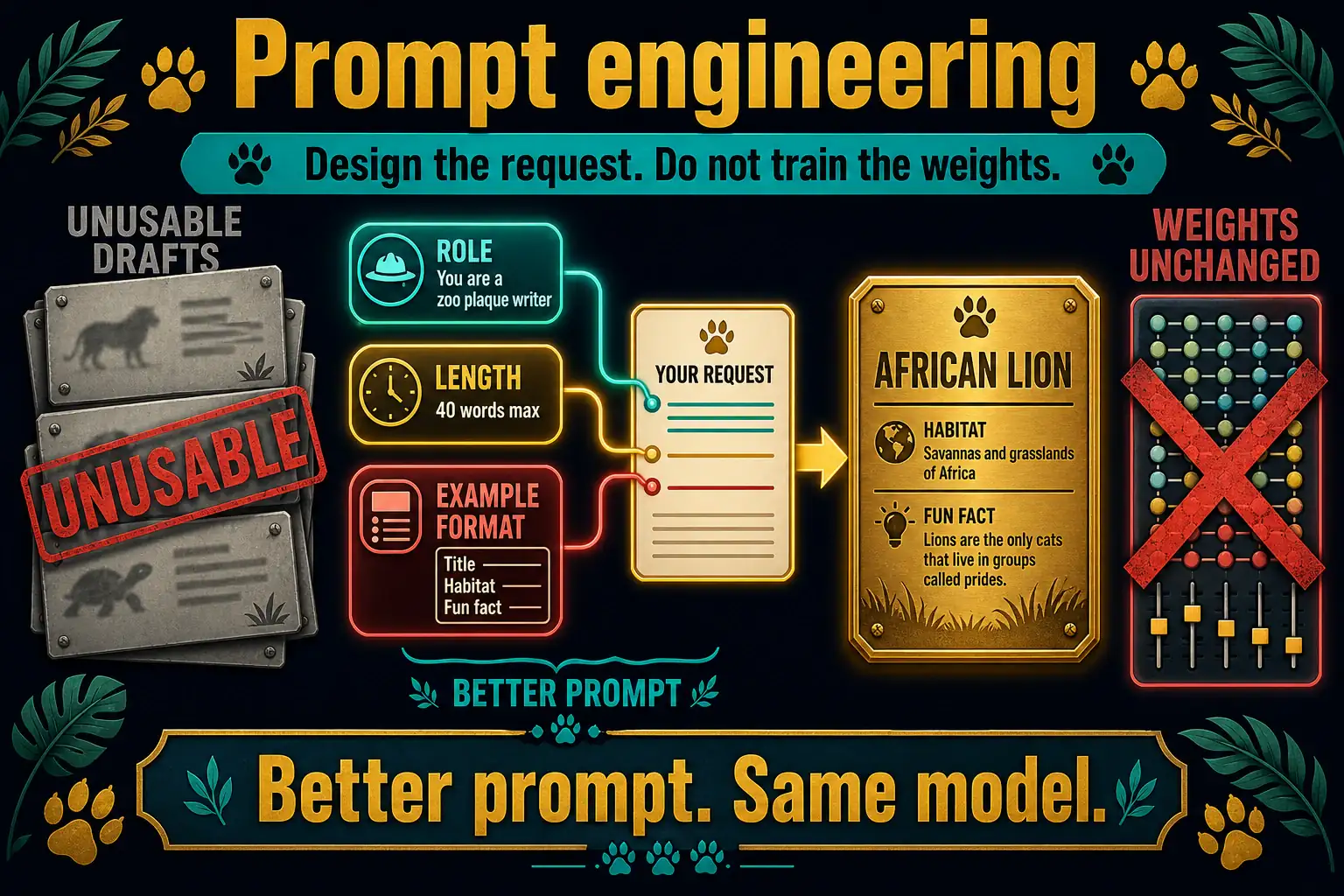
A zoo-sign intern keeps getting unusable plaque drafts until they add a role, a length constraint, and an example of the desired format. They do not change any model weights. Which craft is this?
Select an answer to reveal the explanation.
Short Explanation
Think of rewriting the ask until the plaque looks right: role, length, example. That is prompt engineering, not a weight-changing fine-tune. Cluster counts and learning rates belong to a different shop.
Full Explanation
Adding a role, a length constraint, and an example format to zoo plaque requests—without changing any model weights—is prompt engineering: designing the request so the generative model produces usable drafts. Prompt engineering improves behavior by clarifying instructions, constraints, and exemplars at inference time. The intern's craft is request design, not a training-loop change.
Fine-tuning on a new plaque dataset would update weights with labeled examples. The scenario states weights are untouched; better plaques came from a better ask, which is the definitional contrast exams use between prompting and fine-tuning.
Changing the cluster count of a classical model is an unsupervised ML hyperparameter choice unrelated to drafting interpretive signs with a generative writing assistant.
Hyperparameter search for a learning rate belongs to training optimization. No training run is described, and learning rate does not explain role-plus-example prompt edits.
Exam caveat: strong prompts can still fail on knowledge the model lacks; prompt engineering is not a substitute for retrieval grounding or fine-tuning when the zoo needs reliable species facts beyond the model's knowledge.
Operational check: keep a small gold set of plaque briefs and approved drafts; after each prompt template change, score length compliance, required fields, and factual review flags before rolling the new template to all interns.