
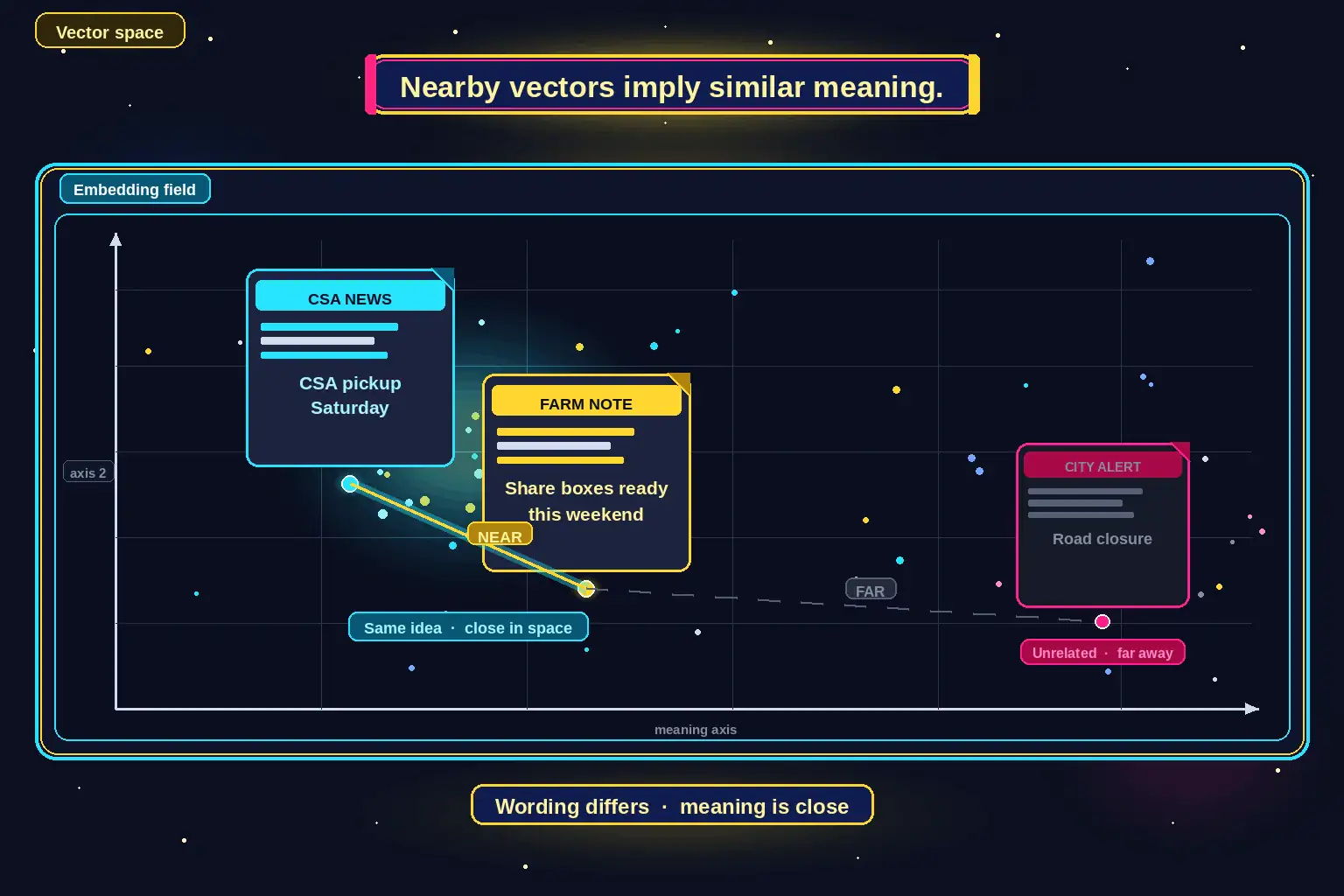
Two CSA-farm newsletters use almost none of the same words, yet a search tool places them next to each other in vector space and treats them as related. What does that nearby placement mean?
Select an answer to reveal the explanation.
Short Explanation
Think of two neighbors who tell the same story in different words and still sit on the same bench. Nearby vectors mean similar meaning, not a shared filename or the same print date.
Full Explanation
When two CSA-farm newsletters share almost no words yet sit next to each other in vector space, that nearby placement means the search tool judges them similar in meaning. Embedding models map text into a geometric space where semantic relatedness becomes proximity, so paraphrase-style farm updates can neighbor each other without sharing a keyword bag. The geometry is doing semantic work, not filename or print-date matching.
Inferring a shared file-name prefix from nearby vectors confuses storage naming with semantic embedding space. Vector neighbors can have unrelated filenames; proximity is about content meaning after embedding, not directory labels.
Treating nearby vectors as proof of one specific distance formula the candidate must name overfits the idea. Many distance or similarity measures can support nearest-neighbor search; the exam-relevant claim is that closeness encodes semantic relatedness, not that you must recite a formula name.
Linking nearby vectors to the same print day invents a calendar signal the embedding space does not represent. Two newsletters can be neighbors because they discuss similar CSA topics weeks apart.
Exam caveat: similar meaning in embedding space is approximate and model-dependent; adversarial or highly technical jargon may still embed poorly even when humans see the connection.
Operational check: sample neighbor pairs from the farm corpus, have an editor judge topical relatedness, and tune chunking or the embedding model if keyword-disjoint but on-topic newsletters fail to land nearby.