
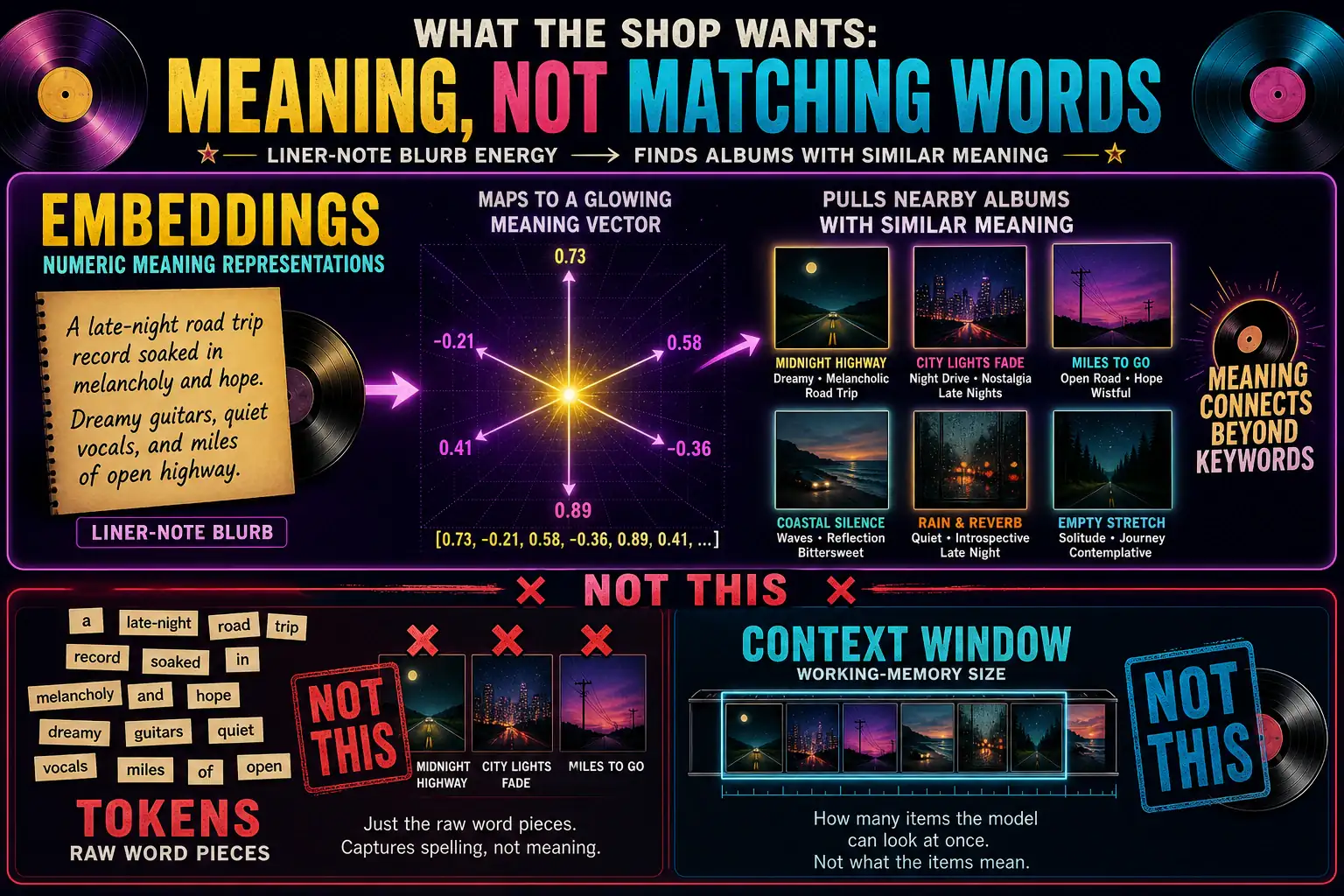
A used-record shop wants albums that mean something like a liner-note blurb, not albums that merely share three keywords. The shop is not asking for the model's working-memory size and is not asking for raw word pieces. Which representation should they use?
Select an answer to reveal the explanation.
Short Explanation
Think of matching albums by the vibe of the liner notes, not by three shared keywords. Embeddings are numeric meaning, so similar sense can sit together. Raw tokens chase exact words, and the context-window size is just how much fits.
Full Explanation
When a used-record shop wants albums that mean something like a liner-note blurb rather than albums that merely share three keywords, the right representation is embeddings: numeric vectors that encode semantic meaning. Nearby embeddings can relate paraphrase-style descriptions even when lexical overlap is low, which is exactly the meaning-over-keywords goal. The shop is not asking for working-memory size and not asking for raw word pieces as the similarity signal.
Relying on raw tokens only because shared keywords equal meaning collapses semantics into exact-word overlap. Token identity helps exact match search; it fails when two blurbs describe the same vibe with different vocabulary, which is the failure mode the shop wants to avoid.
Storing the context-window size as the album's meaning confuses a model capacity limit with a content representation. Window size is how much text fits in one call; it is not a per-album meaning vector you can search against.
A regression forecast of next week's vinyl price is a classical numeric prediction task. It does not represent liner-note meaning or retrieve semantically similar albums.
Exam caveat: embeddings enable semantic similarity but do not guarantee business relevance—poor embedding models or mismatched domains can still rank wrong pressings near a jazz blurb.
Operational check: embed a held-out set of liner notes and known similar pressings, measure whether true semantic neighbors rank above keyword-only decoys, and only then wire the shop's search to vector nearest-neighbor lookup.