
A municipal greenhouse wants three things: a place to train and host a custom wilt model, an API that already serves foundation models without that training job, and dashboards so the director can see weekly detection counts. Which mapping is accurate?
Select an answer to reveal the explanation.
Short Explanation
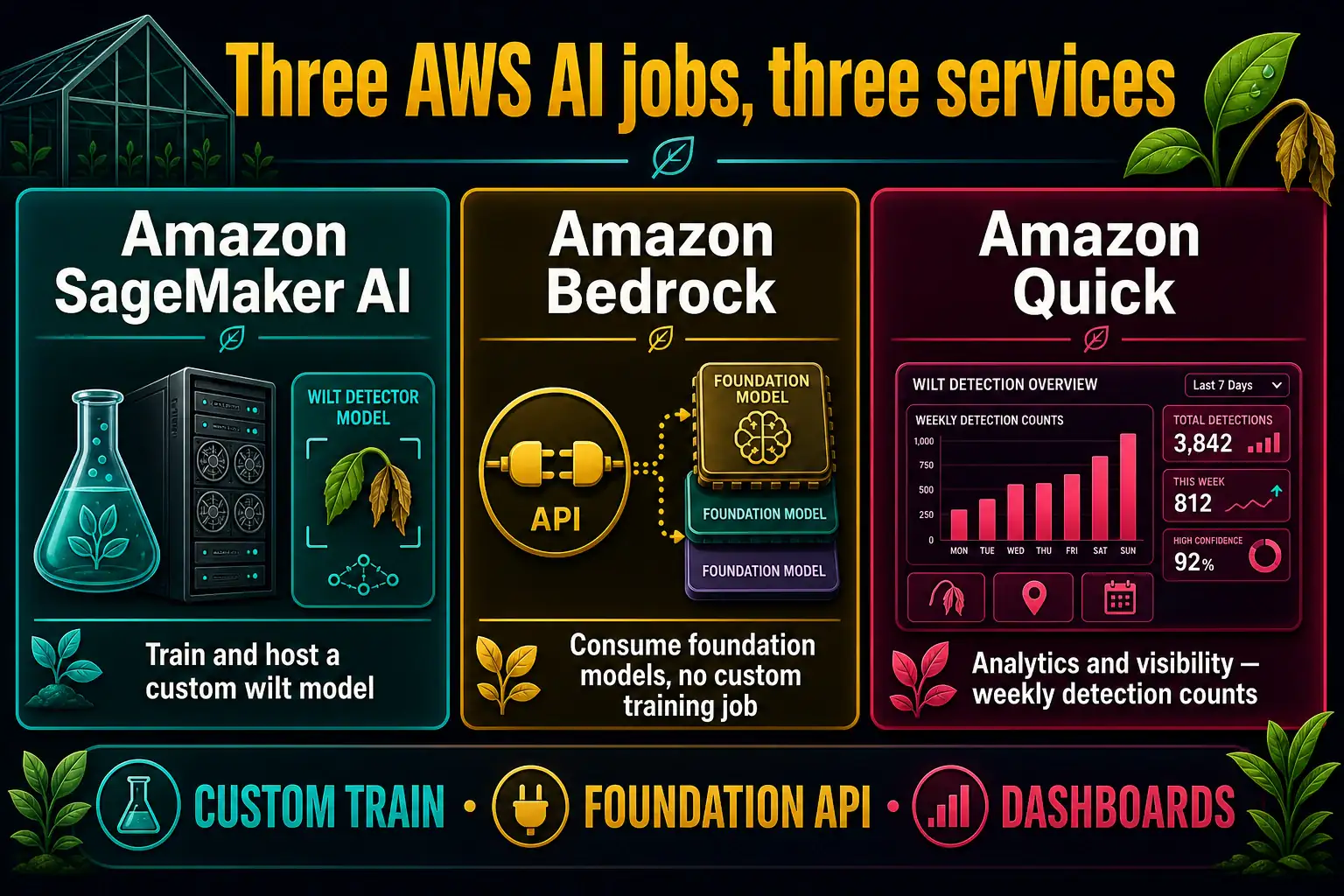
Think of three different shops. SageMaker AI is the custom kitchen (train and host the wilt model). Bedrock is the ready-made counter (consume foundation models). Quick is the wall chart (weekly counts). Do not swap those counters.
Full Explanation
The municipal greenhouse needs three distinct capabilities, and the accurate mapping aligns each to the right AWS surface: Amazon SageMaker AI to train and host the custom wilt model, Amazon Bedrock to call foundation models through an API without running that custom training job, and Amazon Quick for analytics dashboards so the director can see weekly detection counts. Custom ML lifecycle work, foundation-model consumption, and business visibility are different jobs; the products specialize accordingly.
Using Bedrock to train the custom wilt model and SageMaker AI only for spoken audio reverses responsibilities. Bedrock is the managed way to consume foundation models; SageMaker AI is the place for building and hosting custom models. Neither mapping matches spoken-audio-only use as stated.
Hosting the custom model in Quick and drawing weekly charts with Bedrock also swaps lanes. Quick is for analytics and visibility, not model hosting; Bedrock is not the greenhouse's charting layer for weekly detection counts.
Inventing a new AWS training service because none of these cover custom models is unnecessary. SageMaker AI already covers custom train-and-host needs for the wilt detector.
Exam caveat: exam questions often test whether you know Bedrock consumes foundation models while SageMaker AI builds custom ones—do not merge them into a single vague AI service.
Operational check: verify wilt training jobs and endpoints live under the SageMaker AI account path with IAM least privilege, foundation-model calls go through Bedrock with logging enabled, and weekly detection aggregates land in the Quick dashboard the director actually opens.