
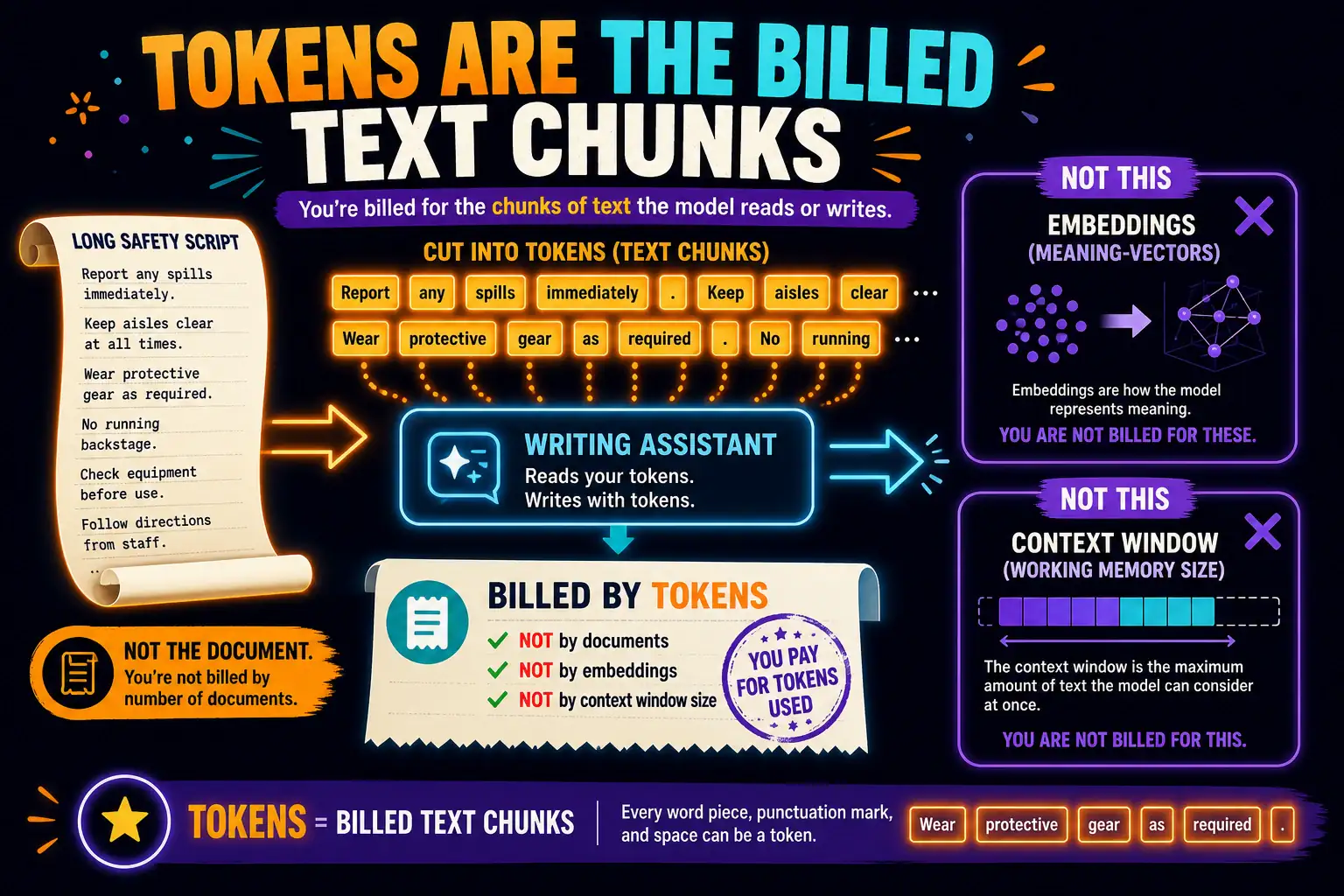
A high-school playbill desk pastes a long safety script into a writing assistant and is billed by pieces of text, not by number of documents. The bill is not counting meaning-vectors and is not the size of the model's working memory. What unit is the desk being billed for?
Select an answer to reveal the explanation.
Short Explanation
Think of paying by the slice of bread, not by the loaf. Tokens are the chunks the model reads or writes, and that is the bill. Embeddings are meaning-vectors, the context window is how much fits on the plate, and this is not clustering.
Full Explanation
When the playbill desk pastes a long safety script into a writing assistant and is billed by pieces of text rather than by documents, the billing unit is tokens: the chunks of text the model reads or writes. Token counts drive usage metering for generative language APIs. The bill is counting how much text moved through the model, not how many files were uploaded and not a separate semantic index charge.
Embeddings are numeric meaning vectors used for similarity search and retrieval. They are related generative-AI building blocks, but they are not the unit described for reading and writing charges on a pasted script. The scenario explicitly rules out meaning-vectors as what is being counted.
The context window is the model's working-memory capacity—how much text can fit in one request—not a billing unit by itself. Window size constrains what you can send; providers still meter the tokens actually consumed inside that window. The desk is not being billed for the size of working memory.
Calling the charge clusters because every writing job is unsupervised grouping confuses a classical ML technique with API metering. Clustering groups items by similarity; it does not explain per-piece text billing for a writing assistant.
Exam caveat: tokenizers differ by model family, so the same English paragraph can consume different token counts across providers; exams care that you know tokens are the unit, not that you memorize one vendor's tokenizer.
Operational check: before pasting full safety scripts, estimate input-plus-output tokens, set max-output limits, and sample a representative playbill request to confirm the metered token count matches finance expectations for the registration rush.