
A campus laundry forecast was solid last term. After a new dorm opens, Sunday dryer-wait predictions start missing the spike, and live inputs no longer match last term's pattern. The model is already deployed. What should the team do first?
Select an answer to reveal the explanation.
Short Explanation
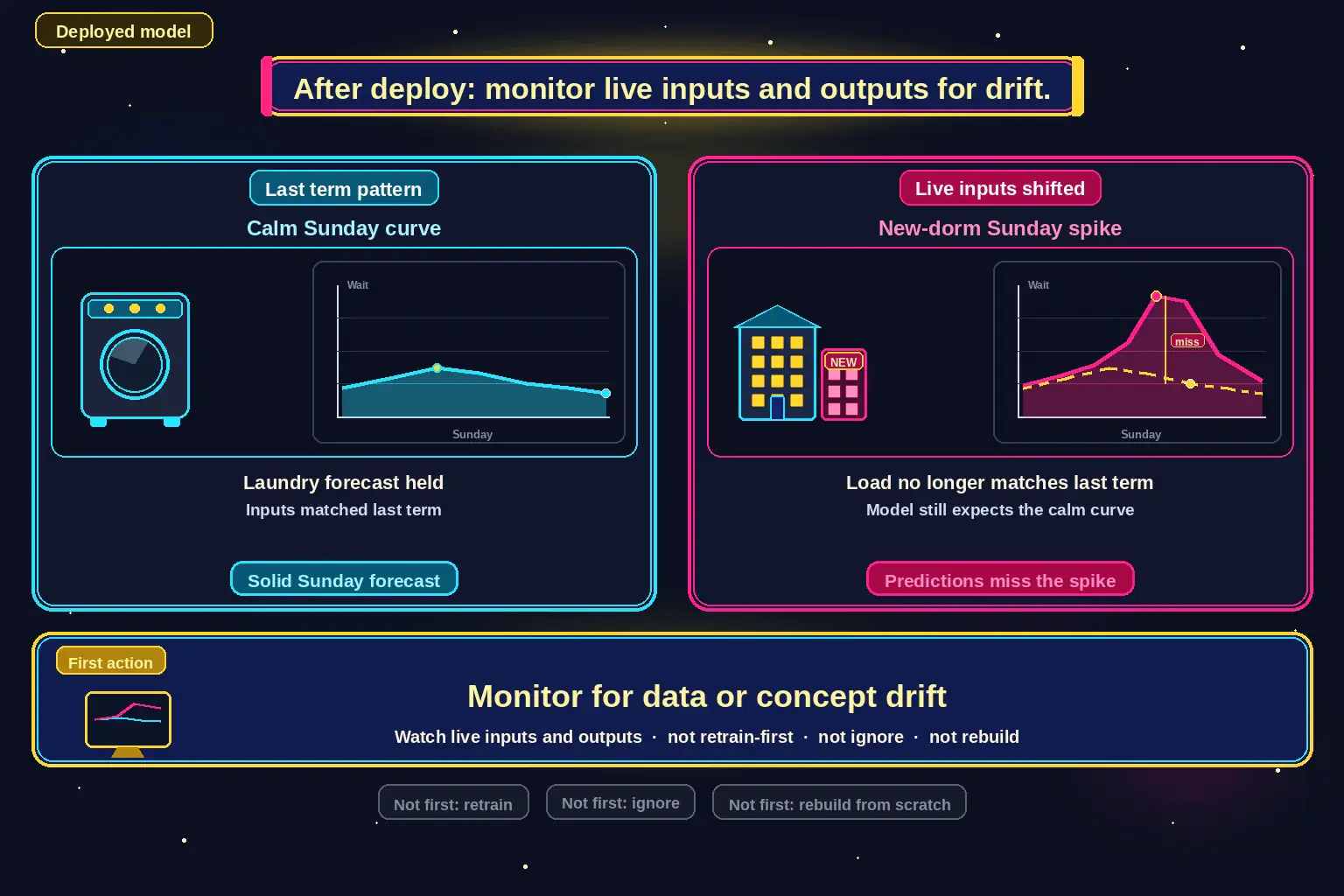
Think of a weather app that still thinks the new dorm is an empty lot. After go-live, Sunday spikes that no longer match last term is drift, and monitoring is how you catch it. Relabeling matrix cells or treating it as speech-to-text does not restore the forecast.
Full Explanation
After the new dorm opens, Sunday dryer-wait predictions miss the spike because live inputs and demand patterns no longer match last term's training distribution. That mismatch is data or concept drift. Because the laundry forecast is already deployed, the first responsible move is to monitor live inputs and outputs so the team can detect the break, quantify how far the distribution moved, and decide whether to retrain or adjust features. Monitoring is the bridge between a once-solid offline model and a changing campus reality.
Relabeling confusion-matrix cells treats drift as a vocabulary or reporting problem. Matrix labels describe how true and predicted classes are counted; renaming them does not restore a forecast that is wrong because Sunday demand changed after a dorm opened.
Framing the miss as a speech-to-text error imports an unrelated modality. Laundry wait times are a tabular or time-series prediction problem, not audio transcription, so speech tooling does not diagnose or fix the Sunday spike failure.
Turning evaluation off permanently because the model is live is the opposite of MLOps hygiene. Production is exactly when you need ongoing checks; a live system without evaluation can drift silently while students keep waiting for dryers.
Exam caveat: drift detection is not the same as an automatic retrain. Monitoring tells you something changed; the controlled response (retrain, feature refresh, or rollback) is a separate decision after you confirm the signal.
Operational check: compare live feature distributions and prediction error by day-of-week against last term's baselines, and alert when Sunday dryer-wait residuals or input histograms exceed agreed thresholds after occupancy changes.