
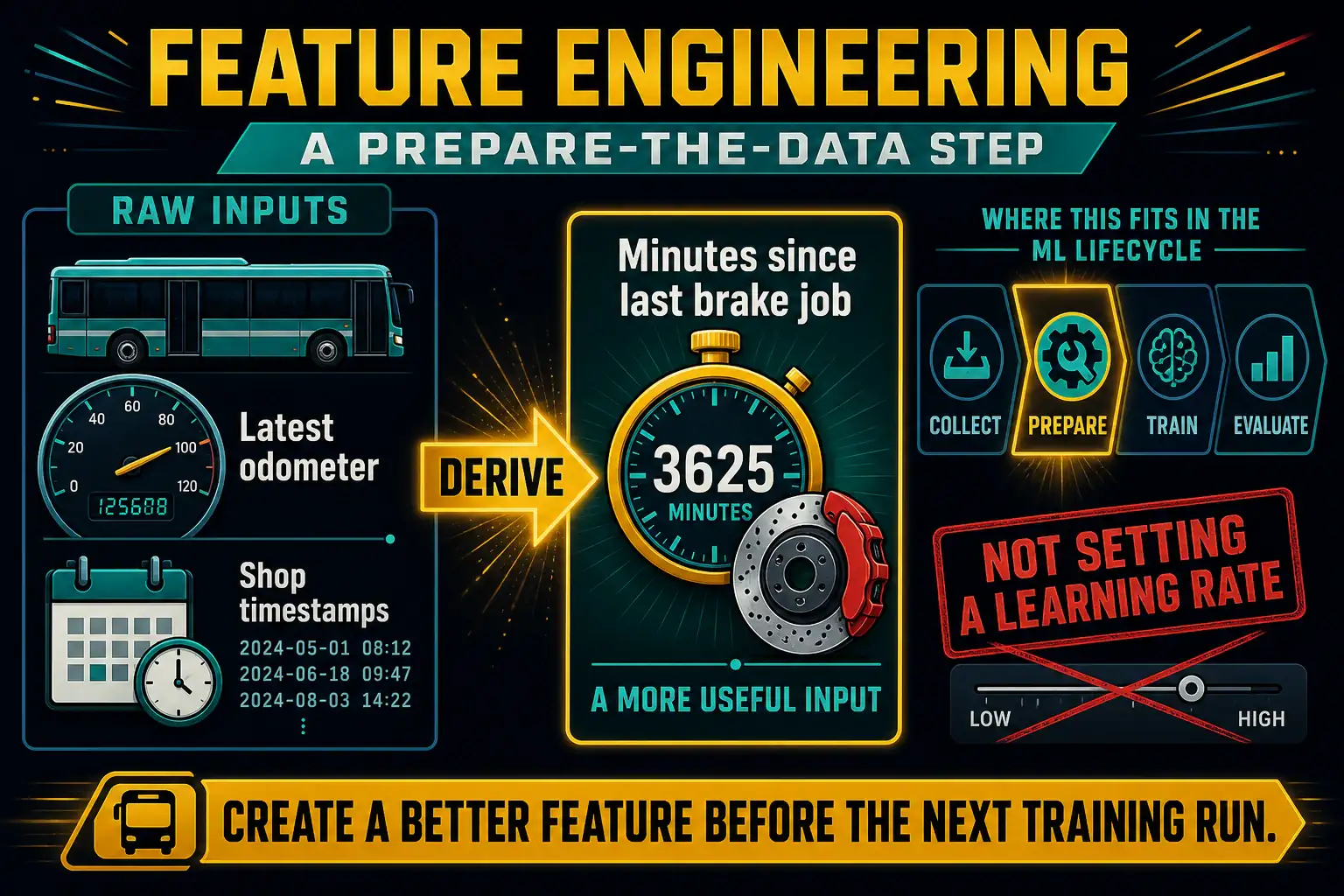
A bus-fleet model currently sees only the latest odometer reading. Maintainers want to add minutes-since-last-brake-job, derived from raw shop timestamps, before the next training run. They are not asking anyone to set a learning rate. Which lifecycle step is this?
Select an answer to reveal the explanation.
Short Explanation
Think of turning raw shop timestamps into minutes-since-last-brake-job before the next training run. That is feature engineering, a prepare-the-data step. It is not a go-live, not a learning-rate knob, and not watching last week's boardings.
Full Explanation
Deriving minutes-since-last-brake-job from shop timestamps is classic feature engineering inside the prepare-the-data phase of the ML lifecycle. The fleet model already had a raw odometer signal; maintainers are constructing a more informative input that better reflects maintenance state before the next training run. Feature engineering does not change the learning algorithm itself—it reshapes what the algorithm is allowed to see so patterns about brake wear become learnable from structured history rather than from a single instantaneous reading.
Shipping a new serving API is a deployment action. Adding a column in the training table does not automatically put a new endpoint live, rewrite traffic routing, or change how predictions are served to technicians. Those are later release steps that follow training and evaluation, not the act of building the feature.
Adjusting the learning rate is hyperparameter tuning during model training. The scenario explicitly says nobody was asked to set a learning rate. Feature creation and optimizer settings live in different lifecycle stages even when both happen before a model is production-ready.
Watching last week's boardings is live monitoring of operational traffic after (or while) a model is deployed. Monitoring detects drift and quality issues; it does not invent derived training inputs from shop timestamps.
Exam caveat: candidates often conflate any data change with go-live. A new feature only becomes a production concern after the model that consumes it is trained, evaluated, and released with matching online feature computation.
Operational check: confirm the same derivation runs offline for training and online at inference time with identical timezone handling and missing-shop-record rules so the live fleet score does not see a different minutes-since-last-brake-job definition than the training set.