
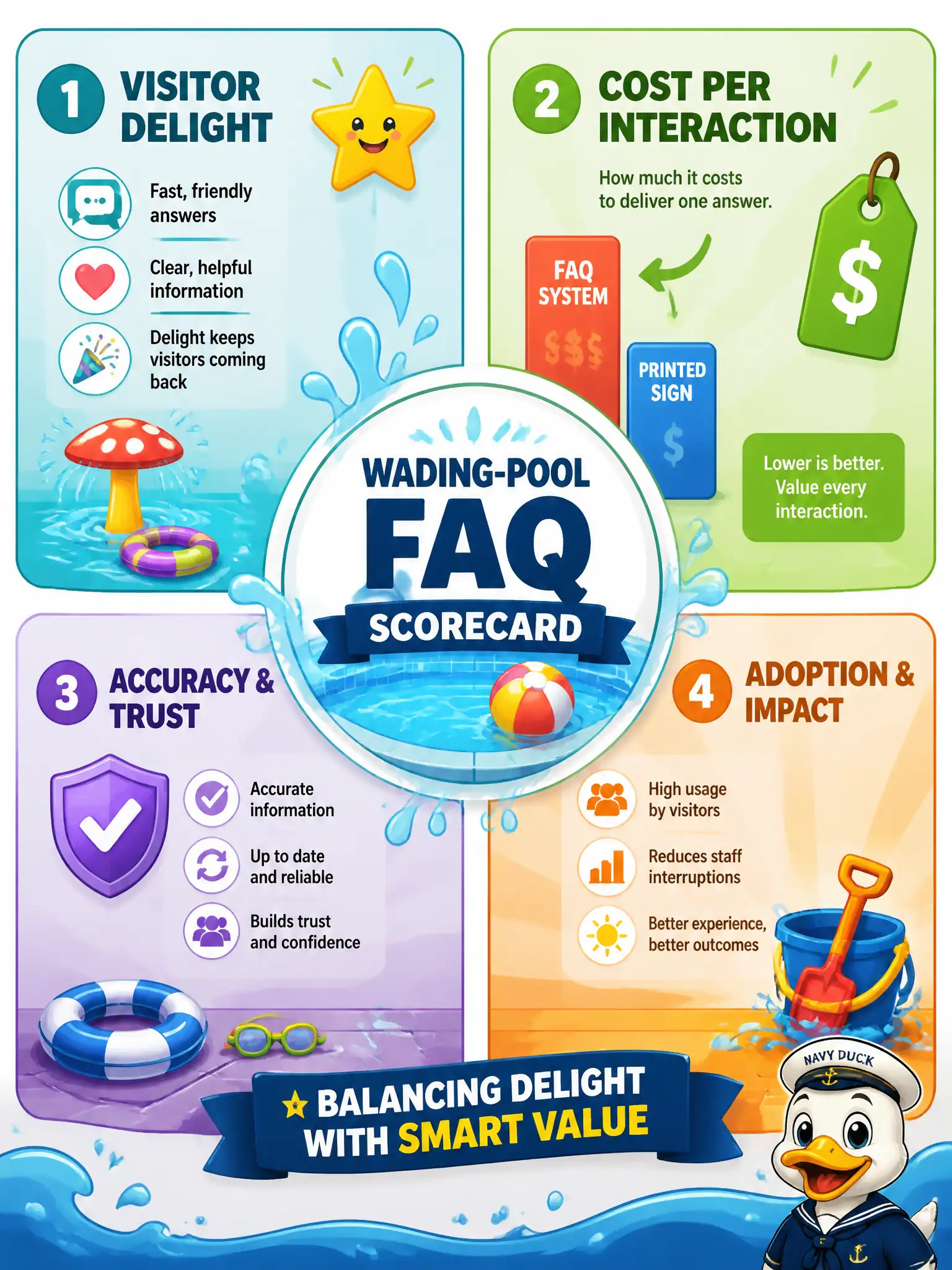
A municipal wading-pool FAQ that delights visitors but costs more per answer than a printed sign fails the business case. Which scorecard item should have caught that?
Select an answer to reveal the explanation.
Short Explanation
Think of a wading-pool FAQ that delights visitors and still costs more than a printed sign. Cost per interaction should have caught that. Fluency and ROUGE are not a unit price.
Full Explanation
Cost per interaction is the scorecard item that should have caught a wading-pool FAQ that delights visitors yet costs more per answer than a printed sign. Business cases for municipal assistants must include unit economics, not only delight or polished sample chats. If each answer is more expensive than the alternative channel, the program can fail even when visitors love the experience and fluency looks excellent in demos for parks leadership.
Fluency alone does not price an answer against a printed sign and cannot save a failed cost case. ROUGE overlap is not a unit price and does not speak to municipal spend on pool season staffing or cloud usage. A writing benchmark is not a business case for continuing a chatbot when simpler channels are cheaper for routine pool hours and rules questions.
Exam caveat: cost per interaction can be cut in ways that hurt quality, such as shorter context or weaker models. Optimize cost without silently dropping faithfulness or safety gates for pool rules and health guidance that protect families.
Operational check: meter tokens and tool calls per FAQ session, compare fully loaded cost to the printed-sign alternative, and revisit model size, caching, and retrieval scope before renewing the chatbot budget for the wading-pool season.