
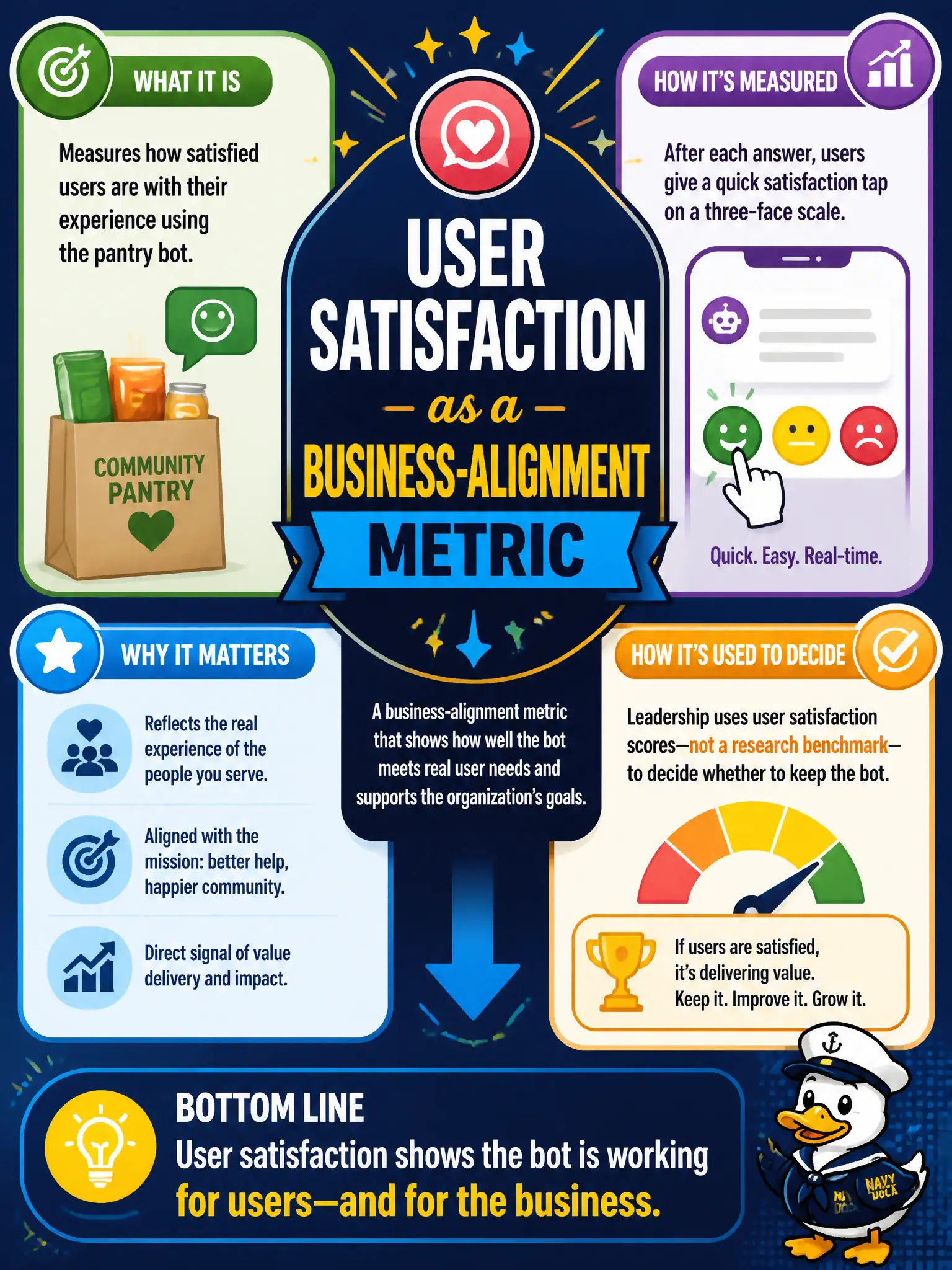
A community pantry helper is scored with a three-face satisfaction tap after each answer. Leadership uses that, not a research benchmark, to decide whether to keep the bot. Which metric is that?
Select an answer to reveal the explanation.
Short Explanation
Think of a three-face tap after each pantry answer. Leadership is measuring user satisfaction. A research benchmark, an endpoint, and a happy face that ignores facts are not that test.
Full Explanation
A three-face satisfaction tap after each pantry answer is user satisfaction used as a business-alignment metric. Leadership is asking whether people feel the helper helped, which is a product signal distinct from research benchmarks or infrastructure capacity. That tap can decide whether a community pantry keeps the bot even when academic scores look fine on offline suites.
A public research benchmark is not what the taps measure; face taps are not ROUGE scores and should not be relabeled as academic leaderboard results. Provisioned throughput is capacity for endpoints, not how satisfied a pantry visitor felt after an answer. Faithfulness alone can be strong while users still dislike tone or usefulness—happy-face scores do not prove every fact was retrieved, and retrieval correctness does not replace satisfaction as the metric named in the stem.
Exam caveat: satisfaction is subjective and can conflict with accuracy. High taps on confident wrong answers are a governance risk for pantry guidance that may affect food access or eligibility understanding.
Operational check: track satisfaction trends by question type, correlate low taps with faithfulness failures, and set a rule that sustained low satisfaction or high confidence-plus-complaint cases trigger human review before expanding the pantry helper.