
A community flea-market flyer is generated in Spanish against a human reference translation. Which metric family should score that job?
Select an answer to reveal the explanation.
Short Explanation
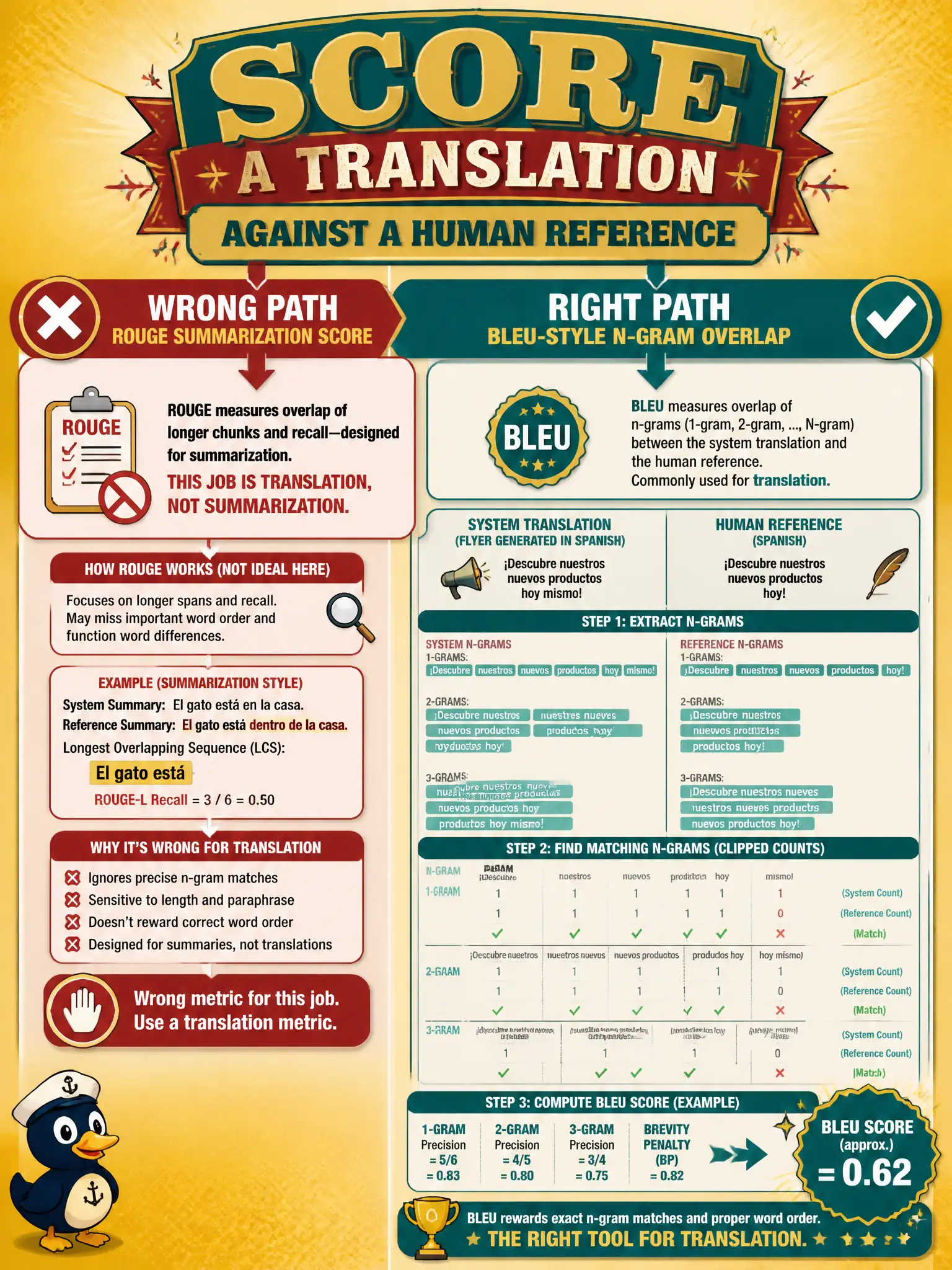
Think of a flea-market flyer in Spanish scored against a human translation. BLEU-style n-gram overlap is the usual metric. ROUGE is the summarization name, and a content filter is not an overlap score.
Full Explanation
Scoring a community flea-market flyer generated in Spanish against a human reference translation calls for a BLEU-style n-gram overlap metric. BLEU compares candidate and reference translations through overlapping n-grams and remains the conventional automatic family for machine translation quality. That gives the market team a repeatable signal when they change models or prompts without waiting for a full human panel every night.
ROUGE is the usual summarization overlap family; using it as the only correct label for translation collapses two task conventions. A denied-topic filter blocks content categories; it does not measure translation overlap. Claiming that only human evaluation applies ignores that automatic overlap metrics are widely used for translation—even when humans still own final acceptance for public flyers.
Exam caveat: BLEU rewards surface overlap and can under-score valid paraphrases or over-score awkward literal matches. For public-facing municipal Spanish flyers, keep a human spot-check for fluency and cultural fit alongside the automatic score.
Operational check: keep a frozen reference translation set for recurring flyer templates, run BLEU with a fixed configuration across candidates, and escalate low-BLEU or high-BLEU-but-awkward samples to bilingual staff before publication.