
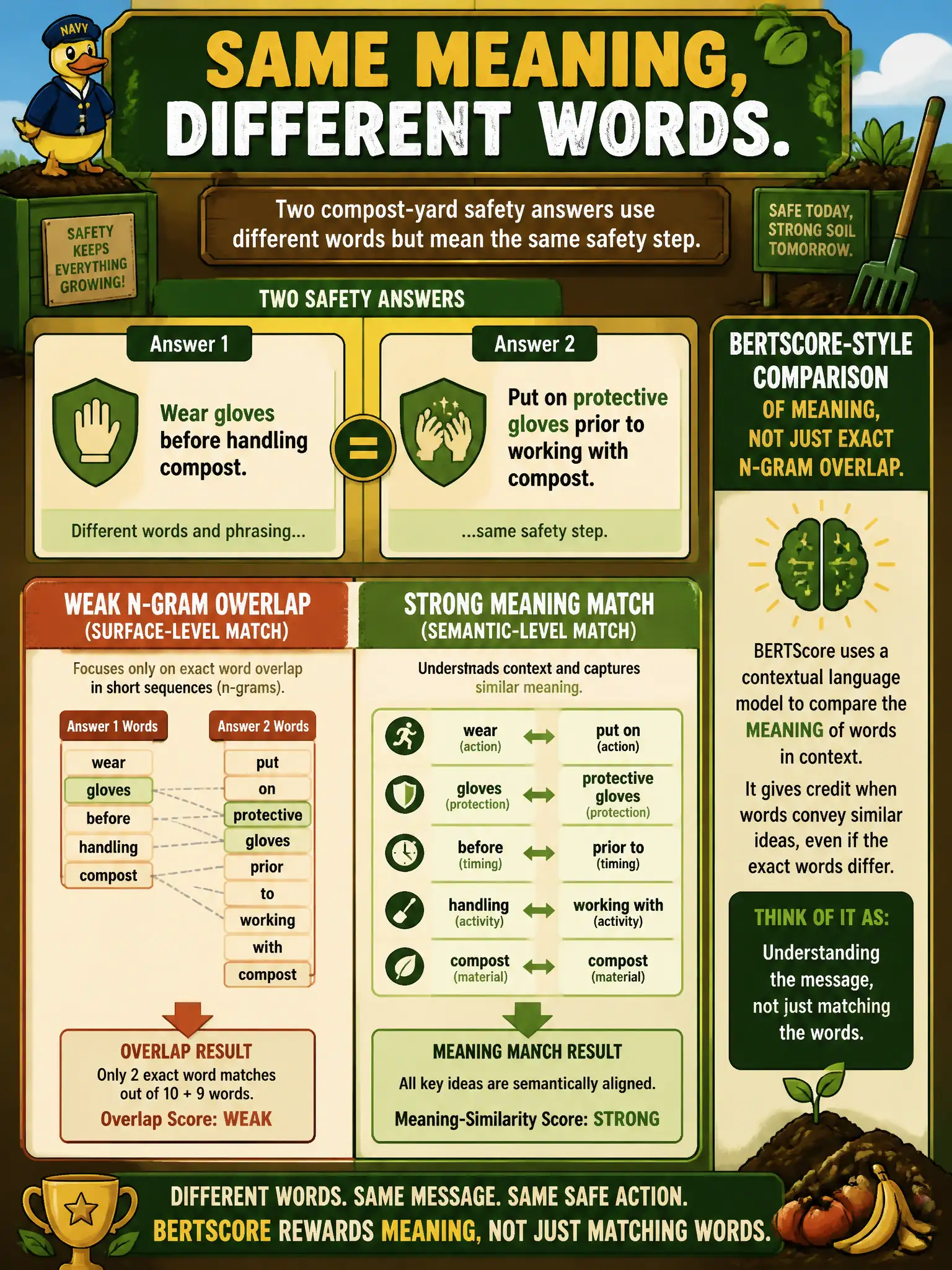
Two municipal compost-yard answers use different words but mean the same safety step. Overlap scores look weak; a meaning-similarity score looks strong. Which comparison is that?
Select an answer to reveal the explanation.
Short Explanation
Think of two compost-yard answers that use different words for the same safety step. Overlap looks weak, meaning looks strong. That is a BERTScore-style comparison, not ROUGE or BLEU counting matching n-grams.
Full Explanation
When two municipal compost-yard answers use different words for the same safety step, n-gram overlap looks weak while a meaning-similarity score looks strong. That pattern is a BERTScore-style comparison: embeddings capture semantic closeness even when surface forms diverge. For civic safety copy, that matters because correct guidance may be paraphrased without sharing exact phrases with a reference answer.
ROUGE alone would treat weak lexical overlap as failure even when the meaning matches, so it is the wrong sole yardstick for paraphrase-heavy answers. BLEU alone likewise equates quality with n-gram identity and misses synonym-level agreement. Provisioned throughput describes reserved inference capacity; it has nothing to do with meaning similarity.
Exam caveat: semantic similarity is not faithfulness to source documents. Two answers can mean the same incorrect thing. Use BERTScore-style checks for paraphrase tolerance, then still verify claims against the compost-yard safety binder when numbers or procedures matter.
Operational check: build a small paraphrase pair set for known safety steps, confirm the meaning metric ranks true paraphrases above unrelated text, and review cases where meaning scores high but a supervisor still flags a wrong procedure.