
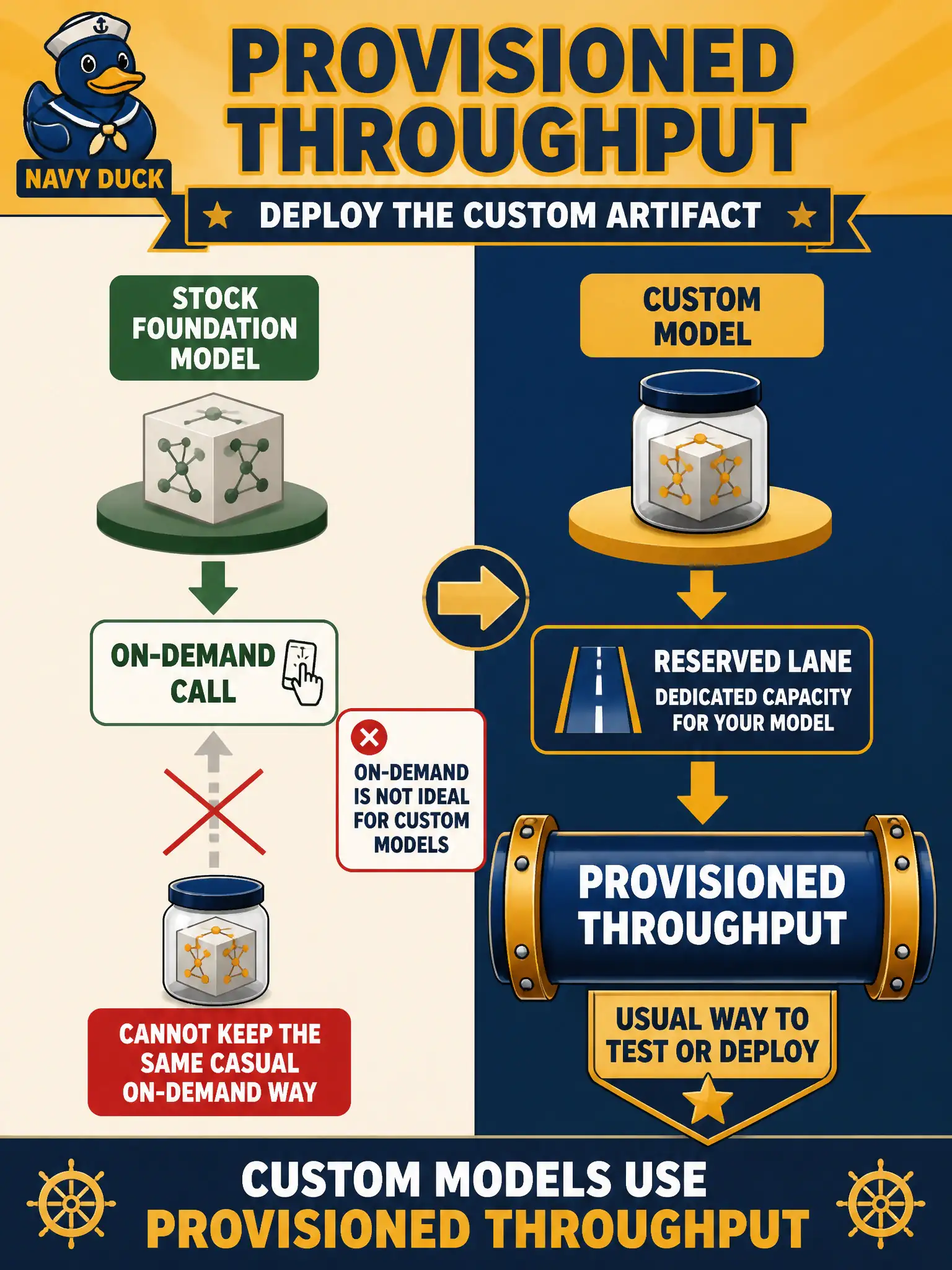
After customization, the same meadery cannot keep invoking the custom artifact the same casual on-demand way they call a stock foundation model. What is the usual way to test or deploy that custom model?
Select an answer to reveal the explanation.
Short Explanation
Think of a custom mead-note model that will not take the same casual walk-up line as a stock foundation model. Provisioned throughput is the usual way to test or serve it. A laptop folder, Polly, and a dashboard are not that line.
Full Explanation
After customization, a custom Amazon Bedrock model artifact is typically tested or deployed with provisioned throughput rather than the same casual on-demand invocation path used for many stock foundation models. Provisioned throughput provides the hosted capacity commitment needed to serve the custom endpoint reliably for the meadery’s tasting-note helper. That correct path works because custom artifacts usually need an explicit consumption setup instead of assuming walk-up on-demand parity with stock models. A laptop folder of weights with no hosted endpoint is not a production consumption path and offers neither managed scaling nor shared access controls. Amazon Polly is text-to-speech, not custom-model throughput for tasting notes. A director dashboard does not serve model inferences to the tasting workflow. Exam caveat: capacity planning still matters—provisioned units must match expected concurrency, and cost differs from on-demand stock foundation-model calls. Operational check: deploy the custom model with provisioned throughput in a non-production account, send a soak test of tasting-note requests, and confirm stable latency and correct custom behavior before production cutover. Size provisioned capacity from measured peak tasting-season traffic, not from guesswork alone.