
A community meadery using Amazon Bedrock has labeled tasting-note pairs and, separately, a pile of unlabeled orchard diaries. How should the team pick the customization job type?
Select an answer to reveal the explanation.
Short Explanation
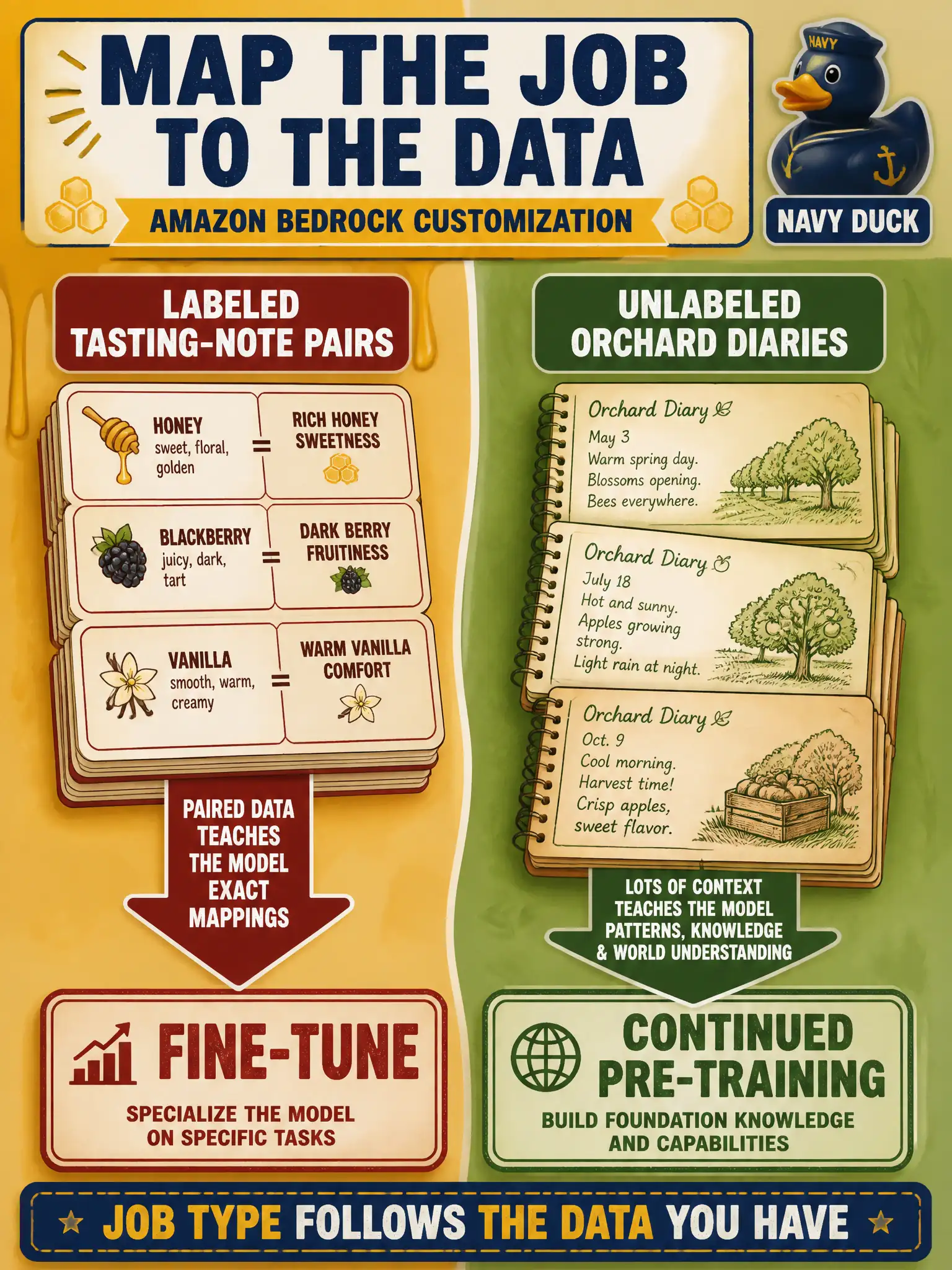
Think of labeled tasting-note pairs in one crate and unlabeled orchard diaries in the other. Fine-tune on the pairs, continued pre-training on the diaries. Do not swap the crates, and a dashboard is not a job type.
Full Explanation
On Amazon Bedrock-style customization for the community meadery, job type follows data shape rather than nickname preference. Labeled tasting-note pairs support fine-tuning; a separate pile of unlabeled orchard diaries supports continued pre-training. Mapping each job to the data works because each method expects different supervision signals, and swapping them produces a mismatched training recipe. Fine-tuning on unlabeled diaries and continued pre-training on labeled pairs swaps the crates and mismatches the algorithms to the supervision you actually have. Ignoring available data to pick a job by vendor nickname is cargo-cult selection that wastes time and budget without improving tasting-note quality. Using a BI dashboard for both jobs confuses analytics with model customization endpoints. Exam caveat: some programs offer multiple customization paths—always start from labeled versus unlabeled data and the task goal, not from marketing names alone. Operational check: inventory each meadery dataset as labeled pairs or unlabeled text, select the matching job type per inventory row, record that mapping in the training ticket, and refuse to start a job whose selected type contradicts the inventory.