
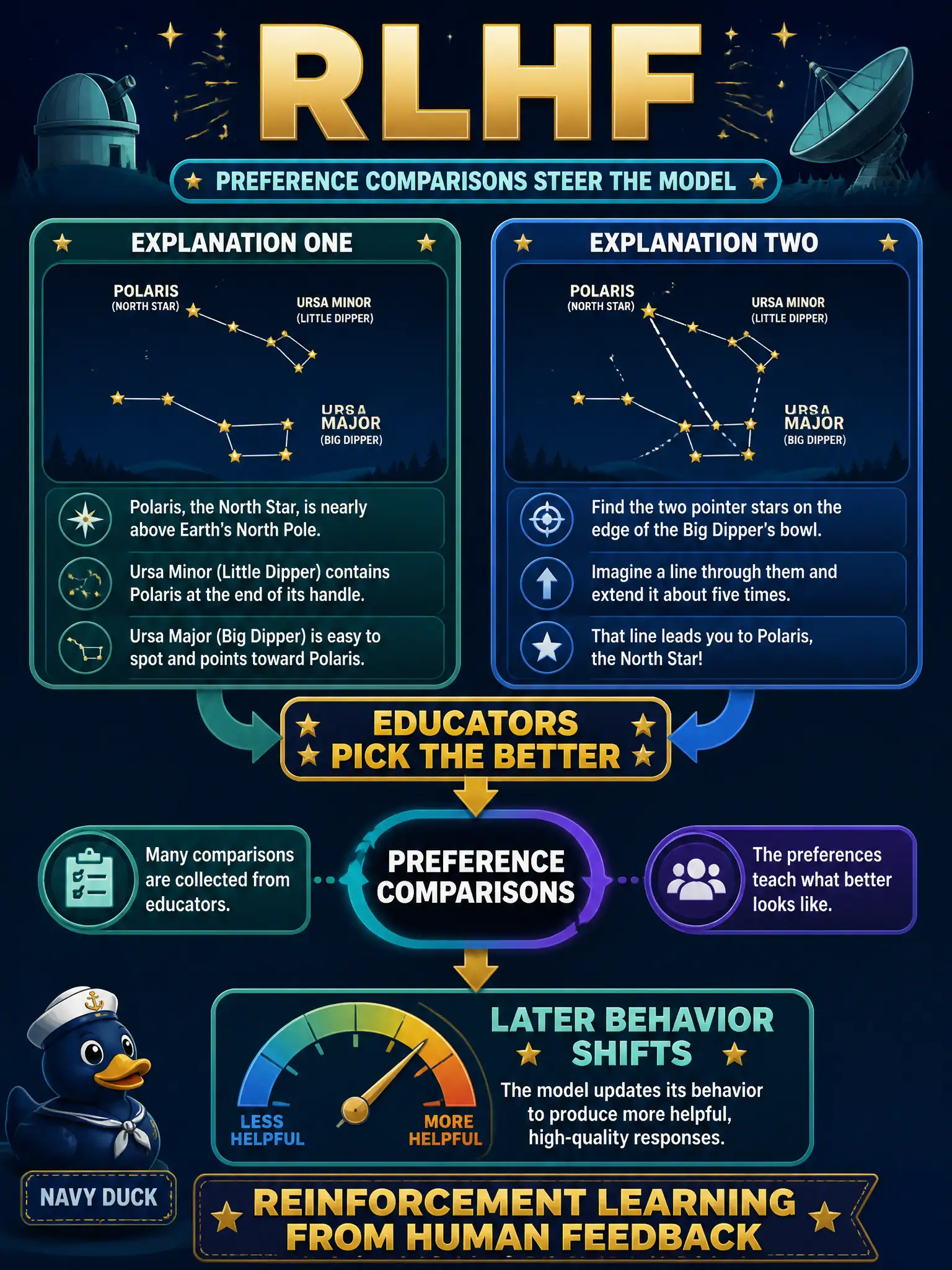
A community observatory wants educators to pick the better of two star-chart explanations, then those preferences shape later behavior. Which loop is that?
Select an answer to reveal the explanation.
Short Explanation
Think of two star-chart writeups and a docent circling the better one. Those preference picks steer later behavior. That is RLHF, not unlabeled next-token training, a cache, or a dashboard vote.
Full Explanation
When community-observatory educators pick the better of two star-chart explanations and those choices shape later behavior, the loop is reinforcement learning from human feedback: preference comparisons provide a signal that steers the model toward preferred educational outputs. That is distinct from next-token pre-training on an unlabeled crawl, which predicts tokens without human preference picks between candidate explanations. Prompt caching reuses a static prefix for efficiency and is not a preference-learning loop that updates behavior from educator choices. A dashboard vote may collect opinions for reporting but is not the RLHF training process that turns pairwise preferences into steered model behavior. Exam caveat: RLHF quality depends on rater guidelines and the rater pool; biased or inconsistent preferences can steer the observatory helper toward flashy but less accurate explanations. Operational check: document the preference rubric, sample double-rated pairs for agreement, and evaluate post-RLHF outputs on clarity and scientific appropriateness before public gallery use. Train raters on the rubric first so preference data reflects educational goals rather than personal taste alone.