
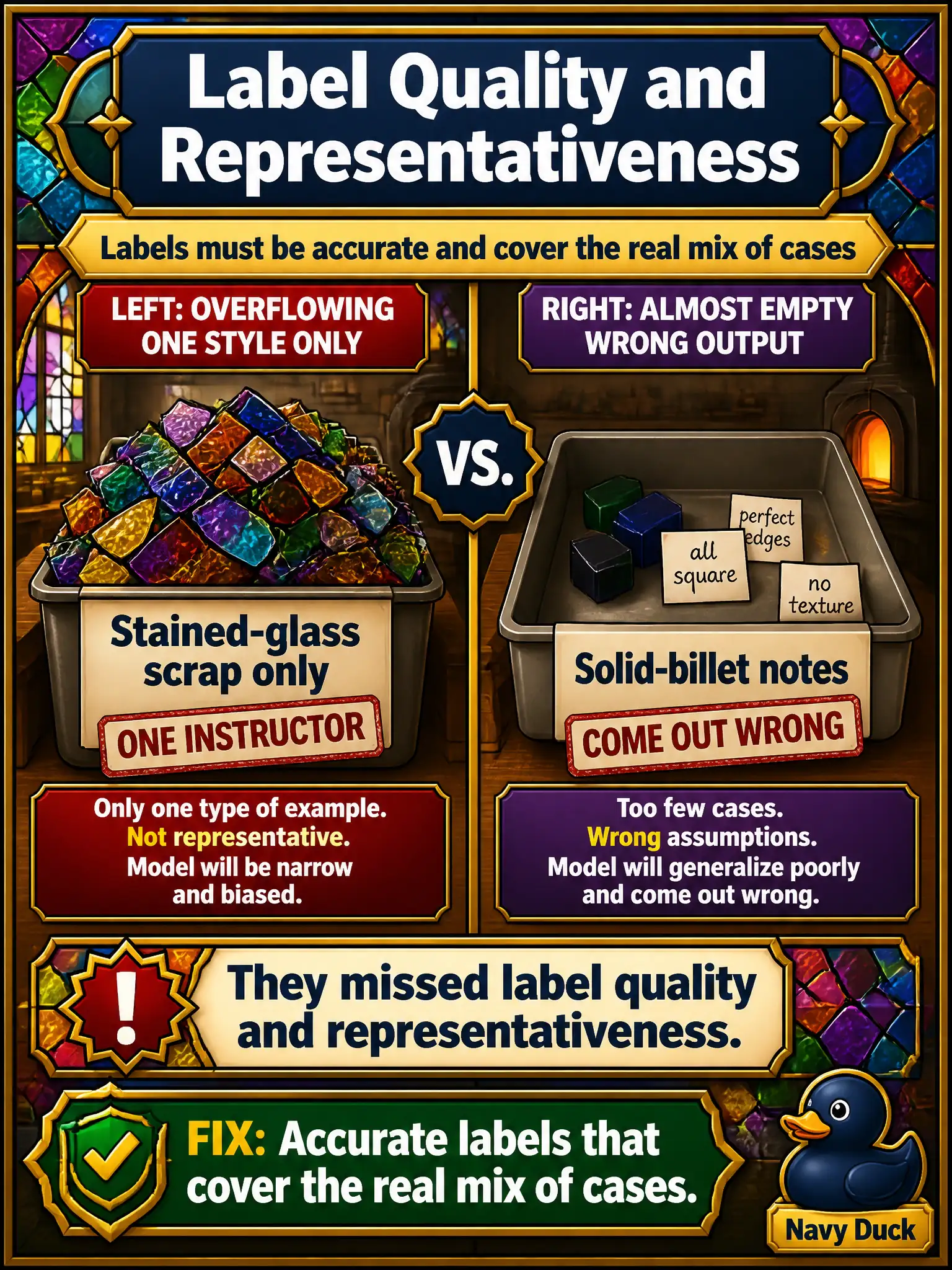
The same guild’s labels were all written by one instructor who only fuses stained-glass scrap. Solid-billet notes come out wrong. What data-prep requirement did they miss?
Select an answer to reveal the explanation.
Short Explanation
Think of one instructor who only fuses stained-glass scrap. Labels have to cover the real mix. Solid-billet notes coming out wrong is a representativeness miss.
Full Explanation
Labels written only by one instructor who fuses stained-glass scrap fail representativeness even if spelling looks fine. Label quality and representativeness require accurate labels that cover the real mix of cases the glass-fusing guild will see—including solid-billet work that currently comes out wrong. When solid-billet notes fail, the model is reflecting the narrow training distribution rather than a mysterious dashboard fault. Assuming one narrow instructor is enough for every glass type is the core data-prep mistake. Treating representativeness as irrelevant if notes are spelled correctly confuses surface text quality with coverage of real techniques. Calling wrong labels a dashboard problem misplaces the issue outside data preparation. Exam caveat: majority-vote or multi-annotator review helps accuracy, but diversity of cases is a separate requirement from inter-annotator agreement on the same narrow scrap set. Operational check: build a stratified review set that includes solid-billet and other underrepresented techniques and measure error rates by glass type before another training run. Invite a second instructor who works solid billet to label a slice so the mix matches shop reality.