
A community glass-fusing guild has 12 messy, duplicated glaze notes and wants a fine-tune. What should the team flag before they hit train?
Select an answer to reveal the explanation.
Short Explanation
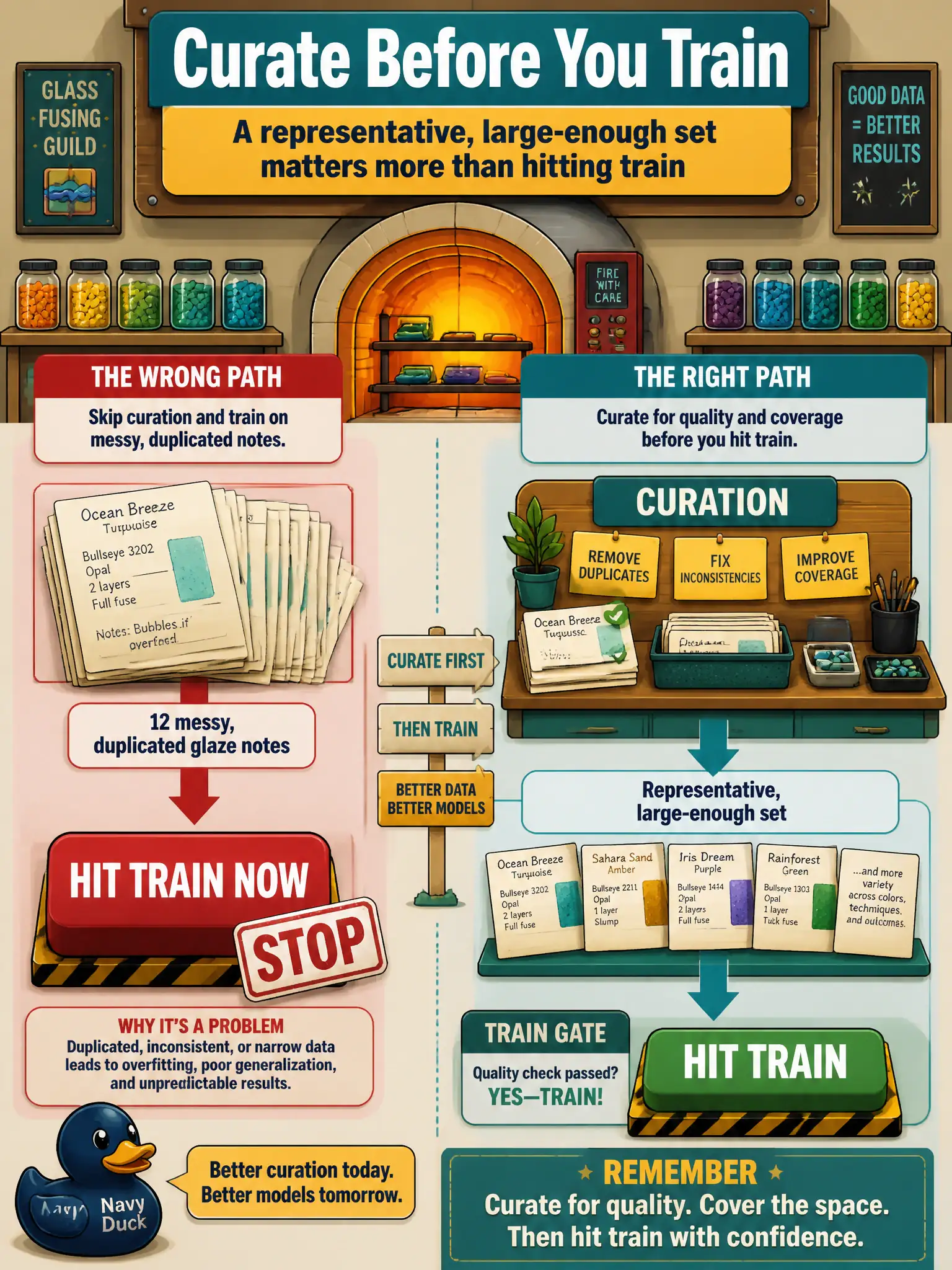
Think of 12 messy duplicate glaze notes. Curate and size the set before you hit train. Twelve dirty copies are not enough.
Full Explanation
Twelve messy, duplicated glaze notes are a data-preparation warning for the community glass-fusing guild, not a green light to train. Curation and a representative, large-enough set matter more than pressing the train button: duplicates inflate apparent size without adding new signal, and mess introduces label noise that the fine-tune will memorize as if it were truth. Claiming twelve dirty duplicates are always enough because the training button is available confuses tooling availability with data readiness for a real fine-tune. Asserting that data size never matters is false for supervised adaptation across diverse glaze chemistries and techniques. Skipping curation because messy duplicates supposedly help actively harms quality and wastes compute on noise instead of signal. Exam caveat: “enough data” is task-dependent; tiny niche tasks can work with fewer examples, but only if they are clean and representative—not duplicated scrap from one notebook. Operational check: deduplicate, repair labels, and estimate coverage of glaze types before training; refuse to launch the job until a minimum curated count and a diversity checklist both pass and are recorded on the training ticket for the guild.