
A community engraving shop needs a stable house voice and line-break style on every card, and the facts already sit in each prompt. Which customization bakes that style in?
Select an answer to reveal the explanation.
Short Explanation
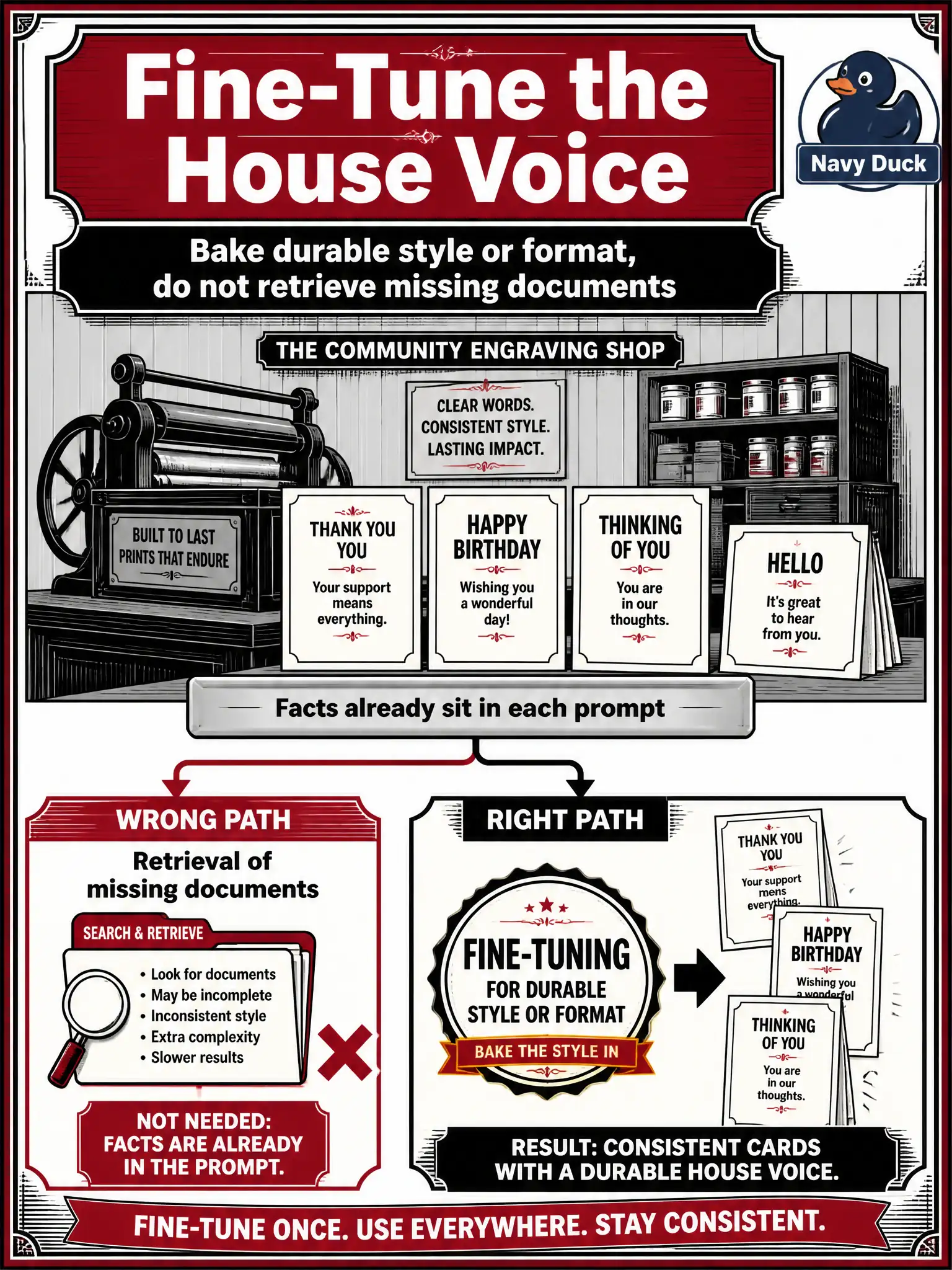
Think of a house voice and line-break style that has to stick, with the facts already in the prompt. Fine-tune the style. RAG will not bake voice into the weights.
Full Explanation
When a community engraving shop already puts facts in each prompt but needs a stable house voice and line-break style on every card, fine-tuning for durable style or format is the right customization. Style baked into weights persists across prompts without relying on retrieval to invent voice or layout, which is exactly what the shop needs when facts are already present. RAG retrieves missing documents into context; it does not bake house voice into model weights and is unnecessary when the facts already sit in each prompt. A dashboard is not a voice or formatting model and cannot teach line-break conventions. From-scratch pre-training from random weights on forty sample cards is disproportionate and starts without useful language priors. Exam caveat: fine-tuning style still benefits from a clear style guide in evaluation; if facts change often, keep facts in the prompt or RAG and fine-tune only the stable voice. Operational check: generate a batch of cards with varied fact blocks and score voice, line breaks, and consistency against the house style sheet before shop-floor rollout. Version the style guide alongside the fine-tune so reviewers score against the same standard the shop intended to bake in.