
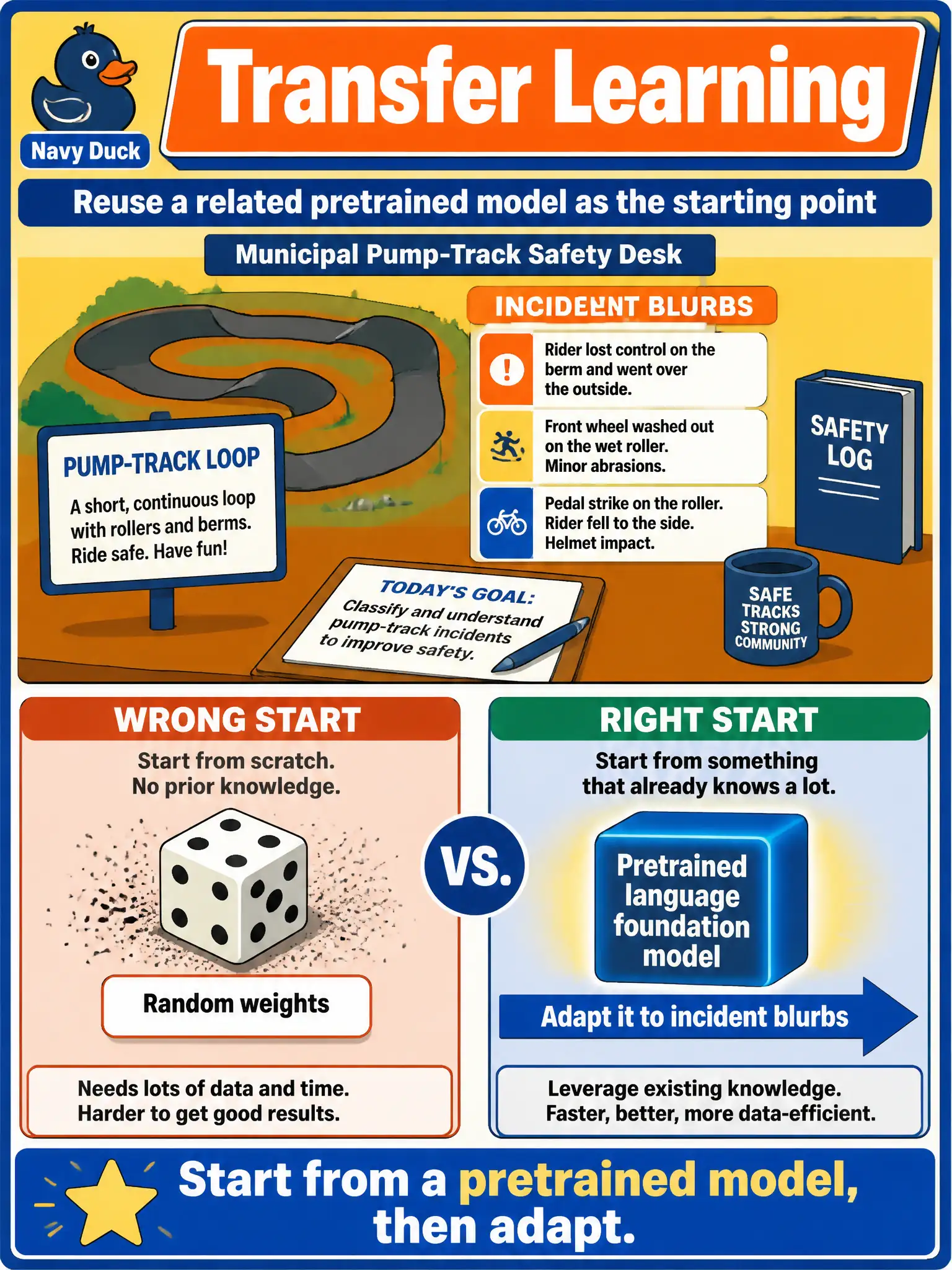
A municipal pump-track safety desk starts from a pretrained language foundation model rather than random weights, then adapts it to incident blurbs. Which idea is that?
Select an answer to reveal the explanation.
Short Explanation
Think of starting from a pretrained language model, then adapting it to incident blurbs. Transfer learning. Random weights are the opposite.
Full Explanation
Starting from a pretrained language foundation model and then adapting it to municipal pump-track incident blurbs is transfer learning: reuse related prior learning as the starting point instead of random weights. That works because general language representations transfer, reducing the data and compute the safety desk needs for the incident-writing task. From-scratch pre-training from random weights is the opposite approach and is rarely practical for application teams with limited civic budgets. Prompt hijacking is an inference-time instruction override by untrusted text, not the reuse of a pretrained base checkpoint. A vector store supports similarity search for retrieval; it is not the definition of transfer learning. Exam caveat: transfer learning assumes the base model’s domain is related enough—extreme mismatch can still require substantial adaptation data and careful evaluation. Operational check: compare a small adaptation from the pretrained base against a from-scratch baseline on incident-blurb quality to demonstrate the transfer benefit before committing production training budget. Record the base-model identifier so later audits know which pretrained starting point the desk reused.