
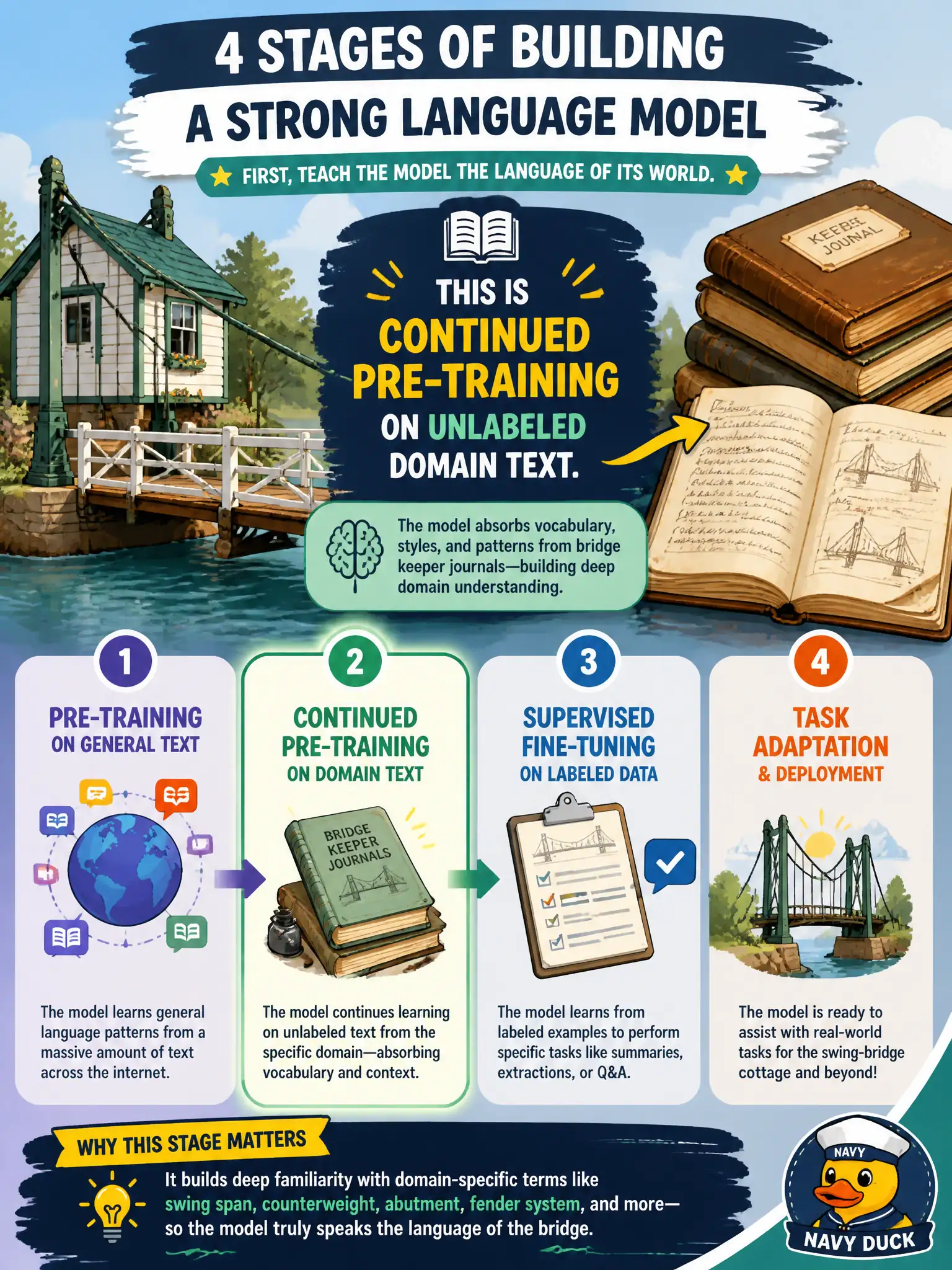
A historic swing-bridge cottage has 20 years of unlabeled keeper journals and wants the model to absorb bridge vocabulary before any labeled task. Which stage is that?
Select an answer to reveal the explanation.
Short Explanation
Think of 20 years of unlabeled keeper journals soaking up bridge vocabulary. That is continued pre-training. It is not a pile of instruction pairs the cottage does not have yet.
Full Explanation
Twenty years of unlabeled swing-bridge keeper journals are domain text without instruction-response pairs for the historic cottage. Continued pre-training on that unlabeled corpus works because it adapts the model’s language distribution toward bridge vocabulary and local phrasing before any labeled task is available. Fine-tuning on instruction-response pairs is the wrong stage when those pairs do not exist yet and cannot be invented from the journals alone without a labeling effort. In-context learning cannot literally place twenty years of journals into a few prompt examples, so it is not a substitute for corpus adaptation. A content filter blocks disallowed topics; it does not teach vocabulary or domain fluency for bridge operations. Exam caveat: continued pre-training improves domain familiarity but does not by itself teach a specific output schema—you still need fine-tuning or careful prompting for structured tasks. Operational check: after continued pre-training, probe with bridge-specific terms drawn from the journals and confirm the model handles them more coherently, then plan a separate labeled task stage if structured outputs are required. Preserve journal provenance so later audits can show which unlabeled sources entered the continued-pretraining set.