
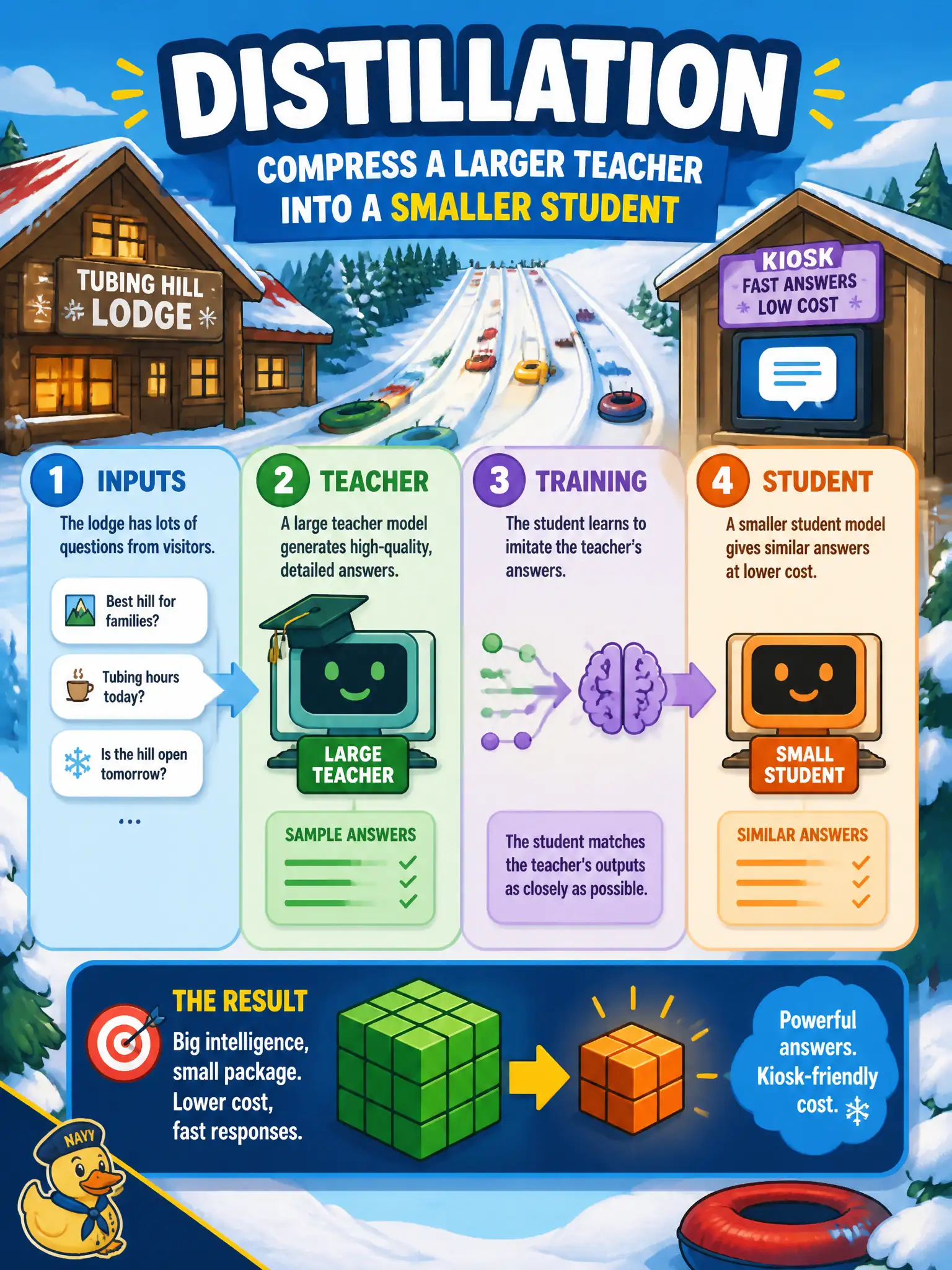
A county tubing-hill lodge uses a large teacher to generate answers, then trains a smaller student to imitate them so the kiosk stays cheap. Which training-family method is that?
Select an answer to reveal the explanation.
Short Explanation
Think of a large teacher writing answers and a smaller student imitating them so the kiosk stays cheap. Distillation. Hijacking, RAG, and temperature do not shrink a teacher.
Full Explanation
Distillation is the training-family method where a larger teacher generates answers or soft targets and a smaller student is trained to imitate that behavior, lowering inference cost for the county tubing-hill lodge kiosk. The goal is compression of capability into a cheaper model that still serves guests acceptably, not document retrieval and not randomness. Prompt hijacking is an inference-time attack with untrusted user text; a student model produced by distillation is not that threat class. RAG retrieves documents into context and does not compress a teacher into a student, so it does not explain the cheap-kiosk pattern. Raising temperature increases sampling randomness and does not shrink model size or replace distillation as a cost strategy. Exam caveat: distilled students can lag teachers on rare edge cases, so validate critical lodge answers against the teacher or a gold set before cutting over the kiosk. Operational check: compare student versus teacher on a fixed kiosk evaluation set for answer quality and measure latency and cost to confirm the compression goal was actually met. Keep the teacher available for periodic student audits so quality drift after distillation remains detectable.