
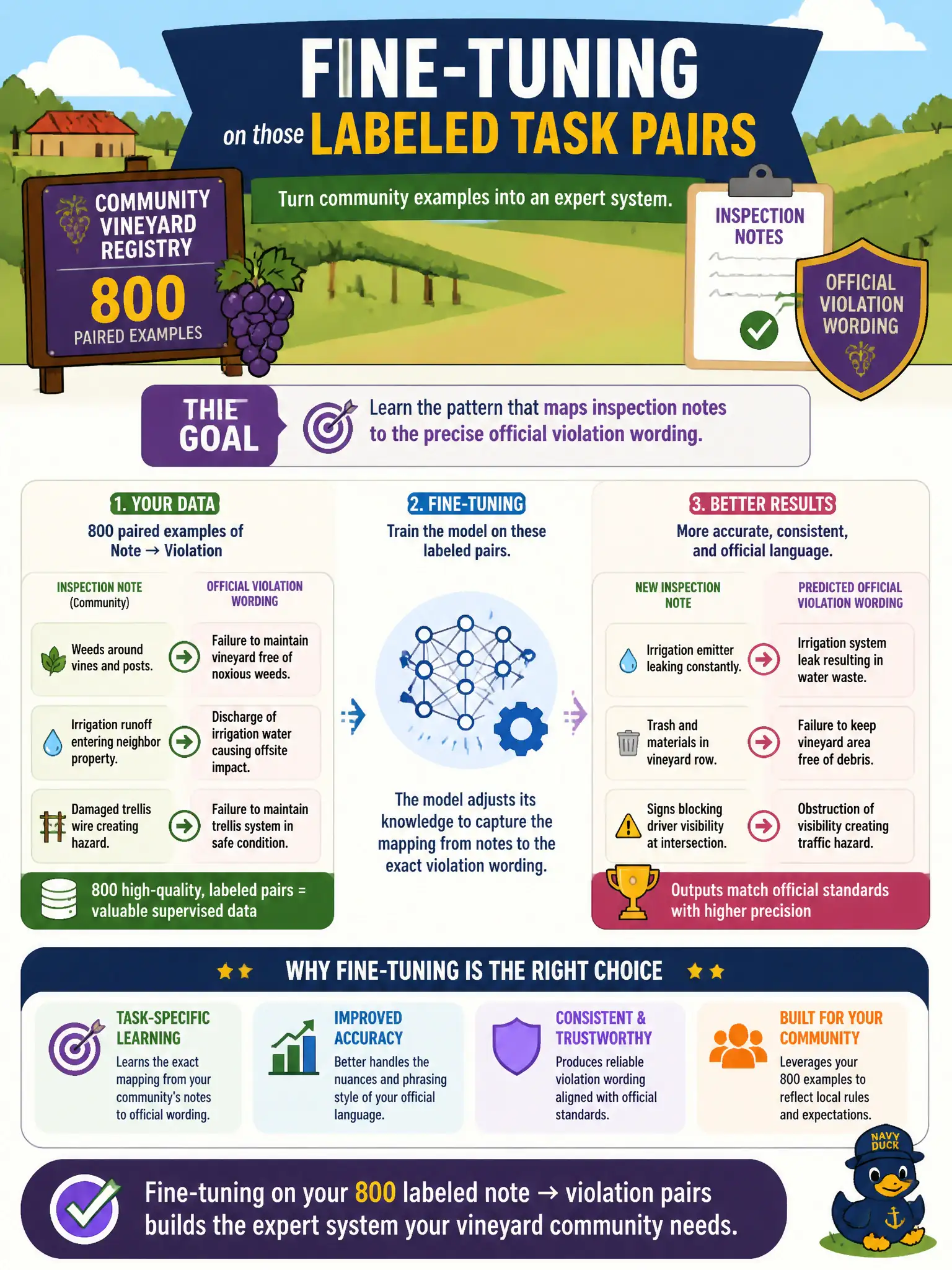
A community vineyard registry has 800 paired examples of inspection note to official violation wording and wants that house format baked in. Which customization should they pick?
Select an answer to reveal the explanation.
Short Explanation
Think of 800 paired inspection notes and official violation wording. Fine-tune on those labeled pairs. Unlabeled diaries, a dashboard, and a cache do not bake the house format into the weights.
Full Explanation
Eight hundred paired examples of inspection note to official violation wording are labeled task pairs for the community vineyard registry. Fine-tuning on those pairs works because supervised adaptation teaches the house mapping from informal notes to official phrasing and bakes that format into the customized model. Continued pre-training on unlabeled diaries only absorbs domain language without teaching the input-output mapping the registry needs for violation wording. A dashboard refresh visualizes vineyard data; it does not update model weights with house format. Prompt caching stores a reusable prompt prefix for inference efficiency and is not a labeled fine-tune. Exam caveat: fine-tuning needs enough clean, representative pairs—volume without quality still fails, and fine-tuning is the wrong tool if facts change constantly and belong in retrieval instead of weights. Operational check: hold out a labeled validation set of inspection-to-violation pairs and measure format compliance and wording fidelity after the fine-tune before promoting the custom model. Keep the pair schema stable so future labeling batches remain compatible with the same fine-tune recipe and evaluation harness.