
A community hops-growers registry hears a vendor describe a months-long run on a huge mixed-language crawl that taught generic language. What stage is that, and who usually runs it?
Select an answer to reveal the explanation.
Short Explanation
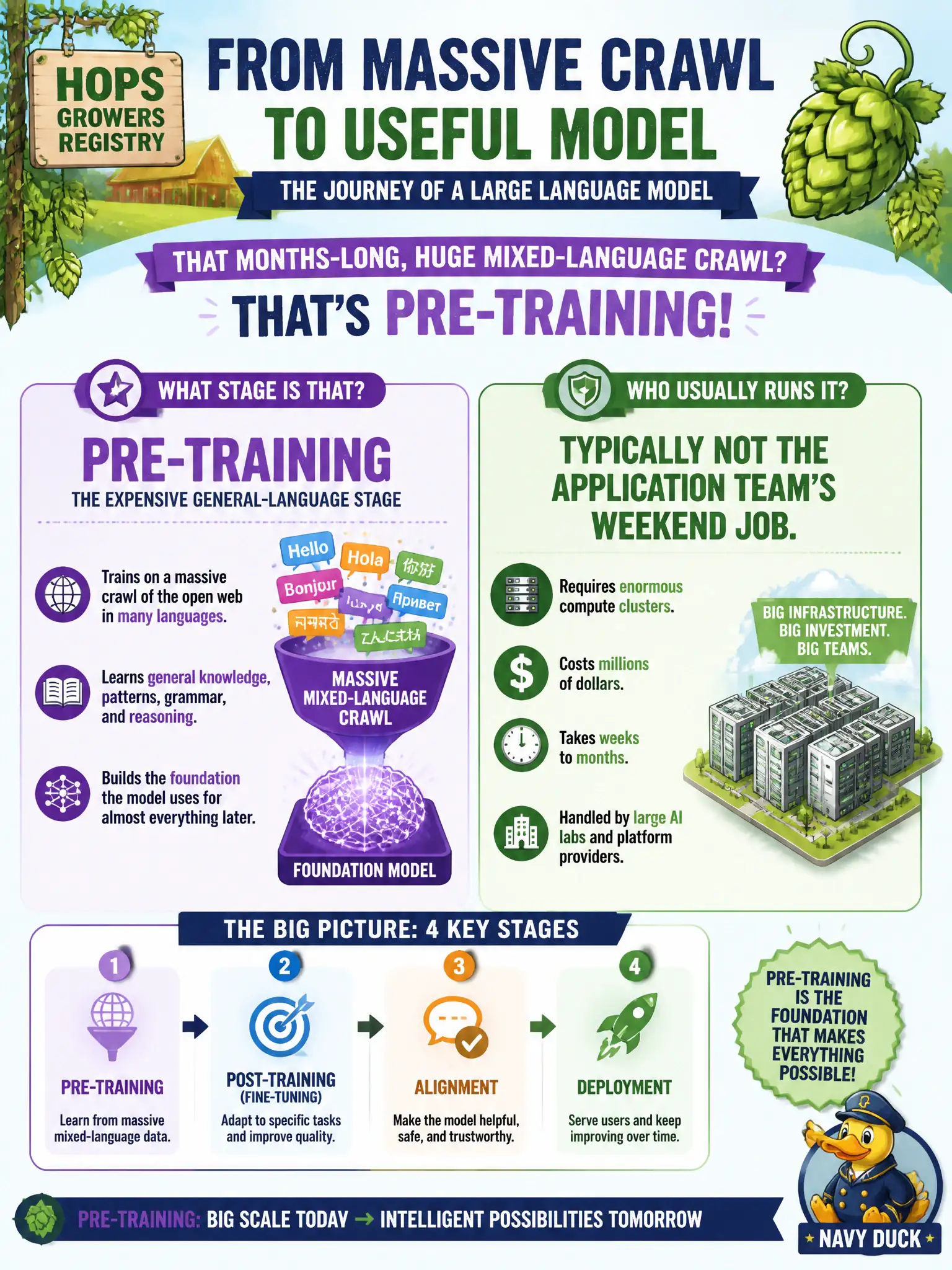
Think of a months-long crawl that taught generic language. That is pre-training, usually not the application team's weekend job. Twenty hop labels are a fine-tune.
Full Explanation
A months-long run on a huge mixed-language crawl that teaches generic language is pre-training: the expensive, foundational stage that produces general capabilities from broad unlabeled text. Application teams for a community hops-growers registry typically consume pretrained models rather than running that stage as a weekend project with limited labels. A weekend fine-tune on twenty hop labels is a small supervised adaptation, not months of general-language pre-training on a mixed crawl. Prompt caching reuses a static prompt prefix at inference time and is not a crawl-based training stage. In-context learning places a few examples in the prompt; it is not a months-long corpus training run. Exam caveat: “pre-training” versus “fine-tuning” versus “continued pre-training” are distinct stages—exam items often test whether you map duration, data type, cost, and ownership correctly. Operational check: when a vendor describes a long unlabeled crawl for general language, classify it as pre-training and ask who owns cost, data rights, and the resulting base checkpoint before any registry commitment. Budget conversations should separate foundation pre-training spend from the registry’s smaller adaptation work.