
A community woodshop co-op with 200 product blurbs wants a catalog helper. Which customization path should the team reject as usually the wrong application choice?
Select an answer to reveal the explanation.
Short Explanation
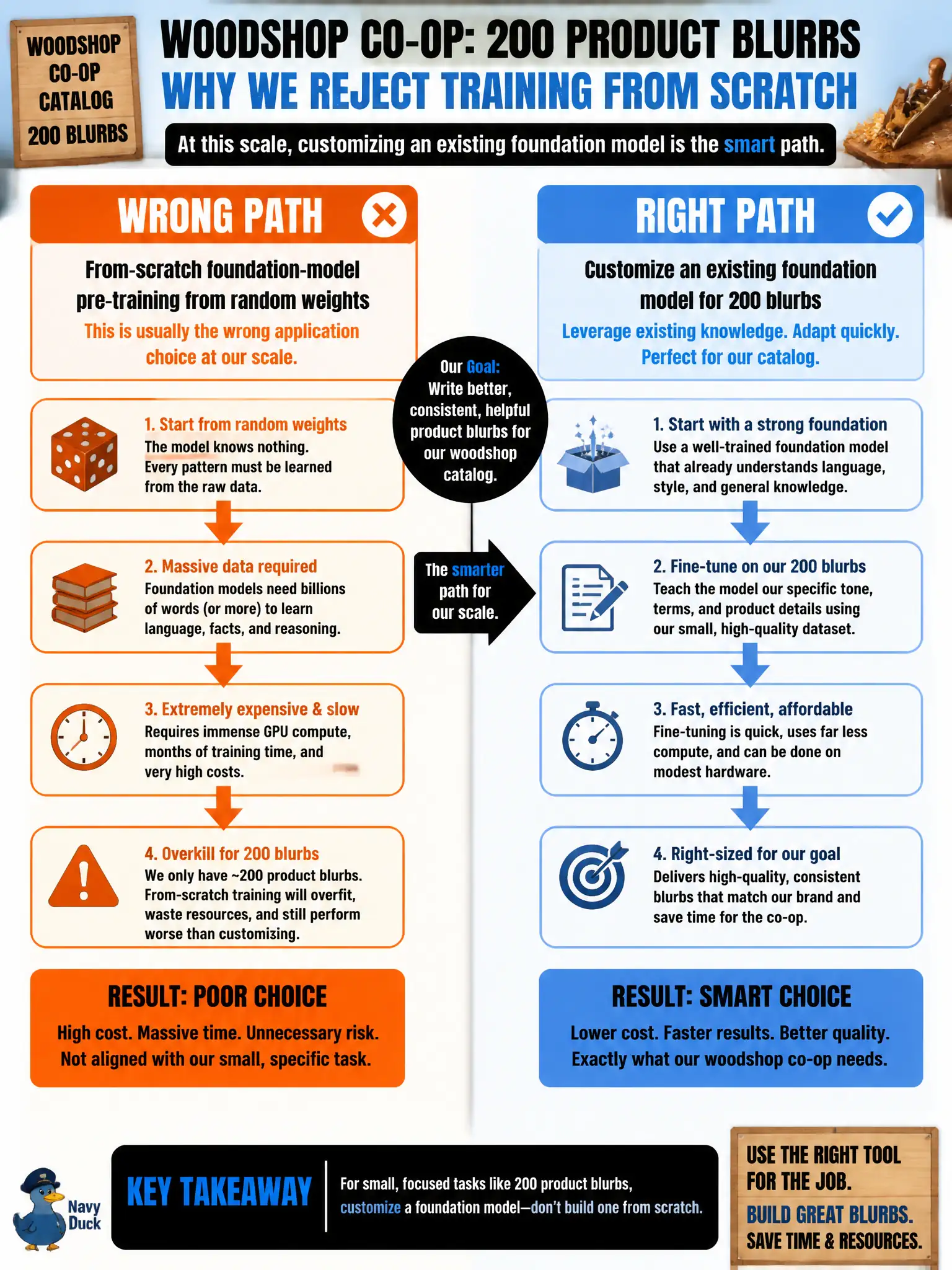
Think of 200 product blurbs. Do not pre-train a foundation model from scratch. Prompt, retrieve, or drop in a few examples. Random weights are the expensive wrong turn.
Full Explanation
With only about 200 product blurbs, from-scratch foundation-model pre-training from random weights is almost always the wrong application choice and should be rejected. Pre-training a foundation model needs enormous corpora and compute; a woodshop co-op catalog is orders of magnitude too small and the cost would dominate any catalog-helper benefit. Hosted foundation models already encode general language skill; the co-op should customize lightly, not rebuild the base.
Prompting a hosted model with a few blurbs is a reasonable in-context path for style. Retrieval from existing catalog PDFs grounds answers in the real inventory descriptions. In-context examples of the house label style further steer wording without training. Those lighter paths match the data volume; random-weight pre-training does not.
Exam caveat: 'never pre-train from scratch' is the usual rule for applied teams on AIF-style questions; continued pre-training or fine-tuning on top of an existing foundation model is a different (and still heavier) discussion than starting from random weights.
Operational check: prototype a RAG-plus-prompt helper over the 200 blurbs, measure catalog answer accuracy and cost for a week, and only escalate to weight-changing customization if quality gaps remain after retrieval and prompting are tuned.