
A county skate-park info bot will run all summer. The team can pay once to shrink a large teacher into a smaller student that keeps most quality at lower serving cost. Which technique is that?
Select an answer to reveal the explanation.
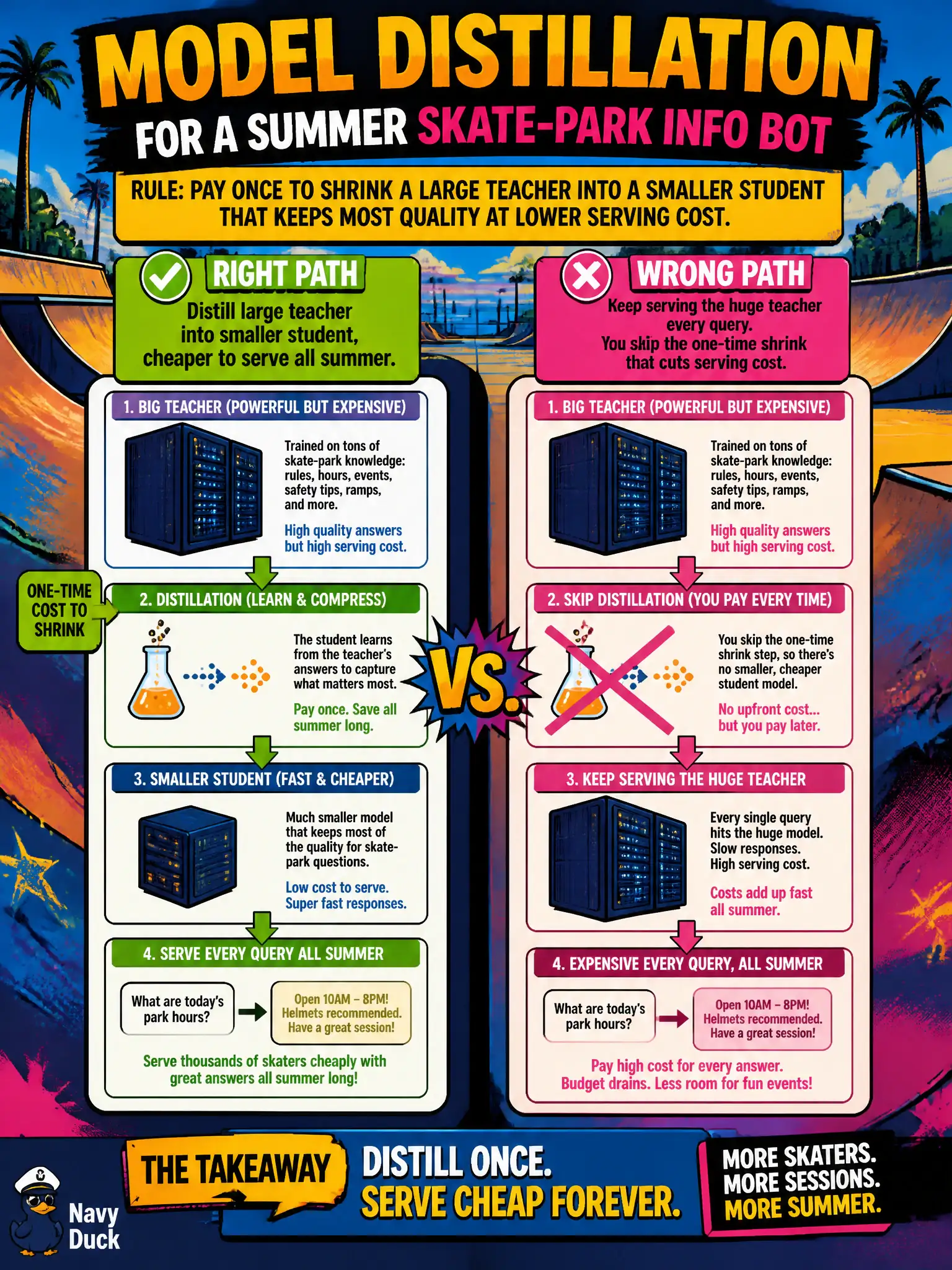
Short Explanation
Think of shrinking a large teacher into a smaller student you can serve all summer. That one-time pay is distillation. Raising temperature or stuffing PDFs does not make the model smaller.
Full Explanation
Model distillation trains a smaller student to mimic a larger teacher so the skate-park info bot can keep most answer quality at lower serving cost all summer. The team pays once (or periodically) for the distillation run, then serves the compact student for the season. That is an application-level cost/performance trade: same family of capability, cheaper inference footprint.
Raising temperature increases randomness in sampling; it does not shrink the model or reduce serving cost in a controlled way, and it can hurt factual park answers. Stuffing every park PDF into every prompt all summer inflates token cost and latency; it is the opposite of shrinking the served model. From-scratch pre-training each morning is vastly more expensive than distillation and is not how teams 'shrink serving cost' for a seasonal bot.
Exam caveat: distillation preserves most quality relative to the teacher, not identical quality—evaluate task metrics (answer accuracy, refusal behavior, latency, and dollar-per-day) before replacing the teacher in production.
Operational check: distill on representative skate-park Q&A, A/B the student against the teacher on a fixed summer evaluation set, and promote the student only when quality stays within the agreed band and serving cost drops as expected.