
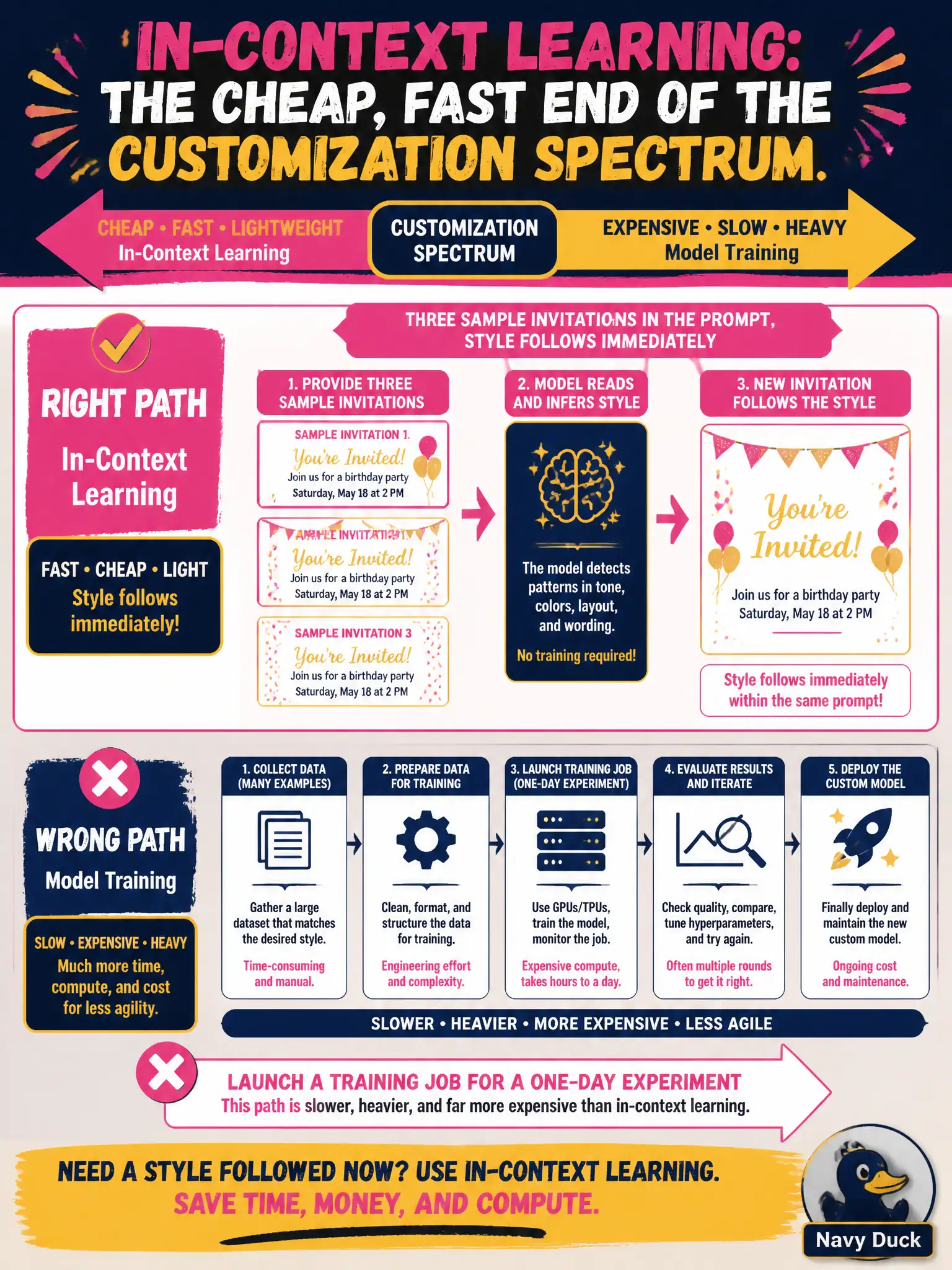
A community card studio can steer invitations by placing three sample cards in the prompt. They do not need a training job for a one-day style experiment. Which customization path is that?
Select an answer to reveal the explanation.
Short Explanation
Think of three sample invitations in the prompt for a one-day style try. That is in-context learning, the cheap fast end. Overnight weight changes are overkill, and a dashboard does not write invitations.
Full Explanation
Placing three sample invitation cards in the prompt is in-context learning: the model adapts style from examples supplied at inference time without changing weights. On the customization spectrum this is the cheap, fast end—ideal for a one-day community card-studio experiment where staff want to steer tone and layout cues quickly. No training job, no new checkpoint, and no overnight GPU bill are required for that trial.
Requiring a full training job before any sample can appear in a prompt confuses prompting with training; samples in the prompt are already a valid customization path. Fine-tuning new weights overnight is heavier customization meant for durable behavior shifts across many requests, not a same-day style try. A dashboard with no prompt cannot customize invitation wording because charts do not generate or condition card copy.
Exam caveat: in-context learning is bounded by context window and example quality; if the guild later needs the same house style on thousands of cards with tight cost and latency, fine-tuning or a smaller distilled model may become appropriate after the experiment proves the style.
Operational check: run the same three sample cards plus a held-out invitation brief through the prompt, score style match with two staff reviewers, and only then decide whether to stay on in-context examples or escalate to a heavier customization path.