
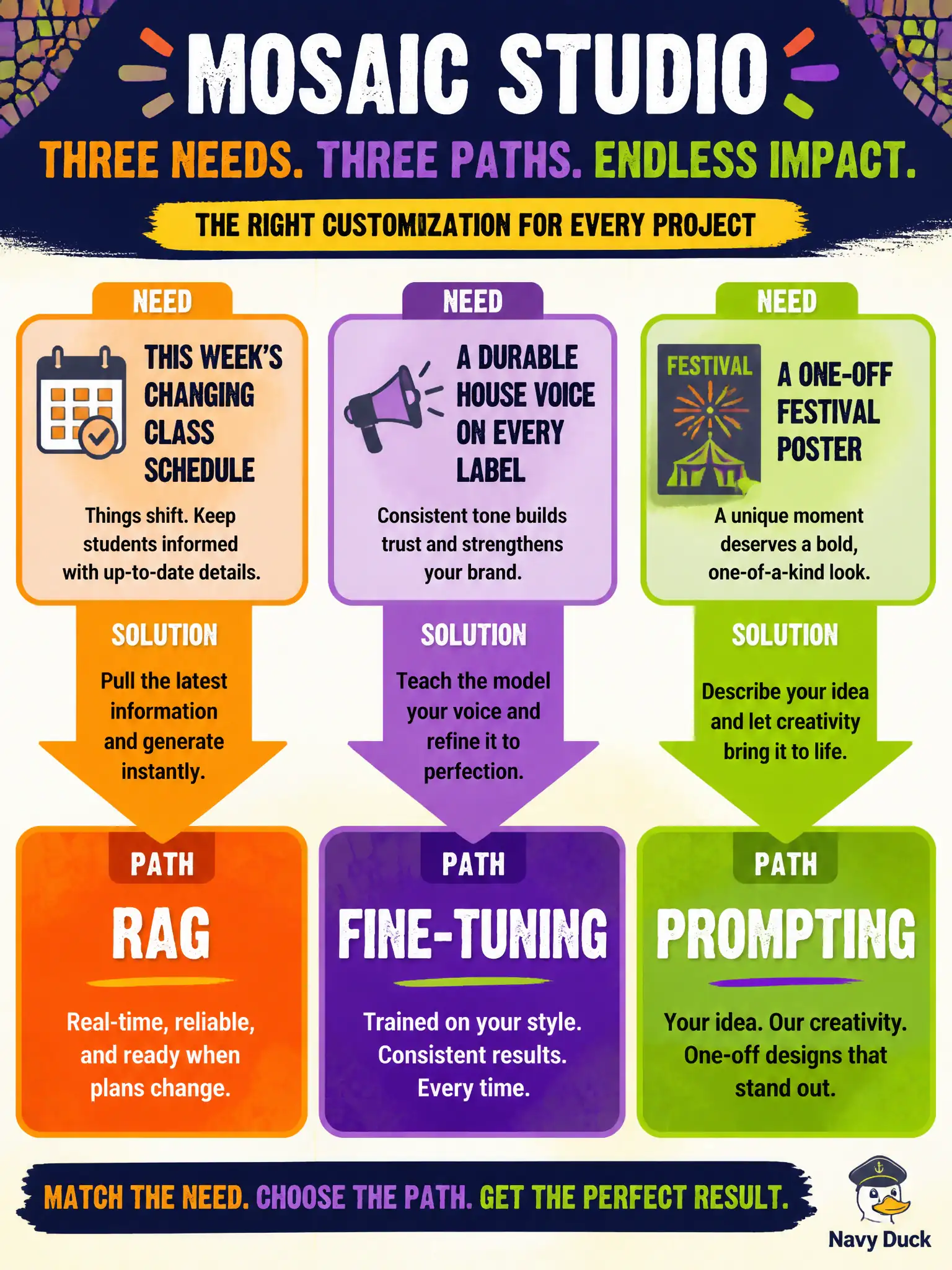
A community mosaic studio needs this week’s class schedule, a durable house voice on every label, and a one-off festival poster. Which mapping of need to customization path is accurate?
Select an answer to reveal the explanation.
Short Explanation
Think of three different jobs: this week's schedule, a house voice that has to stick, and one festival poster. RAG for the changing dates, fine-tune for the voice, prompt for the poster. Swap those and you pay for the wrong tool.
Full Explanation
Different mosaic-studio needs map to different customization depths. This week's class schedule changes often, so retrieval-augmented generation (RAG) keeps answers tied to the current schedule source without retraining. A durable house voice on every label is a persistent stylistic behavior—fine-tuning (or equivalent lasting adaptation) is the path that embeds that voice into model behavior. A one-off festival poster is a short-lived creative task best handled with prompting and in-context examples rather than lasting weight changes.
Swapping those mappings fails conceptually: fine-tuning for a weekly schedule pays training cost for data that will be stale next week; RAG alone does not permanently teach a house voice; prompting alone is a weak way to lock a durable voice across every label. From-scratch pre-training for all three needs ignores huge cost differences and is never the application default for a community studio. A dashboard does not customize festival copy; visualization is not generation.
Exam caveat: RAG, fine-tuning, and prompting are complementary—teams often combine them (retrieve the schedule, apply a fine-tuned voice, prompt the poster layout)—but the question asks which need maps to which primary path.
Operational check: label each content type by change frequency and durability need, assign RAG vs fine-tune vs prompt accordingly, then measure schedule answer freshness, label voice consistency, and poster turnaround on a one-week pilot before locking the mapping.