
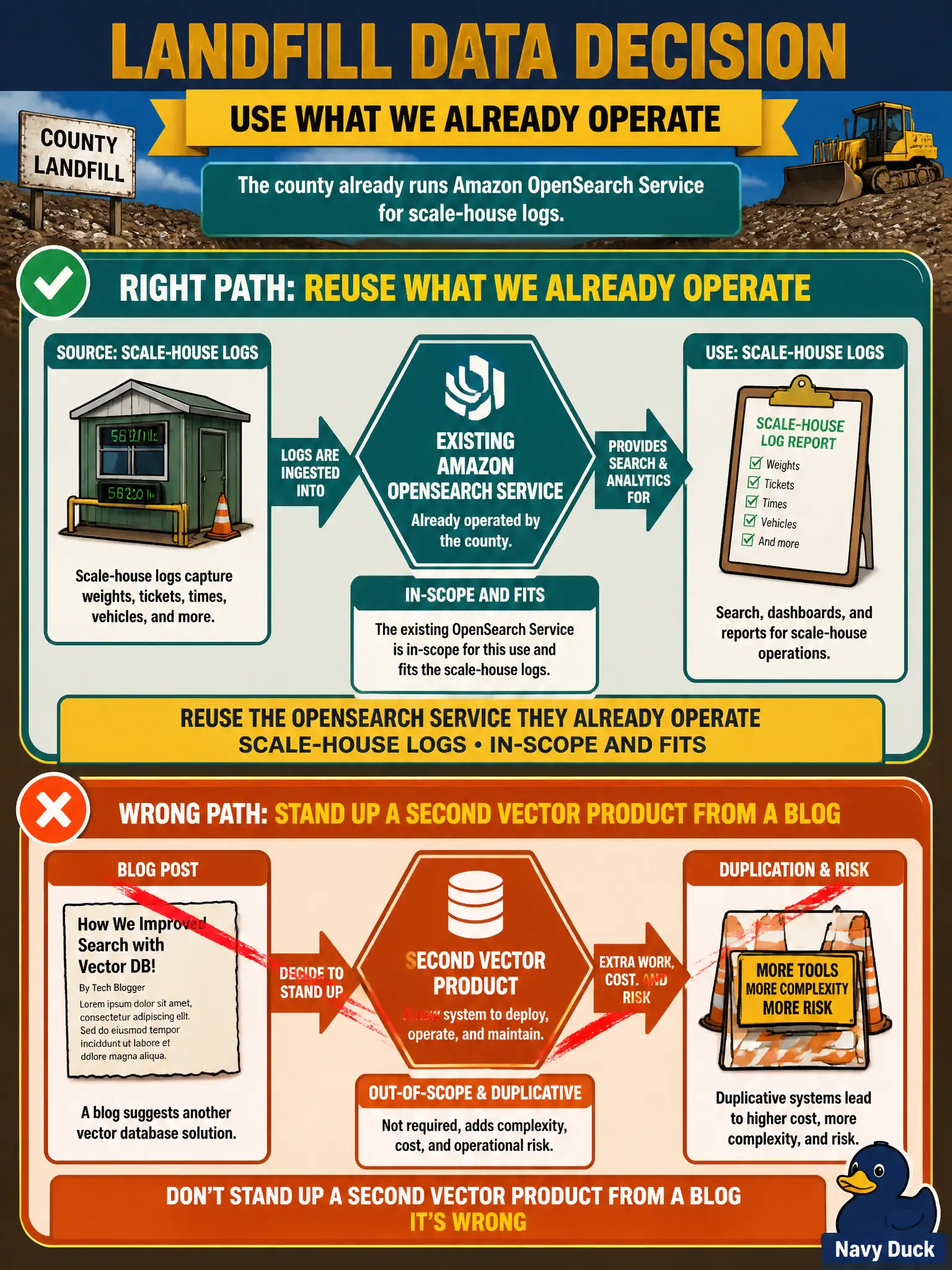
A county landfill already runs Amazon OpenSearch Service for scale-house logs. A blog names a second vector product. The existing store is in-scope and fits. What should the team do?
Select an answer to reveal the explanation.
Short Explanation
Think of a landfill that already runs OpenSearch Service and it fits. Reuse it. A blog-named second product, a laptop folder, or deleting the logs is not a selection rule.
Full Explanation
Reuse is the selection rule when the county landfill already operates Amazon OpenSearch Service for scale-house logs and that store is in-scope and fits vector needs. Standing up another product only multiplies domains, IAM surfaces, backup plans, and skills without improving retrieval quality. If OpenSearch already holds the logs and can host the embedding fields or hybrid queries required, extending the existing estate is the responsible application choice.
A second vector product chosen only because a blog named it is fashion, not architecture—blogs are not a fit assessment against latency, compliance, or team operations. Deleting the logs to avoid needing a vector store destroys evidence the landfill must retain and does not solve retrieval. Moving embeddings to a laptop folder abandons durability, access control, and shared operations, and it actively avoids reusing the estate the question says is adequate.
Exam caveat: 'reuse existing OpenSearch' is correct only when capability and scope align; if a hard constraint (for example a different isolation boundary or unsupported feature) blocks OpenSearch, documenting that gap—not a blog post—justifies a second system.
Operational check: inventory the current OpenSearch domain version, plugin, and mapping support for k-NN; prototype embedding the scale-house fields on a non-prod index; compare relevance and cost against the proposed second product before any dual-running decision.