
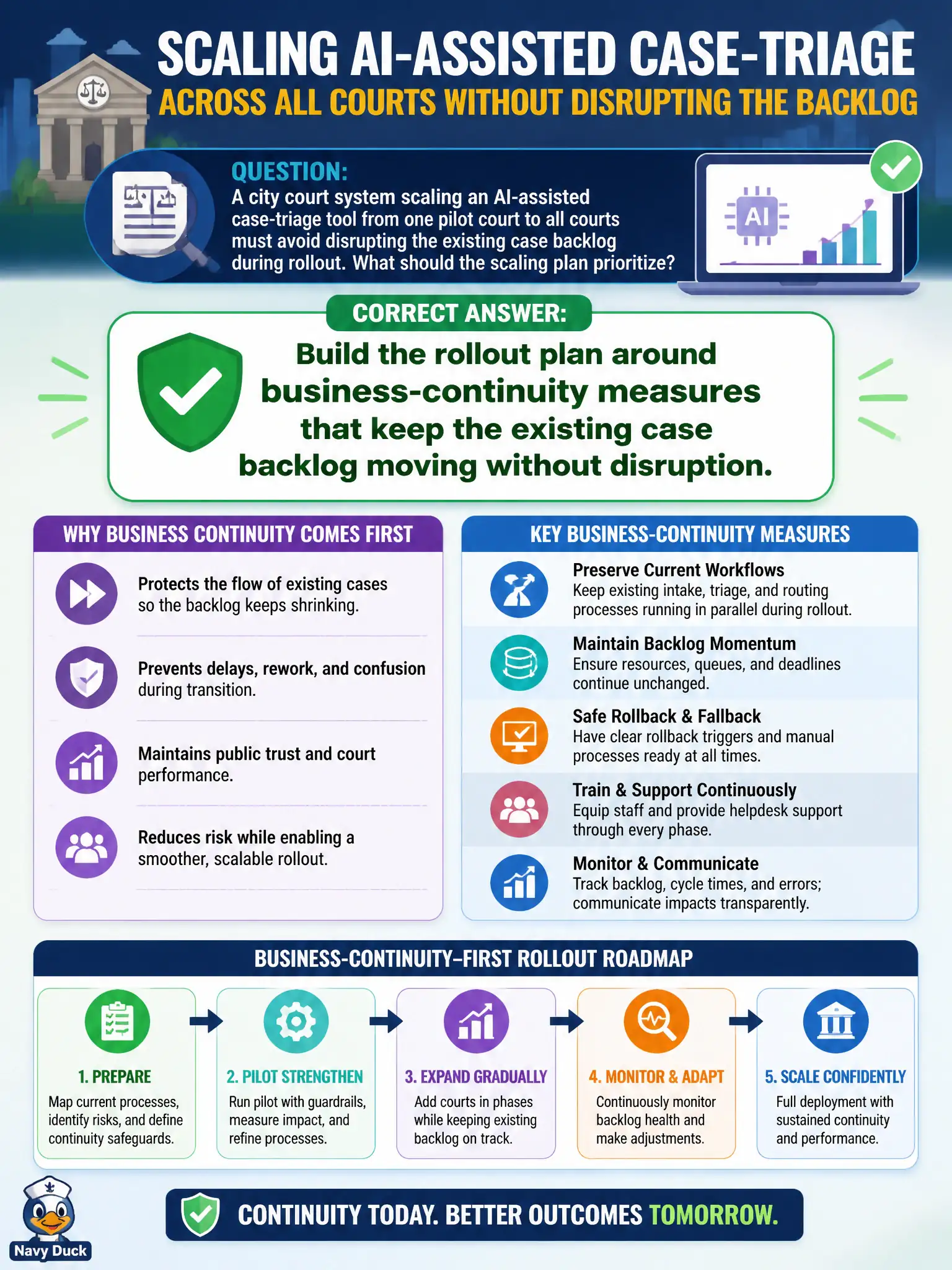
A city court system scaling an AI-assisted case-triage tool from one pilot court to all courts must avoid disrupting the existing case backlog during rollout. What should the scaling plan prioritize?
Select an answer to reveal the explanation.
Short Explanation
Courts don't get to pause justice while they roll out new software. The scaling plan needs to keep the existing backlog moving right alongside the rollout, so residents waiting on cases don't feel the transition at all.
Full Explanation
Business-continuity measures built into the rollout plan keep core operations running during a transition, which matters especially in courts where delays carry real consequences for people awaiting case resolution. Pausing backlog processing to focus on rollout treats the transition as more urgent than the agency's core mission, creating exactly the disruption the plan is meant to avoid. Assuming the new tool won't touch backlog processing ignores that shared staff, systems, and attention inevitably create interaction effects during any rollout, whether intended or not. Prioritizing rollout speed over coordination with existing workload risks overwhelming staff juggling both, degrading service on both fronts rather than improving either. Scope caveat: continuity planning should include a rollback or slowdown option if backlog impacts appear during rollout. Operational check: track backlog processing times throughout the rollout period to confirm they remain stable rather than checking only before and after.