
An emergency management agency's successful resource-allocation pilot needs cross-agency coordination before it can scale to the full region. What should leadership recognize as the binding constraint on scaling?
Select an answer to reveal the explanation.
Short Explanation
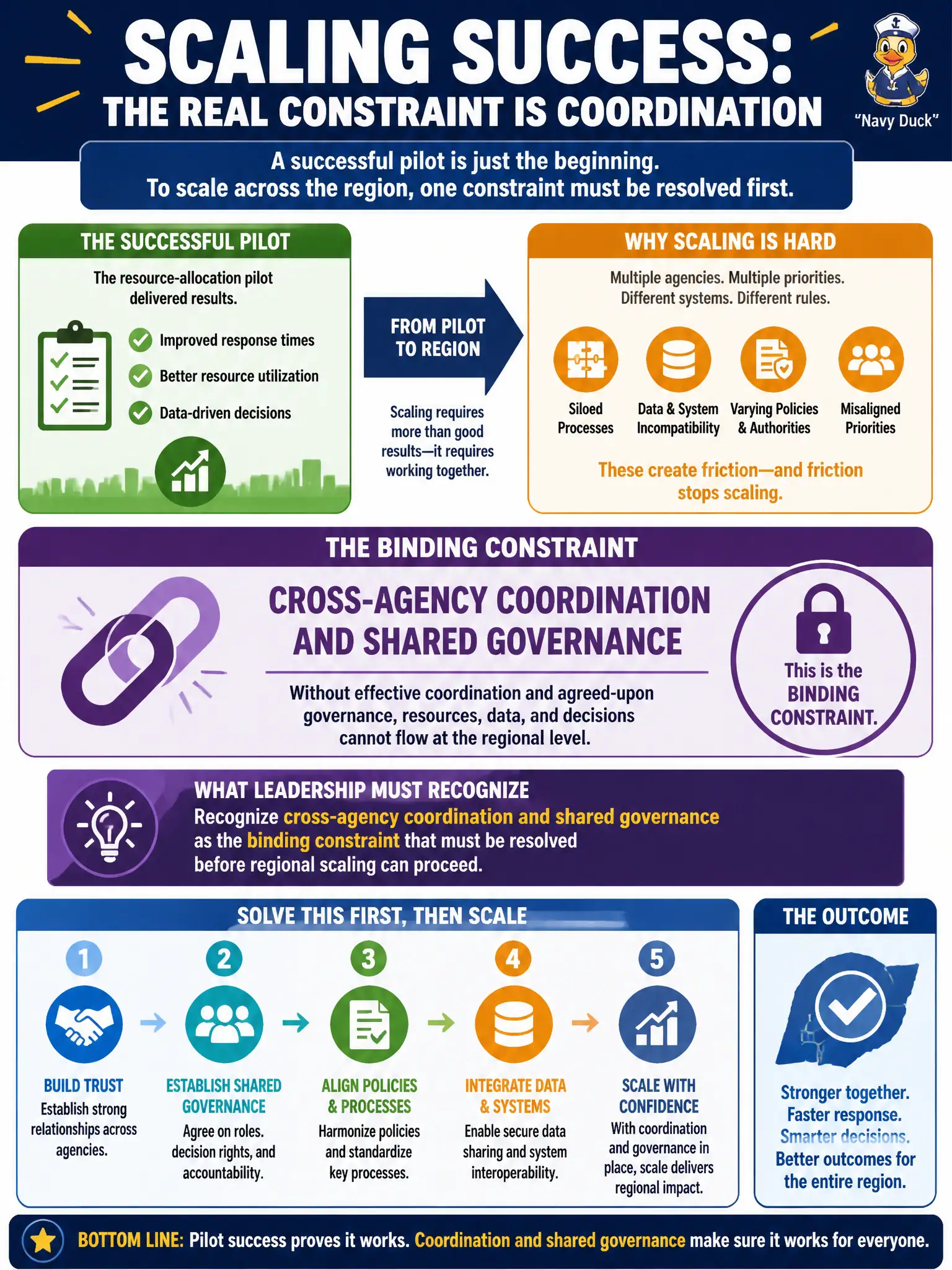
A great pilot in one agency doesn't automatically translate into a region working together. The real bottleneck isn't the tool anymore, it's getting every agency rowing under the same coordination and governance, and that's what needs solving first.
Full Explanation
Regional scaling across multiple independent agencies requires shared coordination and governance structures to align decision rights, data sharing, and response protocols, since technical success at one agency doesn't resolve inter-agency alignment on its own. Treating technical performance as the remaining factor overlooks that the pilot already proved feasibility, while the harder open question is organizational, not technical. Assuming agencies can adopt the tool independently ignores that regional emergency response depends on coordinated action, not parallel, disconnected implementations that may not interoperate during a real incident. Prioritizing funding over coordination misorders the dependencies, since funding without an agreed governance structure risks each agency building incompatible processes anyway. Scope caveat: cross-agency coordination structures should specify decision authority during live incidents, not only during planning. Operational check: confirm a documented interagency agreement or memorandum of understanding exists and has been signed before regional rollout begins.