
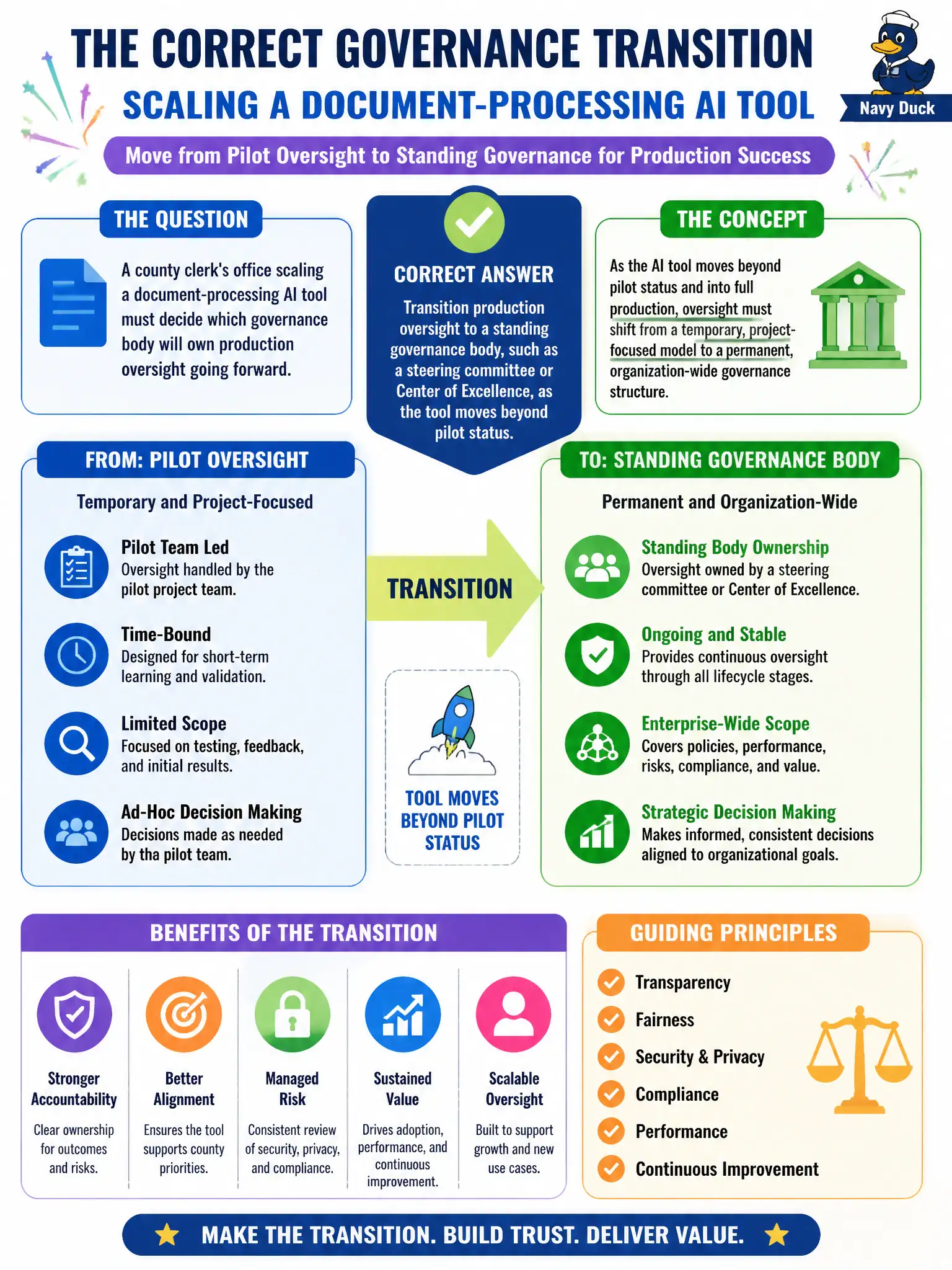
A county clerk's office scaling a document-processing AI tool must decide which governance body will own production oversight going forward. What is the correct governance transition?
Select an answer to reveal the explanation.
Short Explanation
The team that built something small isn't automatically set up to run it at full scale. Hand ongoing oversight to a standing body, a steering committee or Center of Excellence, built for exactly that job, not the crew that just happened to ship the pilot.
Full Explanation
Transitioning oversight to a standing governance body like a steering committee or Center of Excellence provides durable accountability, standardized review, and cross-functional authority appropriate for a production system, matching how scaling governance is meant to mature. Keeping the original pilot team as permanent owner conflates initial build expertise with the different, ongoing responsibility of production governance, and that team may lack the authority or bandwidth for broader oversight. Assigning oversight informally to whoever is available creates inconsistent accountability that erodes the moment that person is unavailable or moves to a different role. Transferring oversight to the vendor misplaces institutional accountability with an external party that doesn't carry the agency's regulatory or public-trust responsibilities. Scope caveat: the governance body's authority and reporting lines should be documented as part of the scaling plan, not assumed. Operational check: confirm the receiving governance body has a documented charter and meets on a defined cadence before production handoff.