
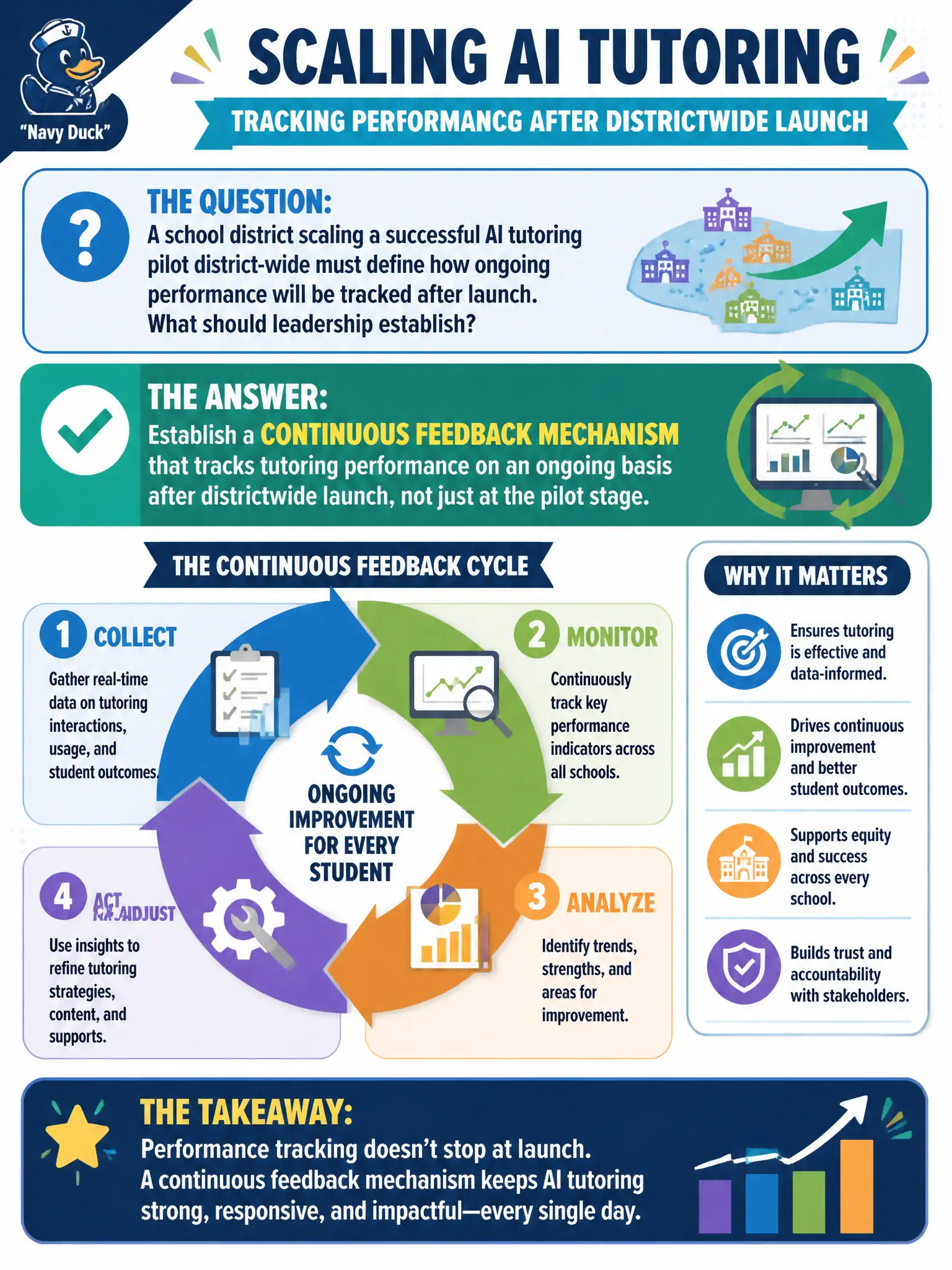
A school district scaling a successful AI tutoring pilot district-wide must define how ongoing performance will be tracked after launch. What should leadership establish?
Select an answer to reveal the explanation.
Short Explanation
A pilot's report card only tells you how one class did on one day. Once the tool goes district-wide, you need an ongoing feedback loop, not a single snapshot, to know if it's still working for every student.
Full Explanation
A continuous feedback mechanism provides ongoing evidence of performance across a larger and more varied population than a pilot could capture, supporting the iterative monitoring that scaling requires. Treating the one-time pilot evaluation as sufficient assumes performance stays constant at greater scale and over time, which glosses over drift and varied classroom conditions across many schools. Informal, occasional conversations lack the structure to catch systemic issues early or compare results consistently across schools and terms. Waiting for complaints to surface turns monitoring into a reactive process, meaning problems affect many students before anyone notices a pattern. Scope caveat: feedback mechanisms should capture both quantitative performance data and qualitative input from teachers and students. Operational check: confirm a recurring review cadence, such as quarterly, and defined metrics exist before districtwide launch, not just a general intention to keep watching.