
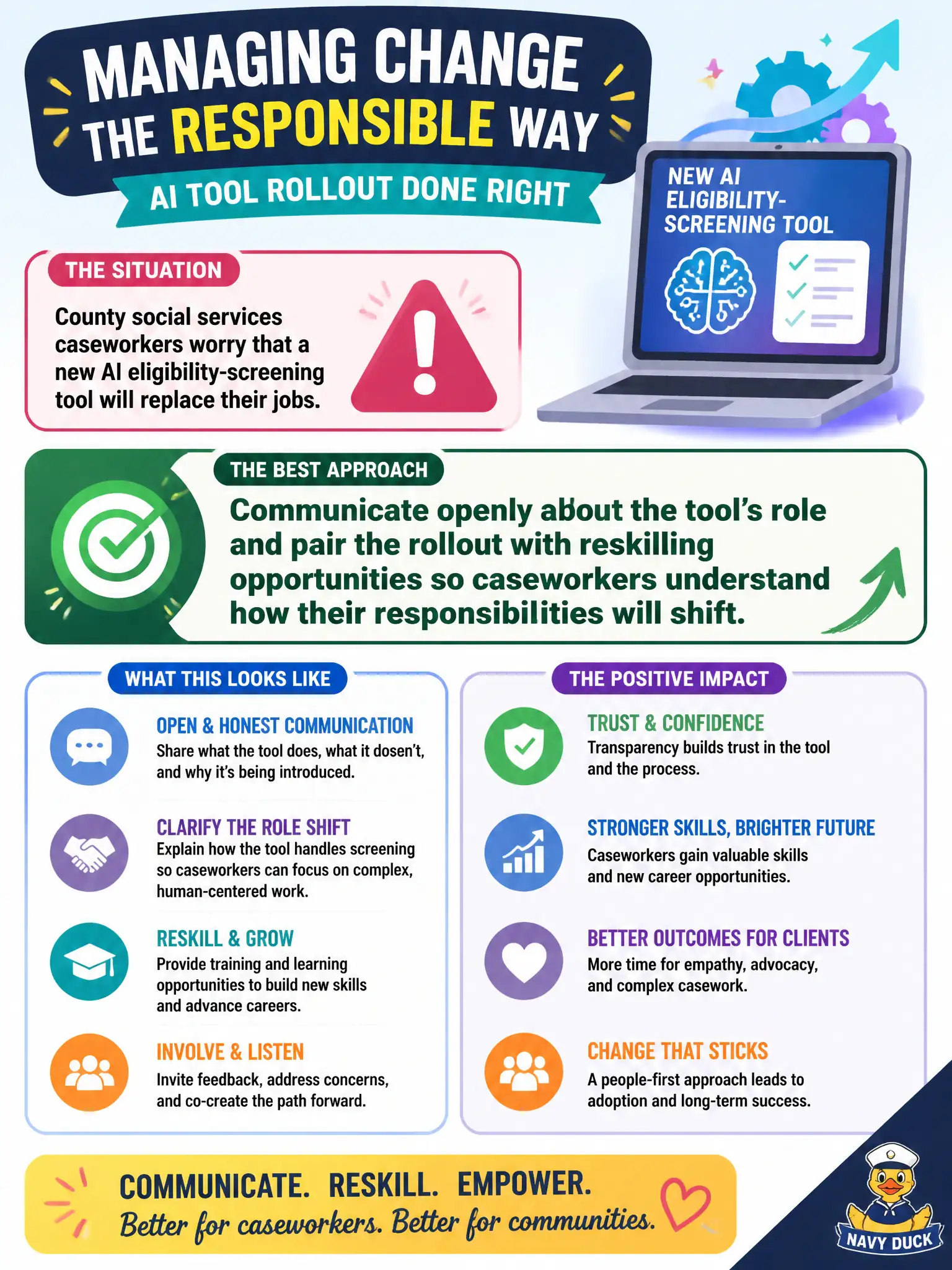
County social services caseworkers worry that a new AI eligibility-screening tool will replace their jobs. Which communication approach best supports responsible change management during the rollout?
Select an answer to reveal the explanation.
Short Explanation
Silence fills fear-shaped gaps with worst-case guesses, so the smartest move is talking first. Pair a clear, honest explanation of what's changing with a real path to new skills, and caseworkers see themselves in the future instead of out of it.
Full Explanation
Transparent communication paired with reskilling reduces uncertainty and builds trust by giving caseworkers a concrete, honest picture of how their role changes and a real path forward, which is the core mechanism behind effective workforce change management. Avoiding public discussion until rollout is finished just delays anxiety and lets rumors fill the vacuum, often making resistance worse once the tool finally appears. Vague reassurance with no specific plan lacks credibility, once caseworkers see their daily tasks visibly changing, an unspecific promise collapses their trust in leadership. Messaging that covers only efficiency gains for the county ignores the workforce dimension staff actually care about and that executives are accountable for managing. Scope caveat: transparency needs to be paired with genuine investment in reskilling, not just messaging, to hold up over time. Operational check: survey caseworker sentiment before and after the communication rollout to confirm concerns are actually being addressed.