
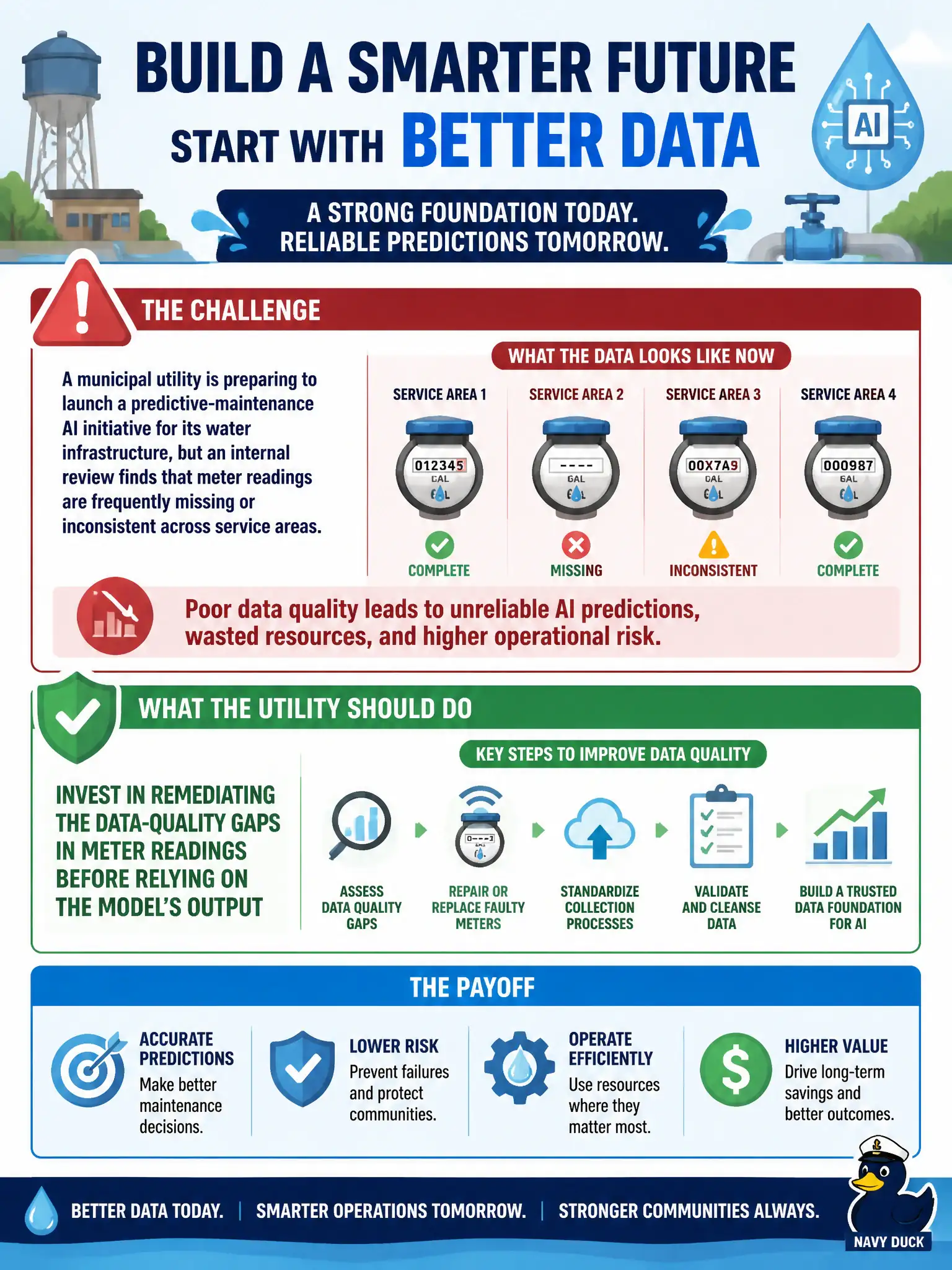
A municipal utility is preparing to launch a predictive-maintenance AI initiative for its water infrastructure, but an internal review finds that meter readings are frequently missing or inconsistent across service areas. What should the utility do before proceeding with the initiative?
Select an answer to reveal the explanation.
Short Explanation
Picture a mechanic trying to predict engine failure from a logbook that's missing half its entries, no matter how skilled the mechanic is, the prediction is only as solid as the log. The utility's predictive-maintenance model faces the same problem with its meter data. Fixing the readings has to happen before anyone trusts what the model says about failing pipes.
Full Explanation
Predictive-maintenance models learn patterns from historical readings, so gaps and inconsistencies in those readings directly translate into unreliable predictions about which infrastructure is at risk of failure. The right move is investing in data-quality remediation, closing reading gaps, standardizing collection across service areas, and correcting inconsistencies, before leadership relies on the model's output to guide costly maintenance decisions. Choosing a more advanced algorithm addresses the wrong layer of the problem; a more sophisticated model trained on the same flawed data will still produce flawed predictions, sometimes with greater apparent confidence. Narrowing scope to one service area sidesteps the issue rather than solving it, since the data problem persists wherever readings remain messy, and it just delays the reckoning. Delaying only the public announcement while the technical build continues unchanged ignores that the model itself is still learning from unreliable inputs, so the underlying risk to decision quality isn't addressed at all. This applies specifically when data-quality problems are broad enough to affect the training set materially; occasional, isolated gaps wouldn't necessarily block an initiative. A practical check is running a data-completeness audit against a minimum coverage threshold for each service area before any model output informs maintenance budgets.