
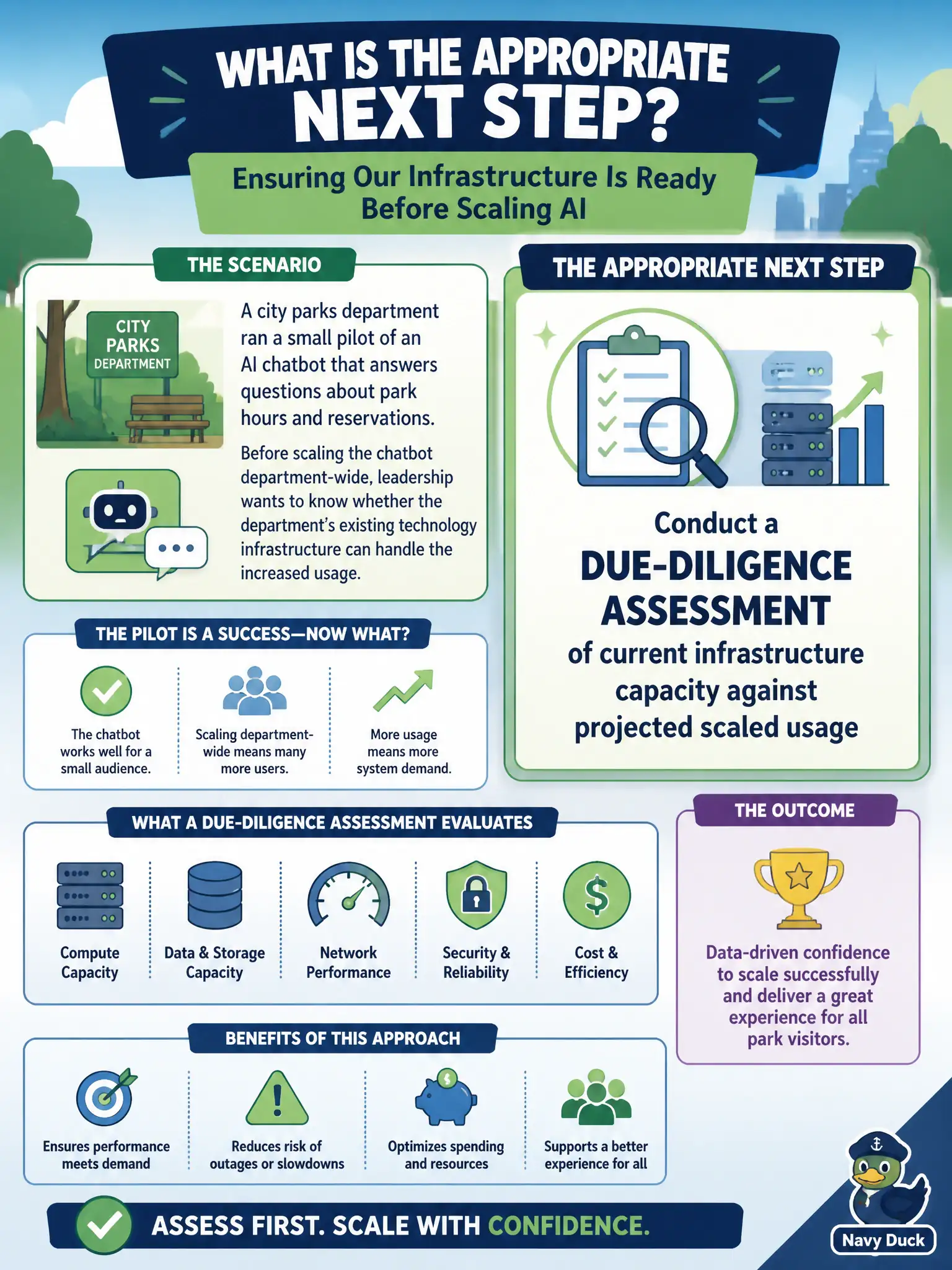
A city parks department ran a small pilot of an AI chatbot that answers questions about park hours and reservations. Before scaling the chatbot department-wide, leadership wants to know whether the department's existing technology infrastructure can handle the increased usage. What is the appropriate next step?
Select an answer to reveal the explanation.
Short Explanation
Think of it like checking whether a bridge built for foot traffic can handle a parade before you actually send the parade across, you look at the load limits first, you don't just watch and see what happens. Leadership's job here is exactly that: commission an assessment that compares current infrastructure against what scaled usage would demand. Building or reacting comes later, after the assessment.
Full Explanation
Scaling a pilot into a department-wide tool changes its load profile substantially, so leadership needs an objective due-diligence assessment comparing current infrastructure capacity against realistic projected usage before committing to expansion. That assessment is a business decision-support step, distinct from the hands-on technical work of building or reconfiguring systems, and it's what lets leadership make an informed go or no-go call. Having leadership itself get into backend reconfiguration confuses governance with implementation; that work belongs to technical staff, and doing it before an assessment even exists skips the diagnostic step entirely. Relying on a vendor's marketing claims substitutes an interested party's assurances for independent verification, which is a weak basis for a scaling decision affecting public services. Waiting until the chatbot has already struggled under real load turns due diligence into damage control, letting residents experience the failure that a prior assessment could have caught. This distinction matters specifically when scaling changes load meaningfully; a pilot expanding only slightly might not warrant a full capacity review. A concrete check for the parks department is obtaining a written capacity report that states current headroom against projected peak concurrent users before approving departmentwide rollout.